
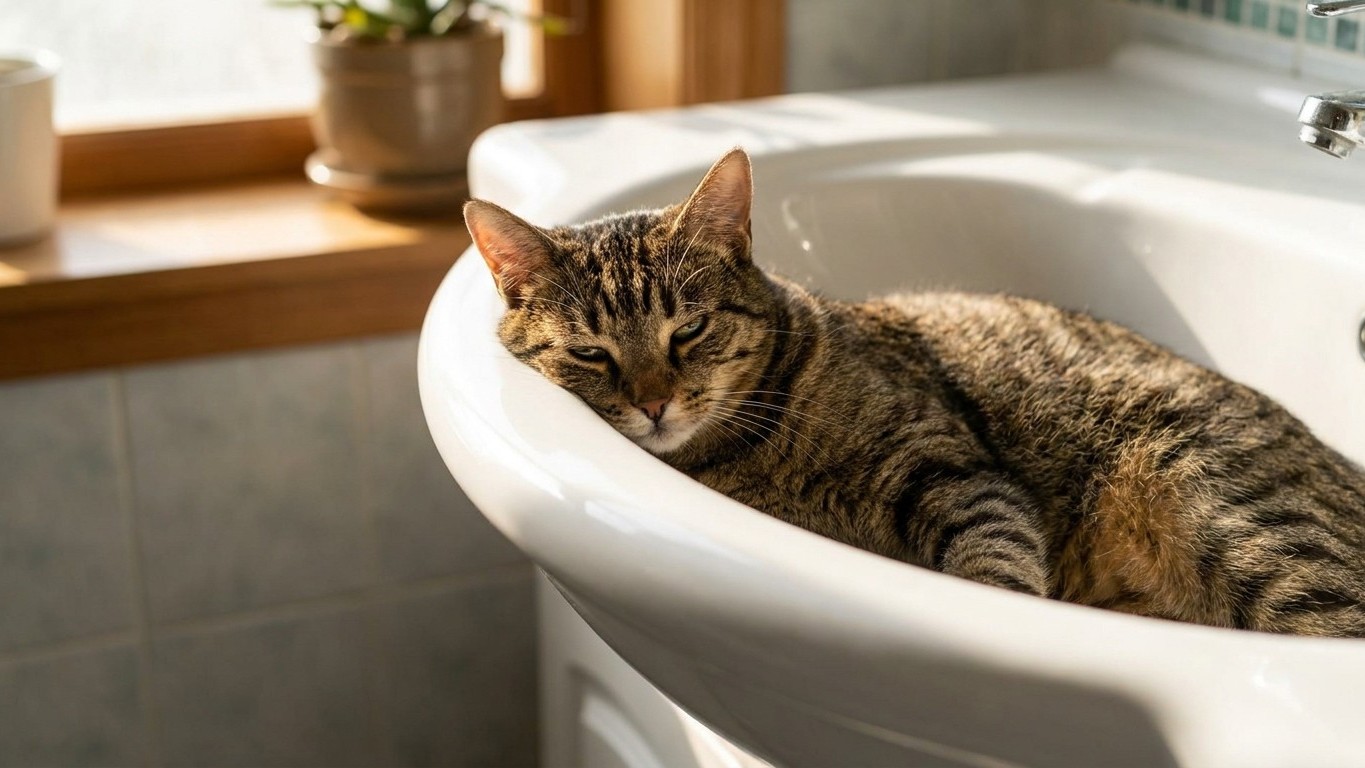
Every summer, thousands of cat owners in the UK find themselves gently evicted from their own bathroom sink by a sprawled, perfectly relaxed feline who has absolutely no intention of moving. It looks bizarre. It probably ruins your morning routine. But that porcelain nap spot is, in fact, a tiny window into your cat’s inner world, one that tells you far more about their biology, psychology, and health than you might expect.
Key takeaways
- Porcelain sinks are nature’s perfect cooling station for cats—but there’s more to the story than temperature
- Your cat’s sink naps might actually be about seeking your scent and feeling safe, not just staying cool
- That bathroom habit could be hiding an early warning sign of kidney disease that only appears in one specific behavior
A body built for temperature hunting
Cats have a higher body temperature than humans, typically around 101°F to 102.5°F (approximately 38.3°C to 39.2°C). That gap matters enormously during a British summer, even one that only reaches 27°C. Cats lose heat mainly through skin blood flow and behaviour, not sweating. Thermoregulation is a constant balance between heat produced inside the body and heat released to the environment. As the room warms, the body relies on vasodilation, more blood flow to the skin, and on behaviour: choosing cooler microclimates, stretching out to increase surface area, and cutting activity that would add heat.
The bathroom sink is, from a feline physics perspective, an almost perfect cooling station. Sinks, especially those made of porcelain or stainless steel, retain coolness better than carpet, fabric, or wood surfaces. Cool, hard surfaces such as ceramic sinks and porcelain bathtubs provide an effective means of heat dissipation. The material’s high thermal conductivity draws excess body heat away, allowing a cat’s core temperature to stabilise without active panting. Your cat isn’t being eccentric. They’re doing what a small, fur-insulated predator must do to stay comfortable on a warm July afternoon.
At home, that looks like a cat relocating from a sunny perch to tile, a bathtub, or a shaded closet, then sleeping longer and playing in shorter, more intense bursts. By licking their fur, cats can also lower their body temperature, as their saliva has a cooling effect when it evaporates. So if you notice your cat grooming more in August and napping in odd spots, that’s not laziness, that’s an elegant, multi-layered cooling strategy.
Security, silence, and the scent of you
Temperature is only part of the story. The sink scores just as highly on the psychological front. In the wild, cats seek elevated or enclosed spaces to nap because these locations offer protection from predators. A sink, while not particularly high, provides a semi-enclosed environment with raised edges that create a sense of security. The curved basin essentially mimics the rocky crevices and tree hollows that wild cats have used for millennia.
Four of the five studies reviewed in a 2025 veterinary evidence paper showed moderate evidence that hiding boxes reduce fear and stress in cats, with reduced cat stress scores in cats given a hiding box compared to control groups. The principle transfers directly to a sink: a snug, enclosed, semi-elevated space ticks every box a cat’s nervous system is wired to seek out. Sinks are also relaxing for cats because they’re typically in quiet areas. A bathroom isn’t as loud or crowded as your kitchen or living room might be, giving your cat some peaceful alone time.
There’s one more layer to this bathroom obsession that owners tend to miss entirely. Cats have an incredible sense of smell and often seek out areas that smell like their favourite humans. The bathroom, filled with towels, clothes, and toiletries, retains human scent more than open rooms do. This makes the bathroom feel like a safe and familiar zone for your cat. The close proximity to your scent helps reduce stress and strengthens the bond between you and your feline companion. So that sink nap isn’t just about temperature regulation, it’s also, in its own quietly devoted way, about you.
When the sink becomes a signal worth listening to
Here’s where the vet conversation gets genuinely important. Most cats who sleep in the bathroom sink are simply hot, comfortable, or seeking quiet. But there’s a version of this behaviour that warrants a closer look, and it’s one that many owners miss precisely because it looks so ordinary.
The earliest sign of kidney disease in cats is increased thirst (polydipsia). This causes cats to drink excessive amounts of water, and it might even include a cat seeking water in bizarre places like the toilet or the sink. A cat who was previously indifferent to the bathroom tap but now camps in the sink and demands it be turned on, repeatedly, is telling you something worth investigating. In cats, some of the most common causes of excessive thirst are diabetes mellitus, hyperthyroidism, and kidney diseases.
Most cats are very good at covering up illnesses, so increased thirst could be the first sign you notice. If you think your cat is drinking a lot more than usual, look out for these other common signs: changes in appetite, changes in behaviour, and changes in sleeping patterns, particularly if they sleep a lot, or sleep in unusual places. That last point is worth pausing on. A cat who has migrated permanently to the bathroom sink, after years of sleeping on the sofa, is showing you a change in sleeping pattern. If you notice your older cat drinking and urinating more, especially if they are losing weight, not eating as well, or showing changes in their personality, it’s time to schedule an appointment for an exam and possibly a kidney screening. Always consult your vet if you notice this kind of shift — early detection makes an enormous difference.
What to do with this knowledge
If your cat’s sink habit is simply a summer cooling strategy, you can work with it rather than against it. A fan aimed across (not directly at) the cat’s preferred cool zone, fresh water in multiple locations, and play sessions moved to early morning can make the day feel smoother. Cats use their powerful sense of smell to find comfort and familiarity. The bathroom or kitchen sink area usually holds your scent, from washing hands, brushing teeth, or doing dishes, which helps your cat feel close to you even when you’re not nearby. Replicating those qualities elsewhere, a cooling mat in a quiet corner, a covered bed near something that smells of you — can give your cat equally satisfying options without the morning bathroom standoff.
Many cats prefer to drink water from running faucets rather than a bowl, and some even enjoy drinking from toilets. This may add to the reasons cats love bathrooms in general. It is also said that some cats have trouble seeing still water, and they prefer to drink from faucets. A pet water fountain, placed away from the food bowl (cats instinctively prefer their water source to be separate from their food), can satisfy this preference year-round and keep them better hydrated, which matters especially for cats prone to urinary issues.
One genuinely useful habit to build: pay attention to how your cat uses the sink, not just that they do. Casual summer lounging is one thing. A cat who’s panting lightly, seems restless, and keeps licking at the tap drips? That’s worth noting. Signs of heat discomfort progress from seeking cool spots and lethargy to panting, bright red gums, agitation, and ultimately collapse. The sink can be a window into thermoregulation working exactly as it should, or, sometimes, working harder than it ought to need to.
Sources : veterinaryevidence.org | veterinaryevidence.org