
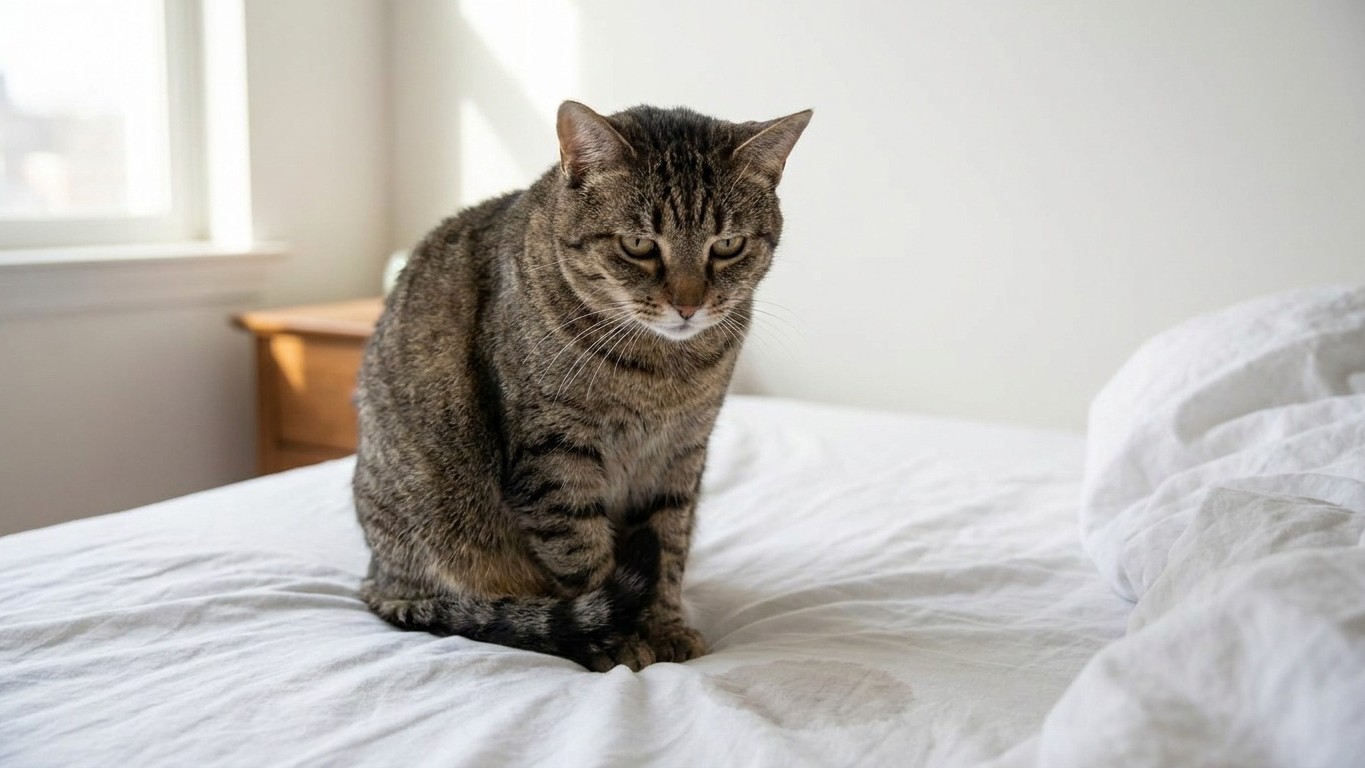
A single damp patch on the duvet has ended more feline reputations than any hairball ever could, but before anyone reaches for the word “revenge”, it’s worth understanding what actually happens inside a cat’s bladder when litter trays become a shared, contested resource. Two cats and one tray in a small flat sounds sensible on paper. In practice, it can quietly tip one of them into a genuine medical problem that has absolutely nothing to do with getting back at you for that late dinner.
Key takeaways
- A single litter tray for multiple cats creates territorial stress that triggers a real medical condition, not spite
- Cats with inflamed bladders gravitate toward soft surfaces like duvets instead of the tray—and male cats face life-threatening complications within hours
- Even tiny flats can accommodate hidden second trays that work around space constraints and prevent emergency vet visits
Why cats hate sharing a tray more than we realise
Cats are solitary hunters by instinct, and that shapes how they treat toileting spots long after domestication softened Everything else about them. Cats are solitary hunters by nature, and their sense of territory plays a central role in how they interact with their environment, including where they eliminate, and even in friendly multi-cat households each cat still prefers to control its own resources, including litter boxes. The American Association of Feline Practitioners puts it plainly: cats perceive litter boxes as key territorial resources.
This is where the famous “n+1” formula comes from, and it isn’t some arbitrary bit of internet wisdom invented by litter brands. The Cornell Feline Health Center puts it plainly, saying to provide as many boxes as you have cats, plus one. Two cats should, by that logic, have three trays between them, not one. It sounds excessive in a one-bedroom flat, but the reasoning is behavioural rather than snobbish: distributing litter boxes throughout the home respects a cat’s territorial nature, as they may not want to share a busy box.
What’s rarely obvious to owners is that conflict doesn’t need to look like conflict to cause damage. The ASPCA notes that sometimes one or more cats in a household control access to litter boxes and prevent the other cats from using them, and even if one of the cats isn’t actually confronting the other cats in the litter box, any conflict between cats in a household can create enough stress to cause litter-box problems. Your two cats might curl up together on the sofa every evening and still be running a silent standoff over who gets the tray first.
When “naughty” behaviour is actually a bladder crying out for help
Here’s the part that turns an annoying laundry problem into something more serious. Vets call it Feline Idiopathic Cystitis, or FIC, and it’s maddeningly common. Experts believe that stress plays a role, as cats who experience sudden changes to their routine or environment and cats that live in multi-cat households are more likely to develop FIC. The mechanism is genuinely fascinating, if slightly unsettling: cats prone to this condition seem to have a nervous system that overreacts to everyday pressure. Although the bladder lining is inflamed, the true cause of FIC is thought not to originate in the bladder but rather in the central nervous system, and cats with FIC have been shown to have an exaggerated stress response due to imbalances in their nervous and endocrine systems.
Stress hormones then go on to damage the bladder’s protective lining directly. Certain physiological abnormalities are found in cats with FIC, offering insight into the disease’s internal mechanisms: cats with FIC often have bladders with compromised mucosal lining, primarily composed of glycosaminoglycans, which allows irritants in the urine to directly irritate and inflame the bladder’s sensitive lining. A cat that avoids a contested tray and holds urine for longer, or squats anxiously and produces only a dribble, is doing serious damage to that lining over time, not sulking.
That damp patch on your duvet is a classic presentation. Cats with a sore, inflamed bladder often gravitate towards soft surfaces rather than the cold ceramic of a bath or the tiles by the tray. And if the affected cat is male, the stakes rise sharply. Multi-cat households and inter-cat aggression are recognised predisposing factors for the condition, and the inability to urinate, especially in male cats, is a critical emergency requiring the cat be seen by a veterinarian immediately. Male cats have a narrower urethra that can become physically blocked by inflammation and tiny crystals, turning a stress problem into a life-threatening one within hours. If your cat is straining repeatedly, crying in the tray, or producing next to nothing, that’s not a duvet issue anymore, that’s an emergency vet visit.
Making a small flat work without cutting corners on trays
None of this means you need to turn your lounge into a litter tray showroom. It means being cleverer about the one resource cats can’t compromise on. Extra trays should be placed in separate locations, not side-by-side, to ensure cats view them as distinct resources and to minimise territorial conflicts. Even in a compact flat, a second tray tucked into a quiet corner of the bathroom, under a console table, or inside a repurposed cupboard with a cat flap cut into the door can satisfy that need without eating into your floor space the way two identical boxes in the same room would.
Cleanliness matters just as much as quantity. A general recommendation is to have one more litter box than the number of cats in the home, and they should all be placed in different locations and cleaned daily. A tray that smells of yesterday’s business to a cat with a sensitive bladder is often enough to push them towards the duvet instead. Vets also stress the domestic knock-on effects of getting this wrong: inappropriate elimination is one of the most cited reasons cats are given up entirely, a pattern first documented in the landmark shelter-relinquishment research by Salman et al.’s landmark 2000 study, which found inappropriate elimination to be the leading behavioural reason cats are surrendered to shelters.
If you’ve genuinely got no room for a second tray, at minimum swap it for the largest one you can fit and keep it immaculately clean, because size and hygiene do some of the work that a spare box would otherwise do. But before assuming any bad habit is simply bad behaviour, get a vet to rule out a urinary problem first. A cat with FIC isn’t being difficult. It’s often in real pain, and the tray you thought was saving space might be the very thing causing the crisis on your bedding.
Sources : inverse.com | honestwhiskers.com