
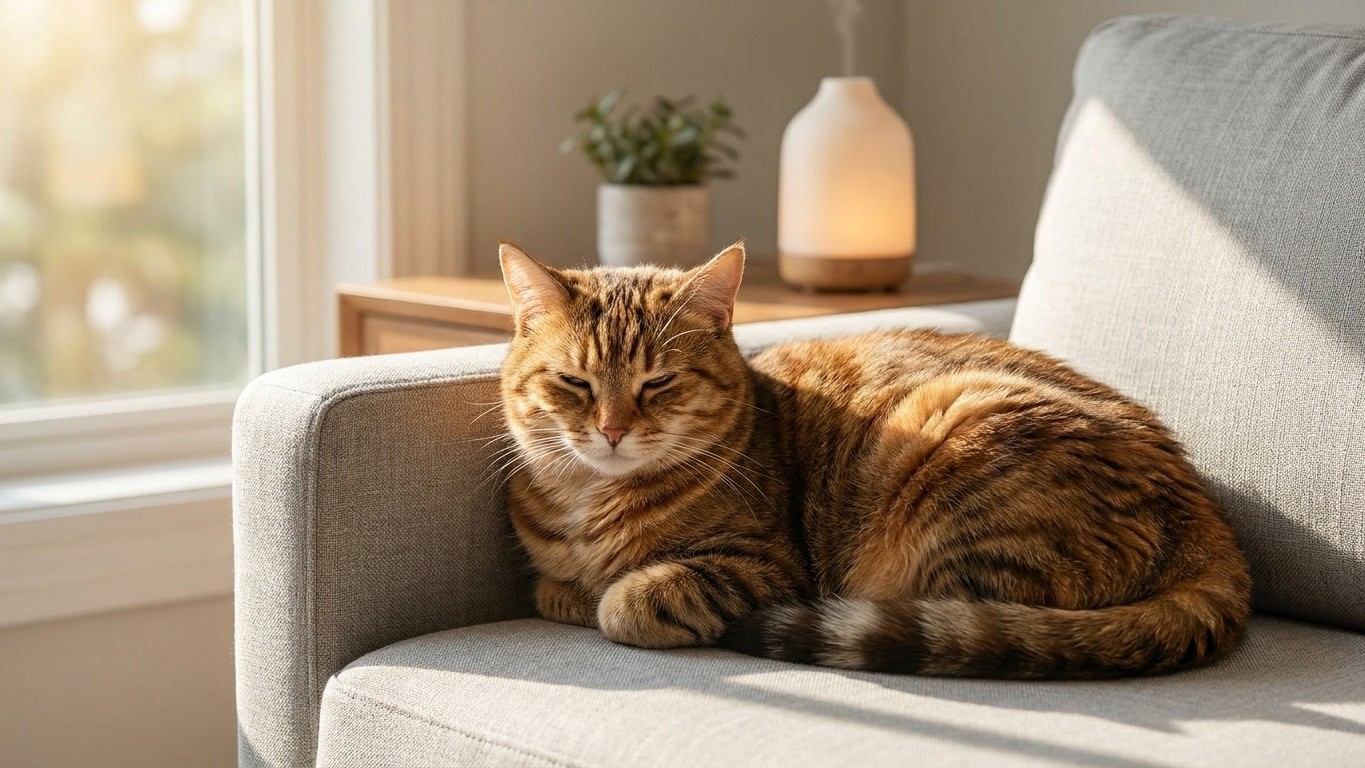
Tea tree oil has become a bathroom cabinet staple for millions of people. Antibacterial, antifungal, pleasantly medicinal in its scent, it feels like a responsible, natural choice. Running it through an evening diffuser feels even better: the living room fills with that clean, sharp aroma, and the whole ritual of it seems utterly harmless. The problem is, for the cat curled up on the sofa three metres away, it is anything but.
Key takeaways
- Cats are missing a liver enzyme that humans have, making them unable to safely process essential oils like tea tree oil
- A diffuser running nightly releases micro-droplets that settle on your cat’s fur—and get ingested during grooming
- Early symptoms are subtle enough to miss, but damage accumulates invisibly until a vet reveals the problem
What tea tree oil actually does to a cat’s body
Tea tree oil has been the most commonly reported intoxicant in pets. That statistic alone should give any cat owner pause. The reason goes straight to the core of feline biology: cats lack an essential enzyme in their liver and as such have difficulty metabolising and eliminating certain toxins like essential oils, and are also very sensitive to phenols and phenolic compounds, which can be found in some of them. cats lack glucuronyl transferase, a liver enzyme that dogs and humans use to metabolise and safely eliminate many aromatic compounds, including phenolic constituents.
This is not a quirk, it is a fundamental metabolic reality. Cats are obligate carnivores whose detoxification system evolved to process animal proteins, not plant compounds. They are missing glucuronyl transferase, the Phase II liver enzyme that binds toxic metabolites (phenols, terpenes, ketones) and Eliminates them via urine. What a human processes and excretes in hours, a cat cannot clear from its system in the same way. Even with supervised care and plenty of fluids, cats are still unable to completely excrete these toxins from their body, which can result in permanently elevated enzyme levels and varying degrees of liver function.
Tea tree oil contains terpenes as its primary active compounds. As little as 7 drops of 100% tea tree oil have been known to cause severe toxicity, and 10–20ml can easily cause death. Those figures refer to direct ingestion or skin application, but a diffuser running every evening creates its own, quieter route of exposure.
The diffuser problem nobody talks about
Cats are sensitive to inhaling essential oils. Tea tree oil diffused in the air can cause respiratory distress in cats, leading to symptoms such as coughing, sneezing, wheezing, or difficulty breathing. That is the immediate, visible effect. The slower, more insidious one is what happens when an ultrasonic or nebulising diffuser is running in a room where a cat spends its evenings.
Active diffusers differ from passive ones in that actual microdroplets or particles of oil are emitted into the air in addition to the pleasant aroma. Nebulising diffusers (using a pressurised high-speed air stream) and ultrasonic diffusers (using an electric current to emit vibration) fall into this category. Some of these diffusers release micro-droplets into the air that may collect on the fur of a pet cat. When the cat grooms itself, the oil may be ingested and the cat may suffer the consequences. A cat licking its own coat, something it does for several hours a day, becomes an involuntary route of ingestion. Grooming, which should be one of the safest things a cat does, turns into exposure.
As one veterinary professional put it: “Diffused oils are very dangerous, as the oils are inhaled. Not only are these oil droplets dangerous themselves, but the inhalation of these oils can cause a foreign body pneumonia in cats.” When a cat breathes in these concentrated fumes, it can irritate the lining of their respiratory tract, including the lungs, in addition to building up in the liver and causing toxicity. Night after night, the damage accumulates, often invisibly.
Recognising the signs before it gets serious
The tricky part is that the early symptoms of essential oil toxicity in cats are easy to dismiss. A cat that is slightly lethargic, occasionally nauseous, or intermittently wobbly is not always a cat that screams “emergency.” Symptoms of toxicity typically appear within two to twelve hours after exposure and can persist for up to three days, and include lethargy, weakness, incoordination, muscle tremors, and drooling. More severe symptoms of toxicity include elevations in liver enzymes, weakness, low body temperature, incoordination, inability to walk, hind leg paralysis, tremors, coma and death.
In cats, difficulty breathing may be mistaken for the animal trying to expel a hairball. Difficulty breathing can be distinguished by the cat crouching low to the ground with little abdominal movement and no hairball produced. Cats that have asthma or heart disease face the greatest threat from oils in the air. Sometimes these conditions will be minor and underlying, but exposure to toxic fumes can heighten them, causing the cat to cough excessively or have trouble breathing.
Cats are particularly sensitive to essential oils as they have a lower number of certain liver enzymes necessary to metabolise these oils. Additionally, very young cats and kittens, and cats with liver disease, are more sensitive to their effects. If your cat falls into any of those categories and you have been running a diffuser in a shared space, a conversation with your vet is overdue. Please, do not wait for dramatic symptoms to appear before seeking advice.
What to do instead, and what to tell your vet
If your cat has been sharing a room with a tea tree oil diffuser and you are now concerned, move them to fresh air straight away. If you think your cat has come into contact with an essential oil, the first thing you want to do is quickly identify what the oil was and how the cat came into contact with it. If you can’t do this quickly, or symptoms are so severe you don’t have time, go immediately to the vet or the closest emergency centre. There is no cure for tea tree oil toxicity, but supportive care is very important, bathing to remove traces of tea tree oil, administration of activated charcoal in cases of ingestion, IV catheterisation and fluid administration, and heat therapy are all important in helping a pet overcome the toxicity.
Some experts note that the effect of essential oils varies depending on your cat’s breed, age, size, and health condition. To be on the safe side, it is best to avoid using essential oils around your cat or in areas where your cat frequents. If you want to keep some form of home fragrance, using an oil diffuser for a short time period in a secured area that your cat cannot access is not likely to be an issue, however, if your pet has a history of breathing problems, it may be best to avoid using one altogether.
The broader lesson matters too. Just because something is “natural” does not mean it is non-toxic. Many compounds found in nature can be very toxic to both animals and people. Similarly, many compounds that have extremely beneficial properties in people can be very harmful to your pet. Tea tree oil, derived from Melaleuca alternifolia native to Australia, has genuine antimicrobial properties backed by science, for humans. For cats, that same potency is precisely what makes it dangerous. The very terpenes that kill bacteria on our skin are the ones their livers simply cannot handle.
One more thing worth knowing: with repeated exposure, even low-level aromatic contact can result in gradual accumulation that eventually exceeds the cat’s ability to compensate, producing effects that appear suddenly, long after the diffuser has become a completely normal part of the evening routine. By the time the problem is visible, it has often been building for weeks.
Sources : dailypaws.com | ladynpet.com