
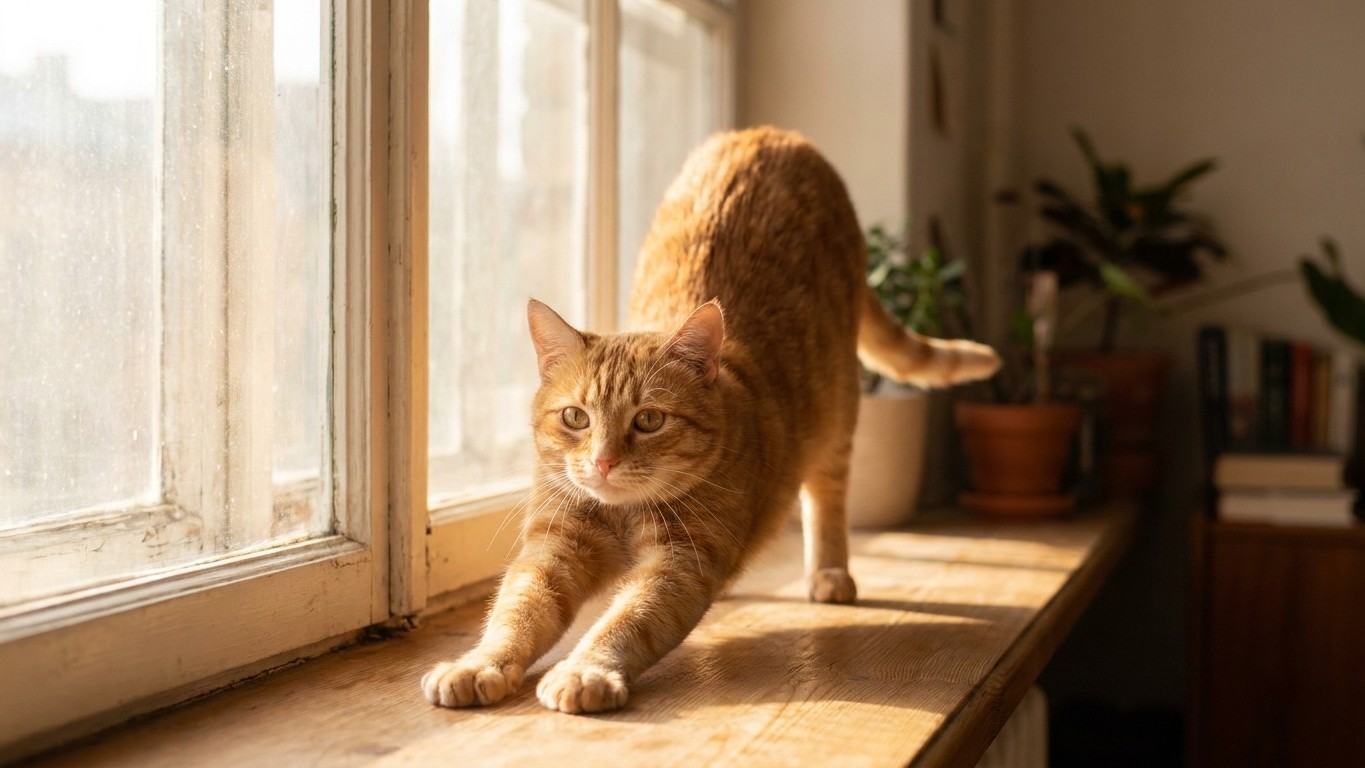
Your cat has been fine all winter. Calm, predictable, sleeping in patches of pale sunlight. Then May arrives, and suddenly she’s ricocheting off the walls at 5am, yowling at the ceiling, and treating your ankles like prey. Most owners shrug it off as “spring energy.” Warmer weather, birds on the windowsill, the general chaos of the season. But the real explanation runs much deeper than that, it starts in the brain, involves a hormone most people associate with jet lag, and it works exactly the same way in your cat as it does in you.
Key takeaways
- Increasing May daylight suppresses melatonin in your cat’s brain, triggering the same hormonal surge that affects their mood and alertness
- A 2025 study tracked eight cat behaviors year-round and found the real change isn’t more activity—it’s different texture: more grooming, scratching, and restlessness
- Spring pollen entering your home could actually be causing skin irritation that mimics ‘wild energy’—a vet check might reveal allergies instead of hyperactivity
The hormone nobody talks about
Melatonin is made in the pineal gland in the brain in response to darkness, and is suppressed by light. In winter, the long nights flood your cat’s system with it, keeping her drowsy and slow. Come spring, something shifts. The increasing light during early spring directly affects the cerebral cortex; consequently, melatonin secretion from the pineal gland is suppressed, which reduces the inhibitory effect on hypothalamic secretion of gonadotropin-releasing hormone (GnRH), and the secretion of gonadotropins is increased. In plain terms: more daylight means less melatonin, which means more sex hormones, more drive, more restlessness. By the time May rolls around, with dawn arriving before 5am in the UK, the effect is at its peak.
This is the part that surprises most owners. The domestic cat is a seasonal long-day breeder, meaning that reproductive activity is influenced by photoperiod. In the northern hemisphere, ovarian activity typically ceases in October under decreasing photoperiod and resumes in January with increasing photoperiod. So the hormonal surge builds gradually through late winter and hits full force in spring, not because your cat is excited about the blossom, but because her ancient reproductive biology is responding to the light in exactly the way evolution designed it to. Even neutered cats feel a version of this, because it’s not purely about reproduction. If your cat seems restless or unusually energetic, the extra daylight, and altered melatonin production, might just be the culprit. The hormone shift affects mood and alertness regardless of whether breeding is on the agenda.
Cats have a crepuscular rhythm, they are most active at dawn and dusk, a result of their hunting instincts and natural biological rhythms. Studies on the circadian rhythm of cats confirm that their activity shows two main peaks, in the morning and in the evening, and that these rhythms are linked to the light-dark cycle. In May, when the sun rises at an ungodly early hour, that dawn peak simply arrives earlier — often right on top of your sleep. The cat isn’t being difficult. Her internal clock is doing precisely what it was built to do.
The suspect nobody mentions: pollen
Here’s a layer to this that gets almost no attention in the average conversation about “cat spring fever.” What looks like hyperactivity or erratic behaviour could, in some cases, actually be discomfort. Pollen and other allergens are often more abundant in the environment in the spring and summer months, and cats can show more allergy symptoms in spring as their exposure to these allergens increases. The itching, over-grooming, face-rubbing, and restless pacing that owners interpret as wild energy can sometimes be a cat trying to relieve skin irritation caused by seasonal allergies.
Even strictly Indoor Cats Are exposed to these changes. Pollen and mold spores easily enter homes through open windows, ventilation systems, and on clothing, shoes, or other pets that go outdoors. The most common cause of these allergies is the pollen from trees, grass, and weeds. These tiny particles are released in large amounts during the spring and summer months and can float in the air for miles. Seasonal allergies arise when your cat’s skin comes into direct contact with the pollen, triggering an allergic reaction. The difference between “playing wildly” and “scratching because everything itches” matters enormously, and it’s one reason a vet check in spring is genuinely worthwhile rather than optional.
The most common symptom of seasonal allergies in cats is itching, which leads to scratching and excessive grooming, and this is usually accompanied by hair loss, often around the neck, the base of ears, the base of tail, or the groin, symmetrically along the back. If you notice these patterns alongside the usual springtime chaos, that’s a reason to ring your vet rather than simply reach for another toy to redirect the energy.
What a 2025 study actually found
The science here is newer than you might expect. A study published in early 2025 explored how seasonal and weather variations influence domestic cat behaviours. Using accelerometer data and a validated machine learning model, eight behaviours, including active movement, eating, grooming, littering, lying, scratching, sitting, and standing — were tracked in research cats over 13 weeks throughout the year. The findings revealed seasonal differences for eating, grooming, littering, lying, scratching, and sitting, but not for active behaviours or standing. That last detail is quietly interesting: broad activity levels don’t shift as dramatically as we assume. What does shift is the texture of behaviour, how much cats groom, how often they scratch, how long they lie still. The “wild cat in May” isn’t necessarily running more laps than in December; she’s just doing everything Differently.
In cats, seasonal changes aren’t just about growing or shedding a thicker coat; they also affect other physical characteristics and behaviour, regardless of whether the animal is indoor, outdoor, stray, or feral. When temperatures are comfortable without requiring special adjustments, cats are at their most active, in spring and autumn. Summer, counterintuitively, tends to slow them down again as the heat becomes its own deterrent.
What you can actually do about it
Knowing the cause is half the battle, and the practical response is more straightforward than most owners expect. Routine Matters More Than anything else. Cats like predictability. So even if you’re in a flurry of spring cleaning and seasonal upheaval, take the time to play with your cat and provide food at all the normal times. Disrupting the feeding schedule further scrambles an already unsettled circadian rhythm, which can amplify the erratic behaviour rather than calm it.
Disruptions to sleep and circadian rhythms can lead to hyperactivity and behavioural problems, so aligning a pet’s daily schedule with their natural biological clock is one of the simplest ways to ensure a calmer and healthier life. In practical terms: play sessions timed for early morning and dusk, those natural activity peaks, give your cat a legitimate outlet for the hormonal surge rather than leaving her to invent her own entertainment at 4am. Offering extra enrichment helps: if your cat is antsy due to melatonin or reproductive hormone activity, look for ways to engage them with extra play, new toys, or thrilling new activities.
For cats who aren’t neutered, the behavioural shift in May is considerably more intense. Cats are seasonally polyestrous, meaning they experience multiple heat cycles throughout specific times of the year. The cycle is triggered by changes in daylight, which explains why cats tend to go into heat more frequently in spring and summer. Spaying and neutering removes the sharpest edge of this seasonal hormonal spike, and if you’ve been putting it off, spring is a pretty compelling reminder to book that conversation with your vet. Spaying your cat is the most effective way to prevent repeated heat cycles and the associated behaviours, and it also offers long-term health benefits such as reducing the risk of uterine infections and certain cancers.
One thing worth knowing if Your Indoor Cat seems particularly reactive despite being neutered: man-made lighting, including light pollution, maintains a constant level of illumination in urban areas that is similar to the crepuscular period. This means that urban cats are exposed to a distorted photoperiod that does not favour proper circadian entrainment, which can lead to alterations of activity patterns, particularly hunting and territorial behaviour. City life, keeps the feline nervous system in a state of perpetual mild twilight, and when real spring light floods in, the biological contrast hits harder than it would for a cat in the countryside. Your fourth-floor flat may be contributing more to the chaos than you realised.
Sources : pubmed.ncbi.nlm.nih.gov | animalbiotelemetry.biomedcentral.com