
Ticks on cats. Most owners barely give it a second thought, they associate ticks with dogs, muddy boots and country walks through bracken. But vets across the UK are seeing something shift. Historically, tick activity in Britain peaked twice a year, in spring and autumn. Climate change is tending to extend that seasonal window. And right now, in June, the timing could not be more loaded: real-time data from the Tick Surveillance Scheme suggests that an extended peak now occurs from early spring through until late autumn, with the highest levels of exposure occurring during May and June. Your cat is roaming out into all of this, and you probably haven’t checked it once.
Key takeaways
- Tick season in the UK is extending due to climate change, with peak exposure happening right now in June when most cat owners are caught off guard
- A tiny hedgehog tick species is the real culprit stalking urban gardens, and ticks transmit serious diseases like Lyme disease within 24 hours of attachment
- The removal technique matters more than you think—one wrong move can actually increase disease transmission risk for your cat and your family
The parasite your cat picks up without you ever knowing
Ticks are small parasites that feed on the blood of animals, including people, they have eight legs and look a bit like spiders. They cannot fly or jump. When a tick is ready to feed, it climbs to the tip of a grass blade and waits for an animal to pass by, reaching out and grabbing hold of the fur when something brushes past — behaviour known as “questing”. Your cat does not feel a thing. The bite is painless, and when a tick first attaches it is likely to be tiny, the size of a pinhead, only growing to the size of a small pea as it feeds. Ticks are tricky to spot until they get quite big, which is why checking your cat regularly is so important, especially if they hunt in long grass.
The species most likely to be lurking in your garden is not necessarily the famous sheep tick of the countryside. The risk is relatively greater for urban cats, where the hedgehog tick, Ixodes hexagonus, is the culprit, the tick most commonly found on cats and the second most common in dogs. As hedgehogs abound in parks and gardens, I. hexagonus is common even in urban areas. Its prevalence is greatest in south-east England, though it is found further north, even into Scotland. That hedgehog visiting your patio at dusk is, in a very real sense, a tick delivery service.
The Big Tick Project identified ticks on 6.6% of all cats visiting vet practices in the UK. That figure sounds modest, but it captures only the cats whose owners bothered to bring them in. The real number is almost certainly higher. Ticks are tricky to spot until they get quite big. The most common time for a cat to get a tick is when they spend time sleeping, prowling, or hunting in long grass, activities that happen at three in the morning, when nobody is watching.
What ticks are actually doing to your cat, and why the window matters
Ticks act as vectors of diseases that affect pets and, sometimes, pet owners. They can transmit bacteria, viruses and other parasitic infections, as well as feeding on blood, which, in heavy infestations, could lead to anaemia, especially in young animals. Ticks spread infectious diseases between animals more than any other parasite except mosquitoes. Lyme disease is the most serious and common disease transmitted through tick bites in the UK, with figures from human medicine suggesting around 3,000 cases per year in England and Wales — a figure likely to be rising.
Dogs, cats and humans can all get Lyme disease, although it is uncommon in cats. Lyme disease is the most serious disease spread by ticks in the UK. However, it remains very rare in cats, and much rarer than in dogs. Irritation or infection at the site of a tick bite is a far more common problem. The bigger practical concern for most cat owners is the transmission window: the bulk of tick-borne infections in the UK are thought to take at least 24 hours to be transmitted after tick attachment, so pets should be checked every 24 hours and any ticks carefully removed. That is a tight timetable for a cat that disappears for 36 hours at a stretch.
Then there is the climate dimension. Ticks are established across the UK and are expanding in distribution due to climate and ecological changes. They are significant vectors of multiple pathogens affecting dogs and cats in Europe. Ticks that are not native to the UK are surviving more easily in our changing climate, and pet travel increases the risk of these parasites and the diseases they carry entering the UK. There has been an increase in tick-borne diseases in the UK that vets are watching closely, not with alarm, but with the kind of careful attention that preventative care demands.
How to actually check your cat, and what not to do when you find one
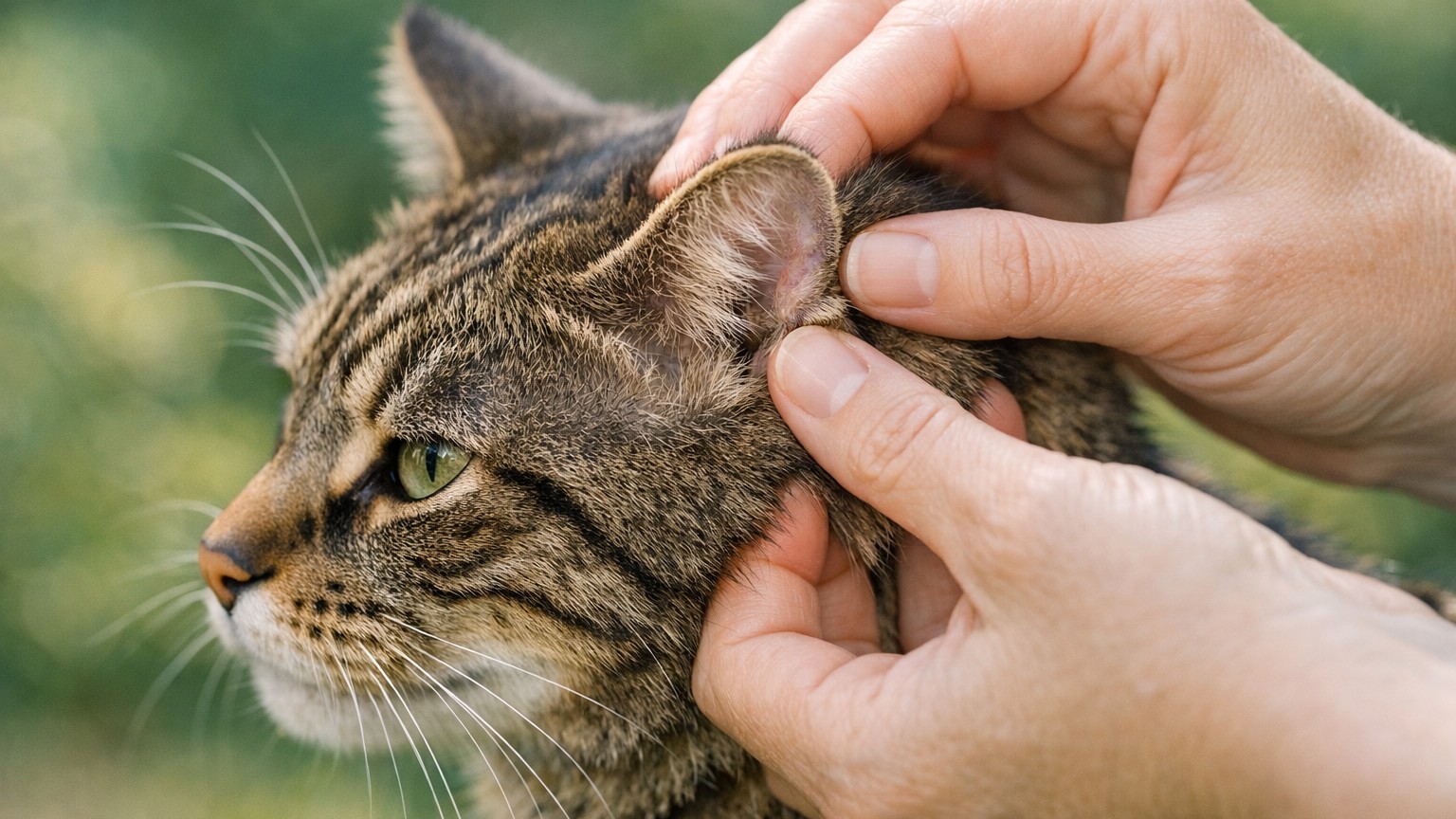
A good routine check takes less than two minutes. Run your hands all over the body, paying close attention to the ears, neck, skin folds and other crevices. Ticks are most common on the head, ears, armpits, groin and tummy. After feeding, ticks are big enough to spot and feel like a small bump on your pet’s skin, slightly firmer than you’d expect, and sitting flush to the surface rather than rolling around freely.
Finding one is not a crisis, but the removal technique is non-negotiable. When removing a tick, make sure you do not squeeze the tick’s body or leave the head in, squeezing it can push blood back into your pet, increasing the chance of disease transmission. You will need to twist the tick off using a tick removal tool, which can be picked up at pet shops or the vets. Do not try to burn them off or use lotion to suffocate them, as this will not prevent your pet from picking up a disease — it may actually make things worse by stressing the tick into regurgitating. There is no need to contact your vet if you have successfully removed the tick and are confident none was left behind. However, if you notice redness, swelling, or signs of infection, contact your vet for advice.
On the question of prevention, the rule is simple: always use products made specifically for cats. Never use dog tick medicine on cats. Some dog tick treatments contain chemicals that are toxic to cats and can even be fatal. Avoid off-the-shelf tick products as these tend to be less effective than prescription products available from your vet. Spot-on treatments, collars and tablets are all available, and your vet will advise on what suits your cat’s lifestyle and risk profile. Indoor cats are at lower risk of getting parasites but it is still possible, parasites can come into your house on your clothes or shoes. Even indoor cats can get a tick that has hitchhiked into the house on the clothing of a human family member before falling off and making its way onto them.
One detail that often surprises cat owners: because cats visit areas inhabited by wildlife infected with Lyme disease, they may bring infected ticks into homes and gardens. Although owning a pet does not directly increase the risk of Lyme disease in humans, preventing the spread of infected ticks is another good reason to use preventative products. Your cat is not just at risk, on a bad day, it is a tick taxi service for the whole household. Worth remembering when you reach for that grooming brush tonight.