
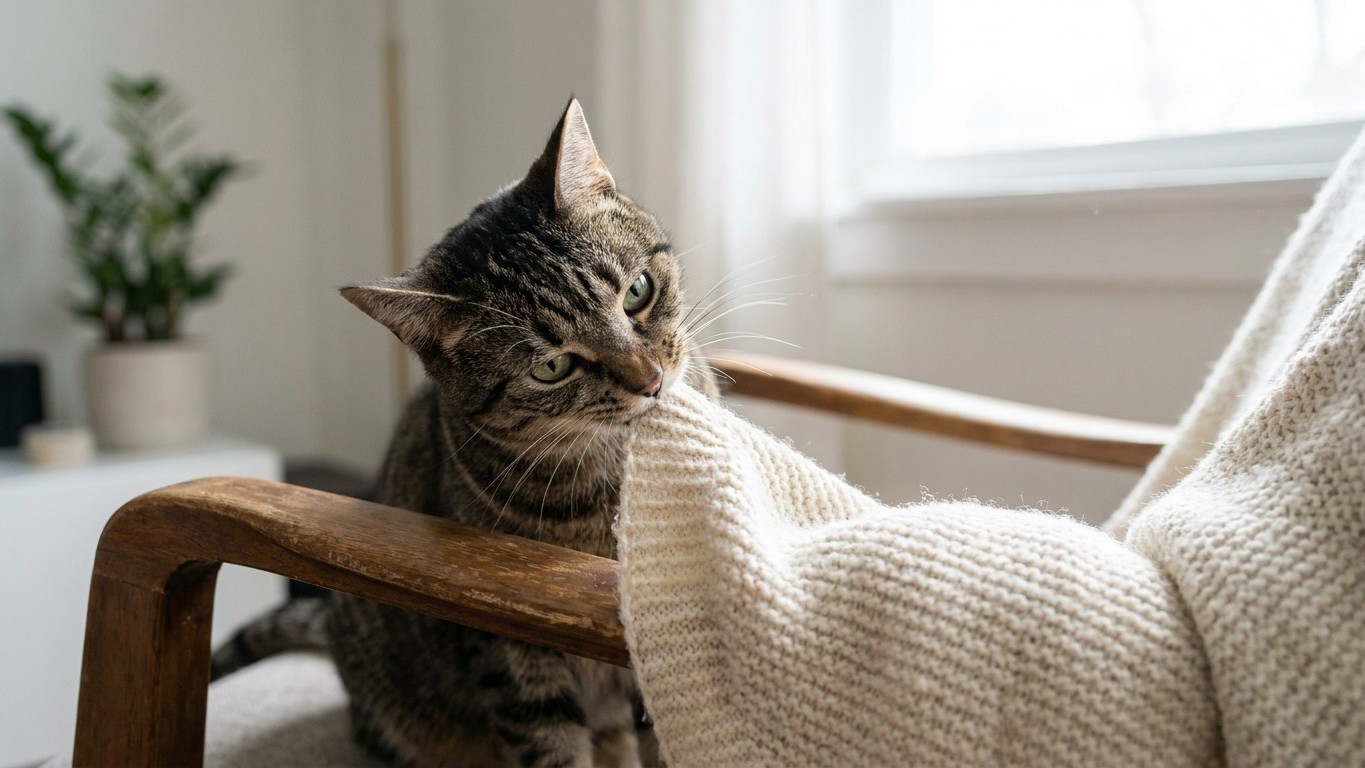
Wool-sucking looks harmless enough, right up until a strand of fibre anchors itself in the gut and starts dragging everything else along with it. That’s the grim reality behind a condition vets call feline pica, and it explains why a habit many owners dismiss as quirky can end with an emergency operation.
Cats with pica don’t nibble curiously the way a kitten investigates a new cardboard box. Cats with pica will hold the chosen object in their mouth, tilt their heads to one side and grind repeatedly with their back molar teeth before swallowing. It’s a deliberate, repeated ritual, not a one-off taste test. Vets at International Cat Care describe the compulsion as almost addictive: the act of chewing releases certain neurotransmitters causing a feeling of intense pleasure, and this then becomes addictive. That’s what makes it so hard to break once it’s established, and why “he’s just keeping himself busy” is exactly the kind of thinking that lets the behaviour spiral.
Key takeaways
- Some cat breeds are genetically predisposed to wool-chewing, but stress and medical conditions can trigger the behaviour in any cat
- Wool fibres don’t break down and can create a dangerous ‘linear foreign body’ that bunches up the intestines, requiring emergency surgery
- Even cats that only suck rather than swallow can accumulate fibres leading to life-threatening blockages
Why some cats simply can’t leave wool alone
This isn’t random. Certain pedigree breeds are genuinely wired for it. There may be a genetic aspect to pica, as it’s more commonly seen in certain breeds such as Siamese, Burmese, Tonkinese and other Oriental types, but any cat can suffer from pica. A landmark Tufts University study of 204 Siamese and Birman cats backed this up, finding that the most common material was wool, in 93% of cases, followed by cotton, man-made fabrics, rubber, plastic and paper or cardboard.
What’s fascinating is how the triggers differ even within predisposed breeds. The same research found that in Birman cats, being weaned early and coming from a small litter both increased the risk, while in Siamese cats early weaning wasn’t a factor at all, but having a history of medical problems was linked to higher rates of wool-sucking. So two genetically similar cats can develop the exact same odd habit for completely different underlying reasons, one behavioural, one medical. That’s precisely why a vet visit at the first sign of fabric obsession matters far more than a quick internet search for solutions.
Timing matters too. Onset of pica could occur at any time during the first four years of a cat’s life, but was most frequent in the two months following rehoming, and in other cases tended to occur between six and eighteen months of age. If your cat suddenly develops a taste for your jumpers shortly after a house move or a new arrival at home, stress is very likely part of the picture.
What a wool obsession actually does inside the body
Wool fibres are thin, stringy and don’t break down the way food does. Swallow enough of them and you create what vets call a linear foreign body, one of the nastier scenarios in feline emergency medicine. As the string is anchored at one end it results in a drawcord type effect where the intestine bunches up along the string, and this is particularly dangerous because it can lead to damage of the intestines and even perforation and resulting abdominal inflammation. That bunching effect is exactly what shows up on a scan, and it’s why “he’s just chewing, not swallowing” is a dangerous assumption. Even cats who seem to only suck rather than eat aren’t necessarily safe: even cats that are just sucking wool or fabric can end up accumulating fibres in their intestines, which can cause blockages.
Once an obstruction forms, there’s no home remedy that fixes it. Pica behaviour is of concern because it can lead to serious health problems if the material ingested causes problems in the digestive tract, most especially an obstruction, and surgery is needed to remove obstructions due to pica. Blocked bowels stop food and fluid moving through the gut entirely, and the longer it goes undetected, the higher the risk of tissue death and sepsis. A cat that’s suddenly off its food, vomiting repeatedly, straining without producing anything, or simply hiding and hunched over needs to see a vet the same day, not “if it doesn’t improve by tomorrow”.
Breaking the habit before it becomes an emergency
The fix isn’t simply confiscating every woolly jumper in the house, though removing obvious temptations is the sensible first step. Vets recommend limiting your cat’s access to the items they’re chewing on, then providing appropriate outlets for chewing, such as small dog chew toys and cat grass, which allow a cat to chew on items with a low risk of causing intestinal obstruction. Puzzle feeders and foraging toys help redirect that same jaw-grinding satisfaction towards something that won’t shred inside the bowel.
Because the causes are so varied, a proper diagnosis Matters More Than a Pinterest-worthy list of deterrent sprays. Underlying triggers range widely: licking or absorption of weird substances has been correlated to endocrine and gastrointestinal conditions, such as hyperthyroidism, diabetes, inflammatory bowel disease, gastric motility issues and hookworm infestation. A vet will typically want to rule these out with bloodwork before assuming the behaviour is purely compulsive. If it turns out to be genuinely behavioural, don’t be surprised if medication comes up as an option alongside environmental changes; fluoxetine, an SSRI antidepressant, can help with OCD-type wool-chewing, though it should always be used alongside behaviour-modification techniques rather than on its own.
One detail that surprised me while researching this: cats living exclusively indoors seem to be at greater risk than those with outdoor access, which suggests boredom and lack of stimulation play a bigger role than most owners realise. A jumper left on the sofa isn’t just an inconvenience for your laundry pile, it’s a genuine medical gamble every time your cat decides to have a chew. If yours has already developed a favourite fabric to gnaw on, don’t wait for a dramatic symptom. Book the vet appointment now, while it’s still a habit and not yet a foreign body on a scan.
Sources : researchgate.net | sciencedirect.com