
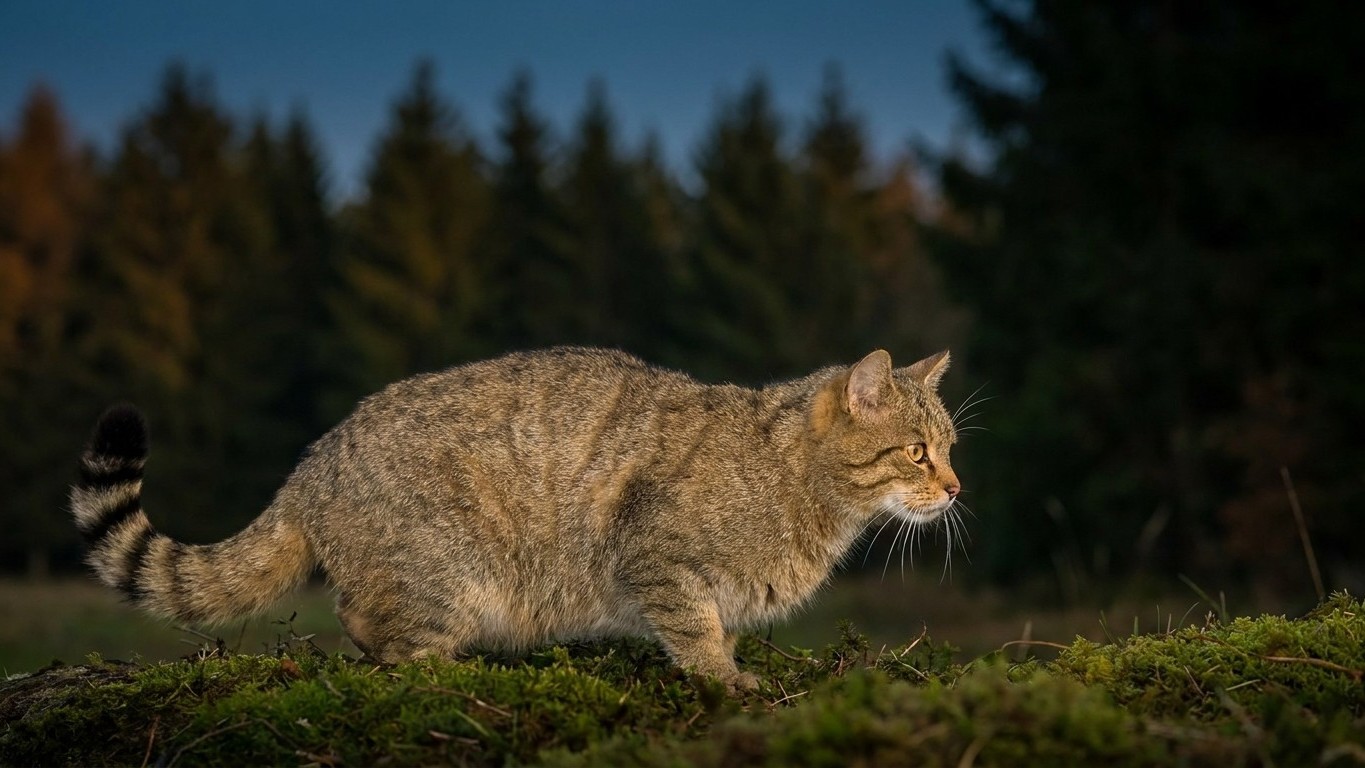
That tabby-patterned visitor prowling the treeline probably wasn’t a stray at all. If you’d trapped what looked like an ordinary farm cat near the Jura and then noticed a thick, ringed tail ending in a blunt black tip rather than a thin pointed one, you’d likely just handled a European wildcat, one of France and Switzerland’s most strictly protected mammals, and the “too late” part isn’t dramatic licence. It’s the law.
Key takeaways
- A thick tail with blunt black rings is the wildcat’s dead giveaway—but most people never look closely enough
- Capturing or harming a European wildcat is strictly illegal in France and Switzerland, even by accident
- Generations of interbreeding have blurred visual clues so thoroughly that even scientists now rely on genetic testing
The tail tells the whole story
Wildlife biologists rely on the tail more than any other single feature when separating a genuine Felis silvestris from a tabby that’s simply gone feral. The forest cat’s tail is thick with 2 to 4 complete black rings and ends in a black sleeve, along with a single fine black dorsal line starting midway down the back. Compare that with a domestic or feral cat, whose tail runs thinner, tapers to a point, and rarely shows crisp, unbroken rings.
The tail of feral cats and hybrids resembles that of the domestic cat, being thinner, pointed at the tip and with less distinct rings. Body shape backs this up too: the wildcat appears stockier, with a wider skull and more robust hind limbs. Colouring offers another clue, though a subtler one. While domestic cats can wear almost any coat colour, wildcats are mostly tawny, sometimes with a touch of grey, and their tabby striping is far less crisp than on a house cat.
None of this is foolproof, mind. A landmark French study led by Sébastien Devillard and colleagues, published in the Journal of Zoological Systematics and Evolutionary Research, found that morphological traits alone don’t always reliably separate purebred wildcats from hybrids, because generations of interbreeding have blurred some of these markers genetically even where the coat still looks textbook. That’s precisely why professional surveys in the Jura increasingly rely on genetic sampling rather than a quick glance.
Why this mistake keeps happening, and why it matters
Size is often the first thing people notice, and it’s frequently wrong. Wildcats look bulkier thanks to dense fur, but they’re only slightly larger than a domestic cat, measuring 43 to 65 centimetres from nose to tail base. Adult males can reach 7 kilograms, females up to 5. That’s a hefty tomcat’s weight, not some phantom lynx-sized beast.
The confusion has real teeth, legally speaking. In France, the wildcat is protected under a ministerial decree of 17 April 1981, which strictly forbids capturing, injuring, killing, transporting or keeping it, whether alive or dead. Cross the border into Switzerland and the protection runs even deeper historically. Since 1962, the wildcat has been protected in Switzerland. Trapping one, even accidentally while trying to help what you assumed was a lost pet, puts you on the wrong side of conservation law the moment the cage door clicks shut.
This isn’t a hypothetical worry dreamt up by bureaucrats. Although legally protected, wildcats are still shot by people mistaking them for feral cats. I find that genuinely maddening, because the very trait that makes wildcats vulnerable, their resemblance to an everyday moggy, is the same trait that’s kept them anonymous enough to survive quietly in places humans have otherwise reclaimed.
A ghost that’s slowly coming back to the Jura
The population’s history reads like a slow-motion recovery from near catastrophe. Persecution during the 18th and 19th centuries, driven by the belief that wildcats were vermin worth exterminating, all but wiped them from the region. The wildcat, once widespread on the Plateau and in the Jura, had almost completely disappeared by the late 18th century, after hunting literature branded it one of the country’s most harmful predators, driving population collapse.
Recovery, when it finally came, arrived quietly and mostly from next door. The wildcat’s return to Switzerland is probably owed to immigration from the French Jura, particularly Sundgau and Burgundy. Today the species clings to a narrow but genuine foothold. In Switzerland, the wildcat was once widespread across the Swiss plateau and the Jura Mountains, though after the 19th century its range shrank to the Jura Mountains alone. On the French side, researchers describe a similarly fragile situation. France has two disconnected wildcat populations, one in the Ardennes extending into Luxembourg, Germany and Belgium.
Monitoring these cats is a genuine challenge because they’re so elusive. Researchers at KORA, the Swiss carnivore ecology institute, have piggybacked wildcat surveys onto existing lynx camera-trap networks across roughly 600 to 700 square kilometres of the Jura, hoping the incidental sightings add up to something statistically useful. It’s detective work built on patience rather than dramatic encounters.
What to actually do if you find one
Should you genuinely stumble across a wildcat-looking animal near a Jura forest edge, resist the urge to intervene physically. The smarter move, and the legal one, is observation from a distance followed by a report. Wildlife groups specifically ask the public to help this way rather than attempting rescue or containment themselves.
- Note the tail shape, ring count, and whether the tip looks blunt or pointed
- Photograph from a distance without approaching or luring the animal
- Report the sighting to a regional biodiversity or wildlife protection body
- Avoid feeding it, since dependence on humans is exactly what erodes wildcat behaviour
Good knowledge of the species’ distribution underpins its protection, so reporting a sighting genuinely contributes to conservation efforts for Europe’s wildcats. If you keep a farm cat or barn tabby near woodland edges, it’s worth having it neutered too. Uncontrolled breeding between domestic cats and wildcats remains one of the biggest long-term threats to the genetic purity of this quietly returning population, and every unneutered tom roaming near the treeline is a potential contributor to that dilution, whether he ever gets photographed or not.
Sources : kora.ch | bigcatswildcats.com