
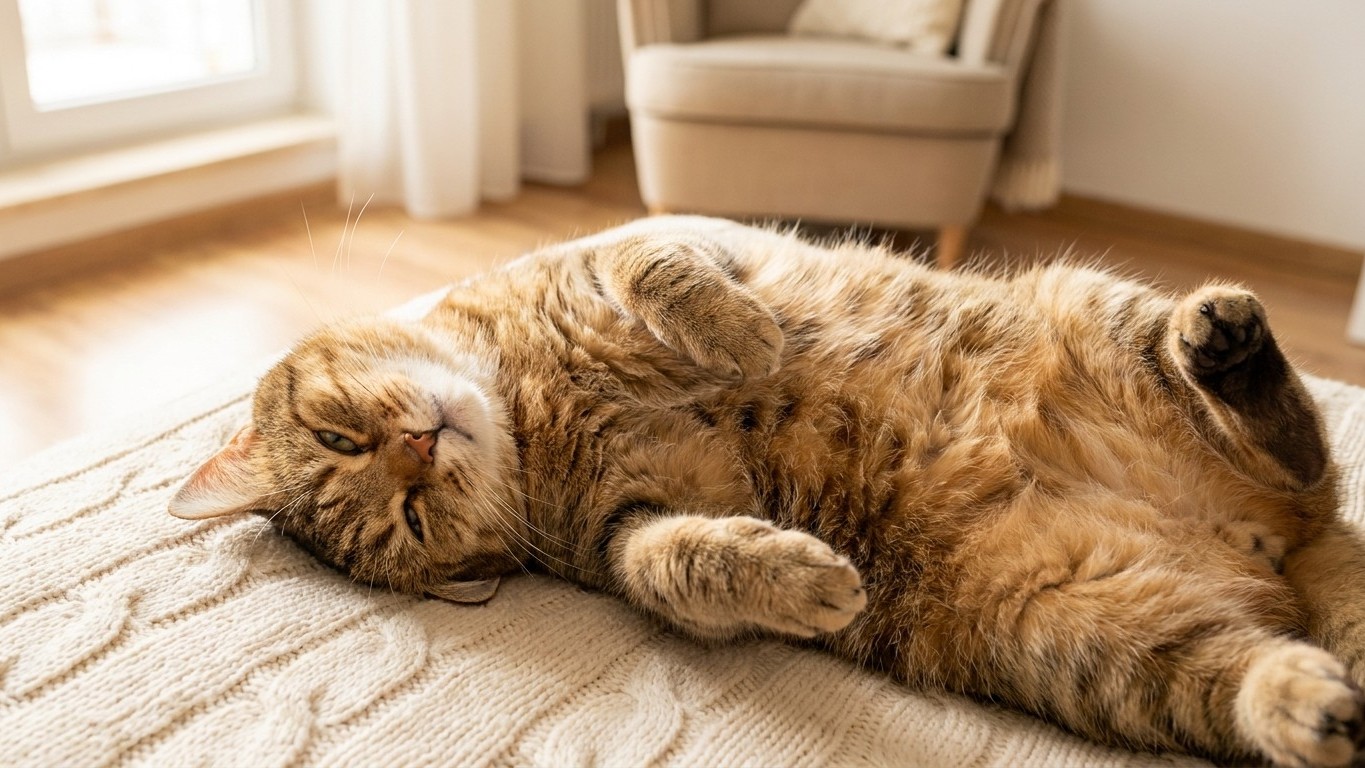
A cat flopping onto its back and showing you that soft, fluffy tummy is not a green light to dive in for a rub. Vets and feline behaviourists agree it’s one of the most misread signals in the whole cat vocabulary. The exposed belly is one of the most consistently misread signals in the entire vocabulary of cat behaviour, and a cat who rolls onto their back and exposes their abdomen is performing a clear, unambiguous trust behaviour, since the abdomen contains all the vital organs and is the least protected part of a cat’s body. That’s the bit worth understanding before your fingers get anywhere near it.
Key takeaways
- Cats borrow this belly-exposure gesture from wild feline communication—it signals deep trust, but definitely not an invitation to touch
- A cat’s exposed belly is actually a fighting stance too: they have instant access to four sets of claws and all their teeth from that position
- Overstimulation, not aggression, causes those scratches—cat belly skin is packed with nerve endings that can flip from ‘cuddle’ to ‘combat’ in seconds
A gesture borrowed from the wild, not an invitation
Dogs roll over and genuinely want a scratch. Cats operate on a completely different set of rules, and the confusion between the two species causes more scratched hands than almost any other misunderstanding in pet ownership. Unlike dogs, cats can be particular, especially regarding their bellies, and when a dog rolls over on their back and exposes their belly, the dog likely wants you to rub it, whereas cats are different. The behaviour has roots going back long before cats ever curled up on a windowsill. There is a good reason why cats protect their bellies: vital organs are there, and they are more vulnerable in this position.
The Science Behind this isn’t just folklore passed between cat owners. A proper piece of research exists on the subject, and it’s older than you might think. According to a 1994 study, “Domestic Cats and Passive Submission,” published in Animal Behaviour and authored by Hilary N. Feldman of Cambridge University’s Sub-Department of Animal Behaviour, an 18-month study was conducted on reproductively intact cats from two semi-feral cat colonies. That research helped establish belly exposure between cats themselves as a genuine social signal, not just something they do for humans. So when your own cat rolls over in front of you, it’s borrowing a gesture from cat-to-cat communication and directing it at you specifically, which is rather touching when you think about it.
Why the hand that reaches for the belly gets bitten
Here’s where things get interesting from a welfare perspective, and where vets consistently steer owners away from the tummy. The position itself is, ironically, a fighting stance as much as a relaxed one. Exposing the belly with all four paws up could be a defensive stance, because on their back, a cat has quick and easy access to four sets of claws and all their teeth, meaning that for a cat, exposing their belly can mean that they are prepared for battle. A hand moving towards that soft patch of fur can flip the switch from cuddle to combat in under a second.
Then there’s the simple matter of nerve density. Cat bellies aren’t padded the way a Labrador’s is, and the skin there is thin, warm, and packed with sensory receptors. Many cats find direct belly touching intensely overstimulating, because the belly is rich in nerve endings and the sensation crosses from pleasant to overwhelming very quickly, and the bite or scratch that often results is not aggression in the conventional sense but a reflexive response to overstimulation, often called petting-induced aggression by feline behaviourists. Nobody enjoys being tickled past the point of comfort, and cats have far fewer polite ways of saying “stop” than we do. A nip is often the feline equivalent of pulling your hand back from a hot pan.
It isn’t only about trust and defence, either. Cats use their bellies for other, more mundane reasons that have nothing to do with emotional bonding. They might be having a good stretch as a way to relax and relieve tension, or they may be regulating their temperature, since cats’ bellies have less fur, so exposing their stomach can be a good way of cooling down, similar to sticking your feet out of the duvet. A cat sprawled belly-up on a warm patio in August might simply be trying not to overheat, nothing more poetic than that.
Reading the room before you reach out
Context decides Everything here, and this is the bit vets wish more owners paid attention to before offering that first stroke. A truly trusting belly-up display will be accompanied by relaxed body language, like slow blinks, a calm tail, and soft ears, and the cat might stretch out comfortably, often inviting gentle interaction, but not necessarily a belly rub. Watch the whiskers too. According to feline behaviour guidance, when their whiskers look relaxed and neutral, your cat is calm and content, whereas whiskers flattened against the face mean your cat is fearful or feeling defensive.
Play is another common motive tucked inside the same pose, and it’s easy to mistake for affection. Showing the belly can also be a play cue, as if they’re saying, “Look, I’m on my back, see if you can catch me!” Then there’s a hormonal explanation that catches many owners off guard. Some animal behaviourists suggest that unspayed female cats may roll on their backs as a mating behaviour, specifically as a post-coital routine, and if you suspect this is the case, don’t attempt to touch or pick up your cat until she’s calmed down. One pose, at least four possible explanations. That’s a lot of guesswork riding on a single gesture, which is exactly why blanket advice (“always rub” or “never rub”) misses the point.
Some cats genuinely do enjoy a belly rub once trust is deeply established, so this isn’t a hard universal ban. Some cats enjoy any sort of attention they can get, and that includes belly rubs, so if you think your cat might be one of those, you can try stroking their side and watching their body language, and if they remain relaxed, slowly move toward the belly. The safer bet, and the one most cat behaviourists recommend, is to treat the exposed belly as the compliment it is rather than the invitation it looks like. A slow blink back, a chin scratch, or simply staying still and letting the cat enjoy being seen tends to land far better than a hand heading straight for the fur. If your cat starts avoiding this pose altogether, becomes unusually clingy, or seems sore when touched anywhere near the abdomen, that’s worth a proper chat with your vet rather than a behavioural guess, since sudden changes in comfort levels can sometimes flag pain rather than personality.
Sources : catster.com | dialavet.com