
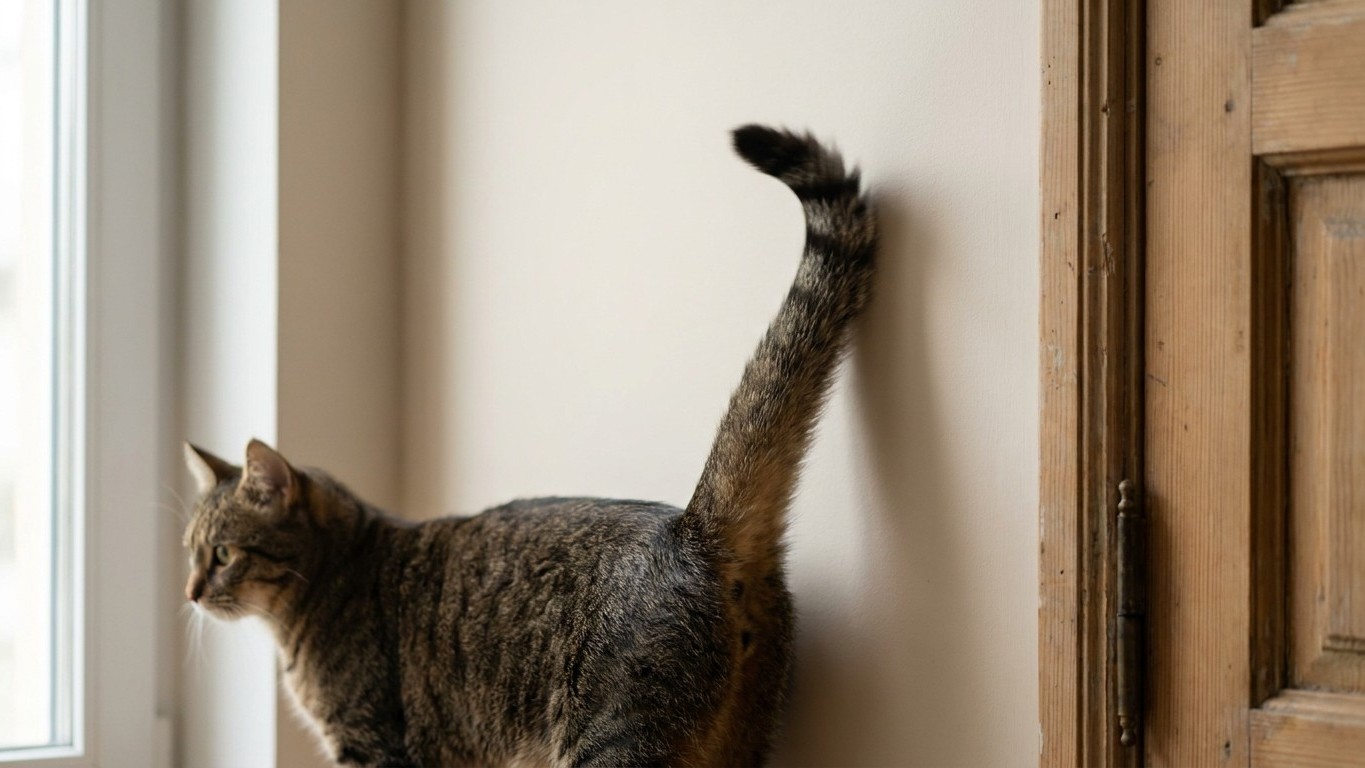
Shouting at a cat for quivering its tail against a door frame is like scolding someone for blushing. The tremor isn’t defiance, it’s a message, and in this particular case it turned out to be the clearest signal a cat can give that something in the house was making him anxious enough to mark his territory with urine.
That’s the twist so many owners stumble into. The vertical tail, the trembling tip, the way the cat backs up against a door frame or curtain before a faint dampness appears: this isn’t a toileting accident or a badly behaved pet ignoring the litter tray. If a cat backs up directly against a vertical surface, lifts their tail straight up, starts quivering, and treads with their back paws, they are actively spraying, and unlike normal peeing in a litter box, spraying is a behavioural issue. It’s a way for cats to mark territory when they feel deeply threatened or stressed by outside cats, new pets, or changes in the home. Shouting doesn’t stop that stress. It adds to it.
Key takeaways
- A cat’s trembling tail against a door frame can mean joy OR anxiety—and the difference determines everything about how you respond
- Urine spraying is triggered by stress and territorial threat, not litter box avoidance—punishing it backfires badly
- Medical conditions like urinary tract infections can mimic stress-driven spraying, so a vet visit is essential before assuming behavior issues
Reading the tail correctly matters more than you’d think
Here’s what makes this behaviour so easy to misread: a quivering upright tail is one of the most affectionate signals in the entire feline repertoire, right up until it isn’t. A high tail means a cat is feeling confident and happy, and if the tail is quivering a little, this can mean the cat is very excited to see you, often a greeting sign when they see someone they know and like. Vets and behaviourists even have a nickname for the harmless version. A straight-up, vibrating tail is usually the ultimate expression of intense feline joy, sometimes called “phantom spraying” because no urine is actually released.
The version that leaves marks on your paintwork looks almost identical at first glance but plays out differently. When a cat sprays urine, they’ll typically back up against an object with their tail raised vertically and spray a stream of urine directly behind them, as their tail quivers and vibrates. Actual urine spraying involves backing up to a wall and is triggered by territorial stress. The context, then, tells you everything the tail alone can’t. A happy greeting quiver happens face-on, tail high, no backing up. A stress-driven spray happens against a vertical surface, rear-end first, with that unmistakable treading motion of the back paws. Get the two confused, as so many of us do, and you end up punishing a cat for an anxiety response rather than addressing what’s actually frightening him.
Why the shouting makes everything worse
Cats spray because something feels unstable in their world, not because they’re being spiteful. Common triggers include a new pet in the household, unfamiliar cats prowling the garden and visible through windows, changes to furniture layout, or even a shift in the owner’s routine. Unneutered male cats are disproportionately prone to it thanks to hormonal drive, though neutered males and females spray too when stressed enough. Adding a scolding into that mix doesn’t remove the trigger. It simply teaches the cat that his owner is now also a source of unpredictability, which tends to increase anxiety rather than resolve it. One behaviour resource puts it bluntly: never punish your cat for spraying. The advice isn’t sentimental, it’s practical. A frightened cat has fewer coping strategies, not more, and punishment closes off the one thing that actually helps: identifying and removing the stressor.
Worth noting too is that tail-quivering marking behaviour sits within a much wider vocabulary of tail language that most owners never learn to read properly. A shaking tail can also indicate irritability or anxiety, especially if it progresses to a fluffed-up or thrashing tail, which screams “leave me alone” and serves as a warning before aggression. None of these signals are about manners. They’re about a nervous system trying to communicate faster than words allow.
Ruling out a medical cause before assuming stress alone
Behavioural spraying isn’t the only explanation for unexplained dampness near doorways, and this is exactly where a vet’s opinion becomes non-negotiable rather than optional. Urinary tract infections, bladder stones, and feline idiopathic cystitis can all cause a cat to urinate more frequently, sometimes in places outside the litter tray, and the two problems (stress-driven spraying and a genuine urinary condition) frequently occur together because pain and anxiety feed each other. A vet visit should be booked promptly if any of the following appear alongside the marking:
- Straining or spending unusually long periods in the litter tray
- Blood visible in the urine
- Frequent, small trips to urinate throughout the day
- Vocalising or showing signs of discomfort while toileting
Advice should be sought if tail shaking is new and persistent, occurs alongside pain signs such as crying out or sensitivity to touch, or leads to changes in toileting including straining, frequent trips, or blood in urine. A cat that’s uncomfortable physically will often show a tail response that looks near-identical to a stressed, territorial one, so a clinical check rules out the possibility that this is a plumbing problem inside the cat rather than a psychological one.
What actually helps once you know the truth
Once medical causes are excluded, the fix is almost always environmental rather than disciplinary. Cleaning sprayed areas with an enzymatic cleaner rather than standard household products matters more than people expect, because ordinary cleaning can leave behind pheromone traces invisible to us but glaringly obvious to a cat’s nose, effectively inviting a repeat mark on the same spot. Reducing visible triggers helps too: blocking a cat’s view of rival cats outside, adding vertical perches and hiding spots so an anxious cat has somewhere to retreat, and making sure litter trays are plentiful, clean, and positioned away from noisy appliances all reduce the pressure that leads to marking in the first place. Neutering, where it hasn’t already happened, cuts spraying dramatically in male cats driven by hormonal surges.
The door frame in question was never the problem. It was simply the surface a stressed animal chose to say something his owner hadn’t yet learned to hear.
Sources : allpetperks.com | catster.com