
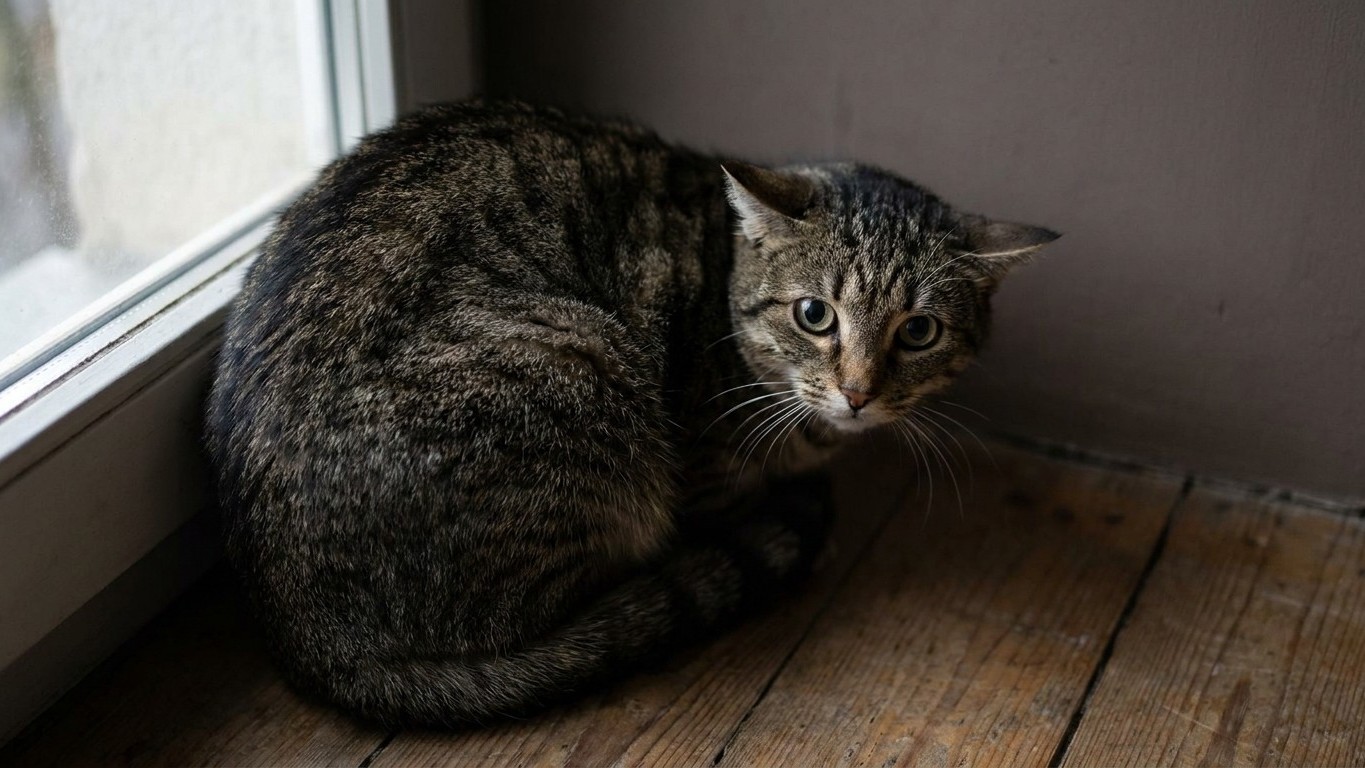
A purring cat curled alone in the corner isn’t always a happy cat. Sometimes that soft rumble is a distress signal in disguise, a self-soothing mechanism cats reach for when they’re frightened, in pain, or physically unwell. Vets have known this for years, yet the myth that purring equals pure bliss persists in almost every household in Britain.
My own cat taught me this the hard way. He’d tucked himself away from the family, away from his favourite radiator spot, and was purring steadily. I assumed contentment. A vet later explained that context matters far more than the sound itself, and that a cat hiding while purring is often anything but relaxed.
Key takeaways
- A vet revealed why a cat purring in isolation might be sending an emergency distress signal, not expressing contentment
- Cat purr frequencies match the exact healing vibrations used in human medical treatments for bone fractures and pain
- The real warning signs aren’t the purr itself—they’re the behavioral changes and body language that accompany it
Why a lone, purring cat can be a warning sign
Cats purr for reasons that go well beyond happiness. Purring can signal contentment, stress, a desire for attention, or even illness, depending on the situation and your cat’s body language. The trick, according to the UK’s own Cats Protection charity, is reading the whole picture rather than the noise alone. If your cat is purring while their ears are flat or turned to the side, their eyes are wide open with wide pupils, and their whiskers are pointing forwards or down, it’s likely that they are stressed.
Pitch offers another clue. Vets note that when cats are purring out of happiness, the purr tends to be lower pitched, while a stressed-out cat might have a higher-pitched purr. A cat hiding in a corner, away from its usual sunny spot or its people, purring at an unusually sharp pitch, is telling a very different story from the one we’re used to hearing on the sofa.
Pain is the other piece of the puzzle. Veterinary guidance is blunt about this: purring can be a sign that your cat is in pain, and if they are purring a lot more than usual or in different situations than they normally would, this could be a sign that something is wrong. American veterinary bodies describe the same pattern. Research shows that this vocal vibration can also support healing, help kittens communicate with their mother, reduce stress, and even act as a self-soothing behavior during pain or fear. A cat curled up alone, refusing company, purring away, may simply be trying to cope.
The remarkable science behind the “healing purr”
Here’s where things get genuinely fascinating. Researchers at North Carolina’s Fauna Communications Research Institute measured feline purrs across species and found something startling: every felid in the study generated strong frequencies between 25 and 150 Hz, and purr frequencies correspond to vibrational/electrical frequencies used in treatment for bone growth/fractures, pain, edema, muscle growth/strain, joint flexibility, dyspnea, and wounds.
Put another way, the frequency your cat’s throat produces sits in almost exactly the same range that human medicine uses for vibration therapy on fractures. Lower frequencies, in the 25-50 Hz range, are thought to be most effective for promoting bone healing and tissue regeneration, while higher frequencies, up to 150 Hz, might be more related to pain relief and relaxation. That’s an extraordinary coincidence, or perhaps not a coincidence at all: some scientists suspect cats evolved a built-in physiotherapy tool.
Cats Protection’s own research team backs this up, noting that the low frequency vibrations of a cat’s purr are suspected to promote bone and tissue growth and lessen pain and swelling. It might even explain an old vet school observation from the 1950s: broken bones in cats have historically been noted to heal markedly faster than equivalent injuries in dogs, a detail some researchers link directly to the purr’s unique frequency profile.
What to actually watch for at home
None of this means every purr is cause for panic. Most of the time, a cat sprawled in a sunbeam purring away really is just content. The distinction lies in the setting and the accompanying signals. Ask yourself a few practical questions before assuming all is well:
- Has your cat withdrawn from spots or people it normally seeks out?
- Is the purr paired with flattened ears, dilated pupils, or a tucked-in body?
- Has appetite, litter tray use, or general activity changed alongside the purring?
Breathing matters too. Normal breathing for a feline is up to 30 breaths per minute with very subtle, barely noticeable chest movements; if your cat is in pain or has a heart or respiratory issue, they could experience taking more than 30 breaths per minute, breathing with an open mouth or with a lot of effort. Combine laboured breathing with a hiding, purring cat and you’re looking at an emergency, not a nap.
The general rule vets give owners is refreshingly simple: if your cat used to purr and has suddenly stopped, or if they don’t normally purr and have suddenly started, this could show that they are unhappy or unwell, and a check-up is the sensible next step. Any sudden change in behaviour alongside the purring, rather than the purring itself, is the real red flag.
What struck me most after that conversation with the vet wasn’t the diagnosis itself, but how ordinary the whole scenario had looked. No yowling, no obvious limp, just a quiet cat making the sound I’d spent years associating with joy. It’s a humbling reminder that the animals sharing our homes have communication systems that don’t map neatly onto ours, and that the most reassuring sound in the house can occasionally be the loudest cry for help going unheard.