
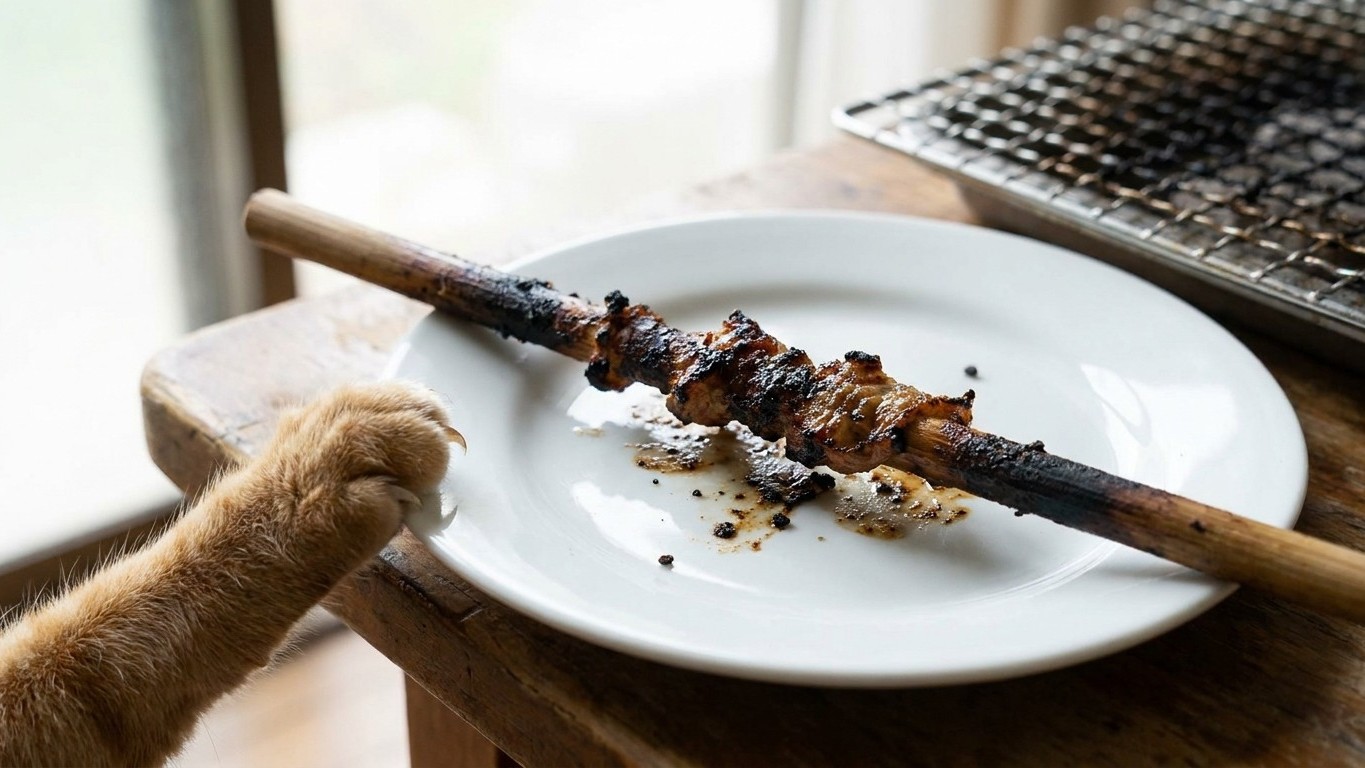
Cats can smell a chargrilled lamb kebab from two gardens away, and that greasy bamboo stick you left cooling by the barbecue is, to feline senses, basically a lollipop marinated in everything they love: fat, blood and charred protein. The wood soaks up meat juices like a sponge, and once a cat’s rough tongue and needle-sharp teeth get hold of it, the skewer rarely survives intact. What follows can turn a sunny garden afternoon into an emergency dash to the vet.
Key takeaways
- Cats’ sense of smell is 14 times stronger than ours—a used skewer marinated in meat fat is basically irresistible
- Swallowed skewers splinter into jagged fragments that can puncture the throat, stomach and intestines
- String attached to skewers creates a ‘linear foreign body’ emergency where intestines bunch and tear—one of the most time-sensitive cat surgeries
Why a used skewer is basically catnip for carnivores
Cats are obligate carnivores with a sense of smell roughly fourteen times stronger than ours, so a stick that’s been sitting in chicken fat and barbecue marinade is an irresistible signal. Add their natural stalk-and-pounce instinct and you’ve got a recipe for trouble: cats often end up eating things they should not eat because of their stalking and hunting behaviour, chasing and pouncing on fast-moving objects and then eating them as they would their prey. A discarded skewer doesn’t move, granted, but the smell alone is often enough to trigger the same chewing, licking, gnawing sequence a cat would use on a genuine catch.
Vets who deal with garden-party casualties every summer point out that skewers aren’t the only culprit at a barbecue. Inedible objects attached to flavourful foods, such as skewers, string and foil, can become tempting morsels for consumption. That’s the double trap with kebab sticks in particular: it’s not just the wood itself, but often a loop of butcher’s string or a metal skewer that came with it, both of which carry their own separate dangers once swallowed.
What actually happens once it’s swallowed
A splintered bamboo skewer is not soft. The pointed ends are exactly the shape most likely to catch, snag or puncture as they travel down. Wood that’s been chewed rarely stays as one neat stick either; it tends to shatter into jagged fragments with edges sharp enough to injure the mouth, throat or gut lining on the way through. Emergency vets treating pets who’ve eaten barbecue skewers explain that wooden skewers are typically very sharp, and if ingested can puncture or tear through the delicate tissues of the mouth, throat and digestive tract, and if the skewer doesn’t pass through properly it can get lodged, causing an obstruction in the stomach or intestines. One veterinary surgeon who has operated on animals after skewer incidents described a genuinely unsettling pattern: skewers can punch a hole through the wall of the oesophagus, stomach or small intestine and then migrate throughout the body, with fragments removed from various locations in the chest and abdomen, though many pets do survive once these miniature migrating “arrows” are located and removed.
If there’s string involved, the risk shifts into a different, more dangerous category. Vets call this a linear foreign body, and it’s one of the classic feline emergencies. A feline linear foreign body is one of the most time-sensitive gastrointestinal emergencies seen in cats, and if one end of a long thin object like string becomes anchored, commonly at the base of the tongue, the intestines can climb the material, bunching and folding while the foreign body repeatedly saws along the intestinal wall. That sawing action is genuinely as grim as it sounds: in severe situations the linear object can begin to cut into the intestinal tract due to a sawing motion, causing perforations with intestinal contents leaking into the abdomen. If you ever spot a thread or string trailing from your cat’s mouth or bottom, resist the urge to pull. Anchored linear material can damage the intestines if traction is applied, so the string needs to come out under Veterinary supervision, not with your fingers over the kitchen sink.
Spotting trouble and knowing when to act
The unnerving part of foreign body ingestion is how ordinary the early signs look. A cat that’s swallowed part of a skewer might simply seem a bit off her food, or drool more than usual, before things escalate. Watch for repeated vomiting, retching without producing anything, reduced appetite, lethargy, or a tender, painful belly when picked up. Signs of gastrointestinal blockage include severe vomiting, anorexia, abdominal tenderness, and a lack of stool production, and none of these should be brushed off as “just a funny tummy” if there’s been a barbecue in the last day or two.
Time matters enormously here. An intestinal or stomach obstruction often compromises the blood supply to these vital tissues, and if the blood supply is interrupted for more than a few hours, these tissues may become necrotic, resulting in irreparable damage or shock. If your vet suspects a swallowed skewer or string, expect X-rays first, possibly followed by an ultrasound, since the foreign object may not be visible on X-rays, but linear foreign bodies cause the intestines to bunch in a way that may be observed, sometimes showing a “string-of-pearls” appearance. Depending on where the object has lodged, treatment ranges from a straightforward endoscopic retrieval to full exploratory surgery, and in the case of a linear foreign body, exploratory surgery is commonly required to remove the material, often via multiple enterotomies, and to resect any damaged or perforated bowel. Never try to induce vomiting yourself: a sharp, splintered object can do just as much damage coming back up as it did going down, and only a vet can judge whether that’s safe.
Keeping the garden barbecue cat-safe
The fix is refreshingly simple compared with the surgery it prevents. Skewers, whether bamboo or metal, should go straight into a lidded bin the moment food comes off them, not left “to cool” on a plate at nose height. Cook meat, fish and vegetables loose on a rack where possible rather than threaded, and if you do use skewers, remove them before serving so nobody’s plate (or paw) ends up near the sharp end. Keep bin bags secured until collection day too, since a warm, meat-scented bag left by the back door is every bit as tempting to a cat as the barbecue itself, and a determined cat will happily rummage for the prize inside. Five minutes of tidying after the last sausage is eaten is a small price for avoiding an emergency vet bill, and your cat’s nine lives really shouldn’t be tested over a stick of wood.
Sources : animalmedicalcenterplainfield.com | medvet.com