
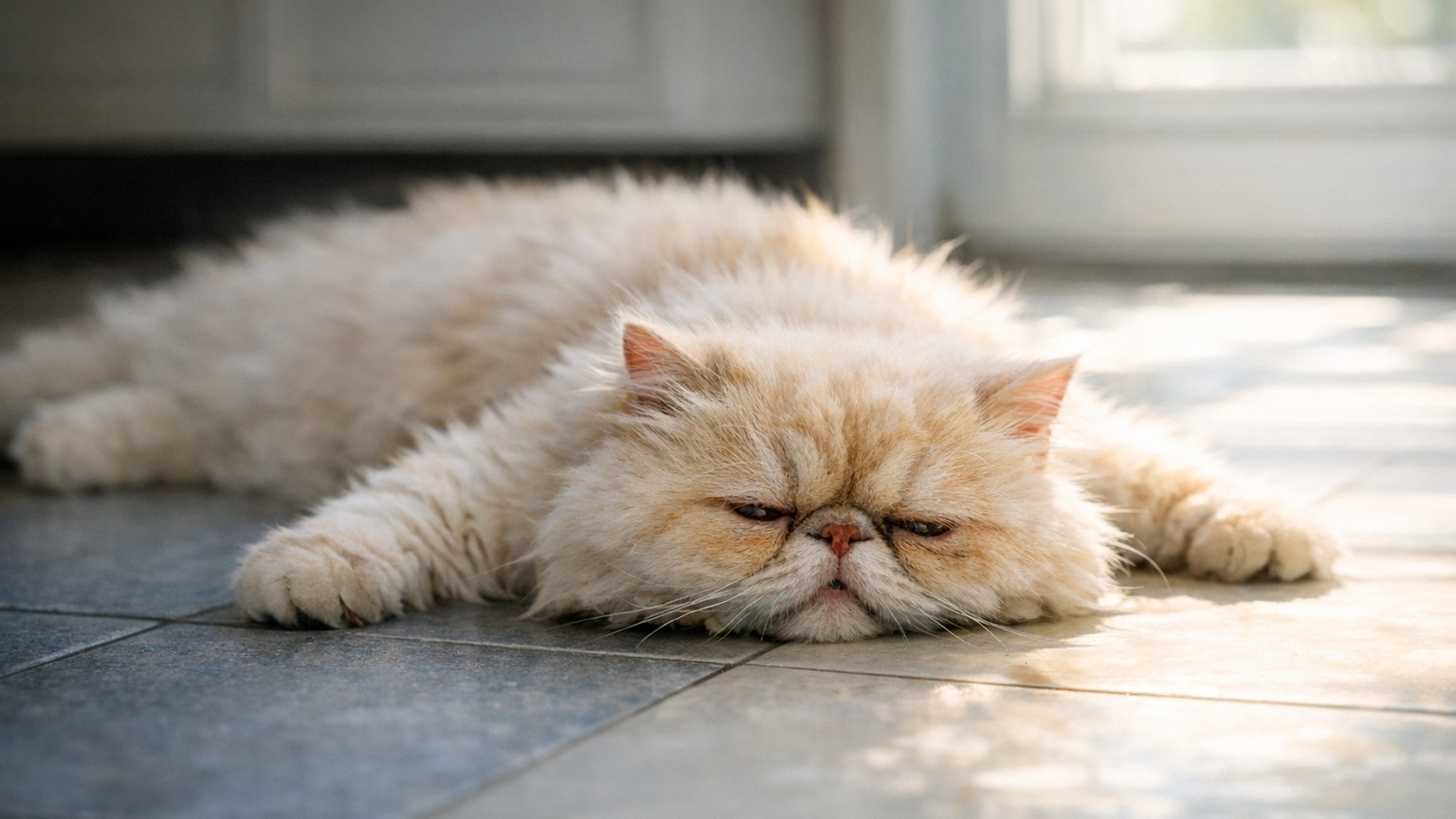
Cats are masters at looking deceptively peaceful. A Persian or Exotic Shorthair sprawled motionless on the kitchen floor on a warm June afternoon can look indistinguishable from a cat simply napping. But for flat-faced breeds, that stillness in summer heat can be the first sign of a life-threatening emergency, and too many owners don’t realise it until it’s too late.
Key takeaways
- Flat-faced breeds have a hidden anatomical vulnerability that makes summer potentially fatal
- Heatstroke can develop in just 20-30 minutes, and early warning signs look identical to normal laziness
- One detail in your cat’s paws could reveal dangerous overheating before it’s too late
Why flat-faced cats are built for the cold, not the British summer
Flat-faced, or brachycephalic, cats include Persians, Himalayans, Exotic Shorthairs, and British Shorthairs, all enormously popular breeds here in the UK. Their smushed, cute faces come with a hidden anatomical cost. Brachycephalic Airway Syndrome (BAS) arises from a set of structural issues: narrowed nostrils, an elongated soft palate, a narrow trachea, and possibly abnormal laryngeal saccules. The result is an airway that simply cannot move air efficiently.
This becomes genuinely dangerous in warm weather. Cats get rid of significant amounts of body heat through their nose as they breathe out. Flat-faced cats, such as Persians, struggle to release heat this way because they have much less space inside their nose, putting them at much higher risk of heatstroke, even on seemingly cool days. So while your British Shorthair looks serenely chilled out on the tiles, their body may be quietly struggling to regulate its temperature in a room that would seem perfectly comfortable to you.
What makes heatstroke particularly dangerous in cats is how quickly it can progress. The condition can develop within just 20 to 30 minutes of heat exposure, leaving a narrow window for intervention. That’s not much time if you’ve just popped out for a few hours on a warm afternoon.
The signs that look like laziness but aren’t
Here’s the cruel irony of feline heatstroke: its early warning signs are easy to dismiss. Cats can be very good at hiding health problems. A cat lying very still on a hot day is not necessarily enjoying the warmth. A cat suffering from advanced heatstroke will become lethargic and weak, and may lie down and refuse to move, indicating that their body is starting to shut down.
While many signs of heatstroke are similar to what you’d see in dogs, cats have a couple of their own tell-tale early warnings. You might observe your cat grooming themselves much more frequently than normal, as this is one of their instinctive ways to try and reduce body heat. Another early sign specific to cats is if they seem to be producing less urine. In addition, panting is significant because cats don’t typically breathe with their mouths open.
Beyond these subtler cues, the warning signs escalate fast. Your cat may seem restless, seek cool surfaces, or breathe faster than usual. More concerning signs include panting, drooling, bright red gums, vomiting, diarrhoea, weakness, wobbliness, and acting confused. Severe heatstroke can cause collapse, seizures, pinpoint bleeding, trouble standing, or unconsciousness. Check those gums: by gently lifting their lip, bright red gums indicate their body is overheating, while pale gums suggest poor blood circulation, both severe signs of heatstroke.
One detail owners often miss is the paws. Cats sweat through glands in their paws, if you’re noticing more than normal “wet” paw prints, your cat may be hotter than you think and dehydrated. It’s not glamorous diagnostic advice, but it could save a life.
What to do, and what not to do
Heatstroke occurs when a cat’s body temperature surpasses 104°F (40°C). To treat heatstroke, it’s important to start brief cooling at home, but take your cat directly to a veterinarian for emergency care. That second part matters. Far too many owners cool their cat down, see them perk up slightly, and assume the crisis has passed. It hasn’t.
The first-aid steps are straightforward but require precision. Move your cat immediately from the heat into a cool, shaded area or an air-conditioned location. Using cool or tepid water, thoroughly and continuously wet their fur. Do not use ice or cold water, as this can make the situation worse. The logic here is physiological: rapid overcooling causes the blood vessels near the skin to constrict sharply, which can actually trap heat inside the body and worsen the situation. Applying cool damp towels and water to the ears and paws is a sound approach, but heading directly to a veterinarian for emergency care is non-negotiable.
At the practice, the veterinary team will immediately take blood samples and start pulse oximetry to check oxygen saturation in the blood, as well as an ECG to monitor the heart. In most cases, supplementary oxygen will be needed, and lab tests are used to check for kidney and liver injury. The inflammation caused by heatstroke sets off reactions that affect every major system of the body, causing the breakdown of essential proteins and enzymes, putting the cat at risk of organ failure and potentially death. This is not a condition that resolves itself overnight.
Protecting your flat-faced cat this summer
Flat-faced cats may need air conditioning even in moderately warm weather. Consider limiting their activity during warm periods and ensuring they always have access to cool resting areas. In a British home during a June heatwave, no air con, sun beating through south-facing windows, that’s a real challenge, but it’s one worth planning for.
Water access is non-negotiable. Ensure your cat always has easy access to plenty of fresh, cool water, with extra bowls placed around the home. To help keep the water cool, use refrigerated water or place an ice cube in the bowl each time you change it. A cat who isn’t drinking enough is already behind in the battle against heat.
The conservatory, the greenhouse, the garden shed: all classic British summer hazards. Most cases of heatstroke in cats develop after being accidentally shut in a hot place such as a shed, greenhouse, conservatory, garage, or car. Before you head to work on a warm morning, do a quick sweep. A Persian locked in a conservatory at 9am will be in serious trouble before lunchtime.
One thing worth knowing for owners of very flat-faced breeds: the anatomical abnormalities of brachycephalic airway syndrome mean these cats cannot move air as effectively, significantly impairing their ability to thermoregulate, and that structural problem doesn’t go away with the seasons. If you’ve ever been told your Persian’s breathing sounds normal “for the breed,” that noisy snuffling actually deserves a vet conversation in its own right. Cats who already struggle to breathe have almost no margin left when the temperature climbs. The sweet sound of summer is not quite so sweet when you understand What It Really Means for your flat-faced companion.
Sources : askavet.com | pvecvets.com