
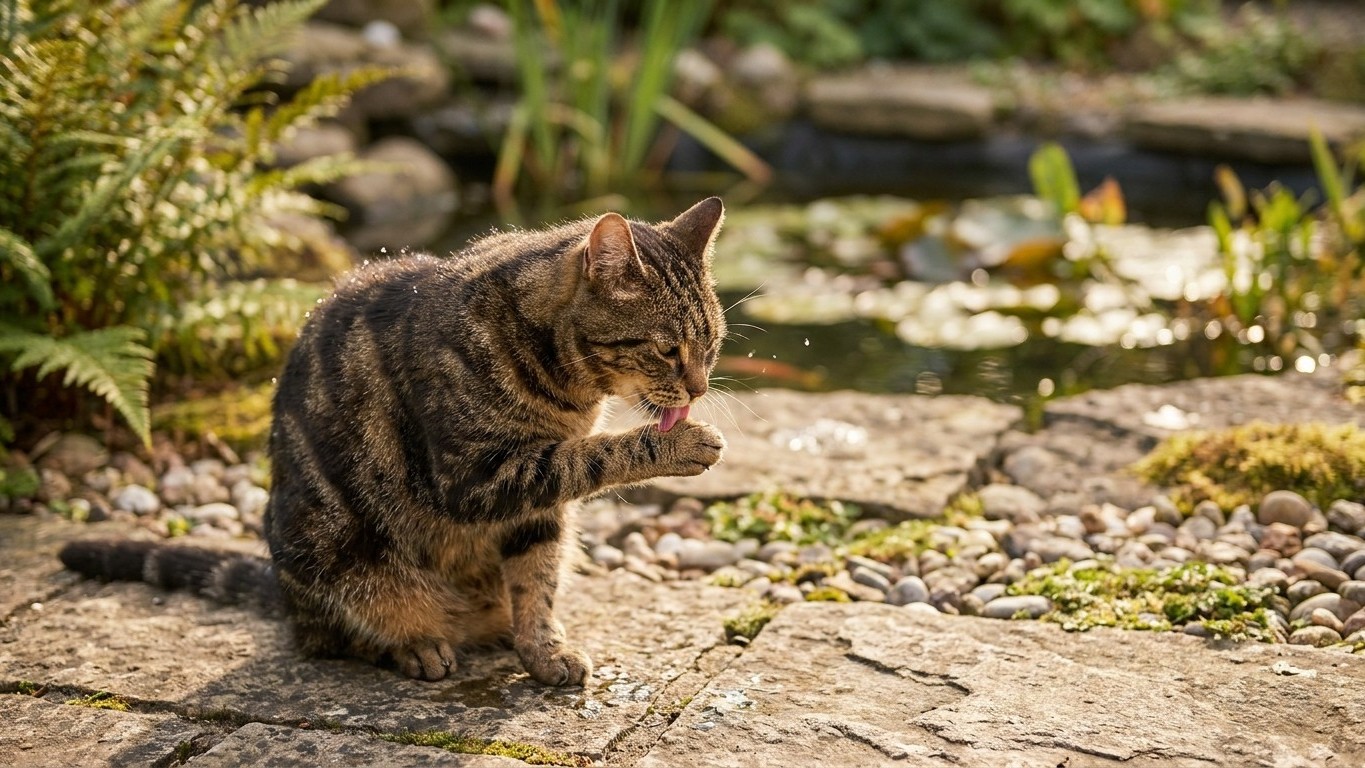
That fastidious little tongue bath your cat gives its paws after a stroll round the garden pond isn’t simply about looking presentable. Vets say the gesture often has nothing to do with cleanliness at all, and everything to do with what the cat’s whiskers, nose and paw pads picked up on that walk, whether that’s an invisible parasite, a stress trigger, or a scent it’s desperate to wash away.
Key takeaways
- Pond water harbors invisible threats like giardia cysts that transfer directly to cats through grooming
- Cats may lick their paws obsessively not to clean, but to self-soothe after sensing unfamiliar pond environments
- Certain licking patterns signal serious issues—when does grooming become a red flag worth a vet visit?
What’s actually clinging to those paws
Pond water rarely looks dangerous, which is precisely the problem. Giardia cysts can survive for weeks in cold water, making even seemingly clean ponds potential hazards. A cat doesn’t need to drink from the water to pick up a parasite load; simply paddling through shallow mud at the edge, then grooming afterwards, can be enough to transfer cysts from paw to mouth. That single lick your cat gives after a pond walk might be the exact moment an unwelcome hitchhiker gets swallowed.
Then there’s the algae question, which sounds dramatic because it can be. Blue-green algae poisoning occurs when a cat is exposed to toxic cyanobacteria, and once absorbed, the toxins can affect the liver, nervous system, kidneys and sometimes their skin or mouth. The reassuring bit: cats are susceptible to poisoning, but their risk of exposure is lower because they rarely swim and are picky about the water they drink. Even so, the risk may be higher in cats that roam outdoors near ponds, lakes, canals or reservoirs, or walk through shallow or muddy water during warm weather. Worth remembering too that not all toxic water looks obviously contaminated, so a pond that looks pristine to your eye may not be pristine to your cat’s paws.
Why licking might be self-soothing, not scrubbing
Cats are formidable groomers by nature. Cats typically spend between 30 and 50 percent of their day grooming themselves, according to Dr Pamela Perry of Cornell University’s Animal Behavior Clinic. But the mechanics matter here: paw licking is one way that cats clean themselves, distributing saliva all over their body to help with grooming. That paw isn’t just being washed, it’s being turned into a flannel for the whole face and ears.
What changes near a pond is the sensory load. Unfamiliar smells (algae, waterfowl, other animals’ scent trails), the sensation of damp fur, and the general vulnerability of standing near open water can all register as mild stress to a cat, even one that seemed perfectly happy paddling about moments earlier. Licking and grooming in general releases endorphins, the body’s feel-good hormone, making it a calming activity, according to the Cummings School of Veterinary Medicine at Tufts University. So that vigorous paw-licking session on the patio afterwards may be your cat processing a slightly unsettling outing, not simply drying off.
There’s a scent-communication layer too, one most owners never think about. As cats move about, the scent glands on their feet leave pheromone deposits, identification stamps, and after picking up a wash of foreign pond smells across those same pads, a thorough lick-clean restores the cat’s own familiar scent signature. I find this the loveliest bit of feline biology: your cat isn’t just tidying up, it’s quite literally re-establishing its own identity on its paws after the pond overwrote it with someone else’s smell.
When the licking stops being routine and starts being a message
A single grooming session after a walk is nothing to fret over. The concern starts when the behaviour becomes fixated, repetitive, or focused on one paw only. Vets flag several red flags worth watching for:
- Redness, swelling or hair loss on the paw, which can point to allergies, a skin infection or an injury such as a splinter or thorn
- Licking one specific paw obsessively while ignoring the other three, often a sign of localised pain
- Licking that continues for days, spreads to the belly or legs, or leaves the fur constantly damp
Compulsive paw licking from anxiety is well-documented in cats and can progress to fur loss known as psychogenic alopecia, with triggers including a new pet, a move, schedule changes, or an unfamiliar smell. A pond walk that coincided with, say, a heron scare or an encounter with next door’s tomcat could easily tip a slightly anxious cat into this pattern, with the paw licking becoming the outlet rather than the cause. As one clinic puts it plainly, most cats overgroom simply because they itch, not because they’re “mentally unwell.”
What to actually do about it
Don’t scold the behaviour, whatever you do. Telling a cat off, spraying water, or grabbing them can increase your cat’s anxiety and make overgrooming worse. Instead, give the paws a quick once-over yourself after any pond adventure, checking pads and between the toes for grit, redness or anything embedded. If you own the pond, keeping algae in check and skimming stagnant scum reduces exposure risk considerably, and providing fresh water elsewhere in the garden makes pond water far less tempting to sip. Should the licking become fixated, bloody, or paired with lethargy, vomiting or diarrhoea, that’s the moment to ring your vet rather than wait it out, since monitoring for signs of illness such as lethargy or gastrointestinal issues and consulting a veterinarian immediately if symptoms appear is genuinely the safest approach with anything pond-related.
One detail I find genuinely fascinating: cats process scent through a second organ entirely, tucked into the roof of the mouth. Cats have 200 million scent receptors, as opposed to our 5 million, and a special scent analyser called the Jacobson’s organ or vomeronasal organ, located in the roof of the mouth. So next time your cat pauses mid-lick with that odd, slightly gormless open-mouthed grimace after a pond outing, it isn’t confusion. It’s actively reading a scent report you’ll never be able to smell yourself.
Sources : quora.com | bowwowinsurance.com.au