
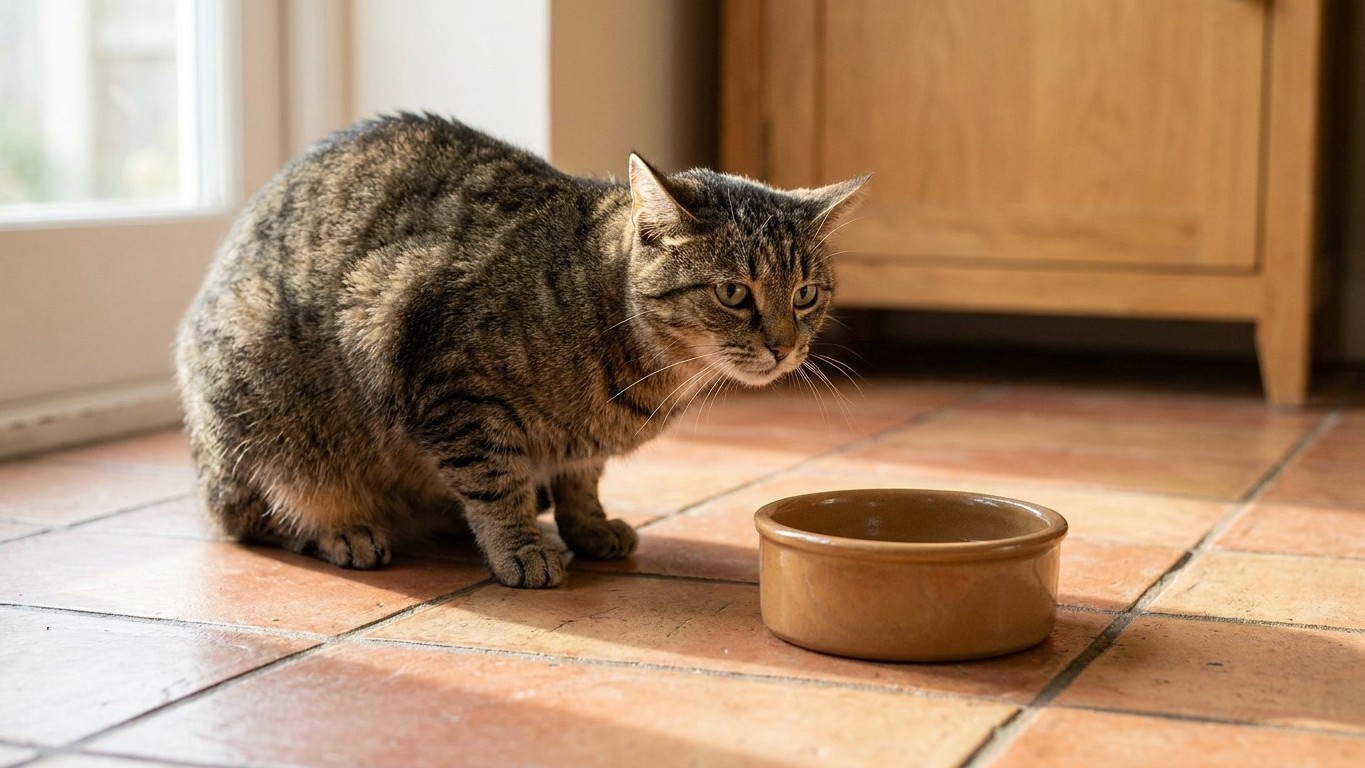
Three weeks is a long time for any cat to boycott her own dinner. But if this is happening after a cucumber ambush filmed for a laugh, the behaviour makes more sense than you might think. Cats don’t process practical jokes the way we do. What felt like thirty seconds of viral content to you registered, in her nervous system, as a genuine predator event.
The mealtime location Matters More Than the vegetable itself. According to Cornell Feline Health Center behaviourist Dr Pamela Perry, the cats in the videos may be reacting to the sudden appearance of a novel object, and personality plays a huge role in how badly that reaction lingers. “Cats have different personalities,” Perry explained. “It might be the fearful ones who are most likely to react to the appearance of a strange object behind them that was not there a minute earlier.” If your cat already leans towards the anxious end of the spectrum, a cucumber ambush during her most vulnerable moment (eating, with her back turned) can leave a mark that outlasts the clip’s watch time by weeks.
Key takeaways
- A single cucumber ambush can trigger weeks of bowl avoidance through a cat’s deep predator-avoidance instinct
- Experts reveal the neurological reason cats process jump scares as life-or-death threats, not jokes
- Chronic stress from this prank can cause physical health issues beyond just refusing meals
Why the Jump Scare Cuts So Deep
Cats eat with their guard partially down, which is precisely why the prank works so well for the camera and so badly for the cat. Veterinary behaviourist Wailani Sung notes that if a cucumber shows up out of nowhere while a cat is eating or relaxing, their instinct is to react first and investigate later. That’s not comic timing. That’s a startle reflex built over millions of years of avoiding things that could kill them.
The snake theory gets thrown around a lot, and it’s genuinely divided among experts. Some experts theorize that cats associate the shape of a cucumber with a resemblance of snakes; however, not all agree with this theory, as Dr. Pamela Perry points out that cats sometimes hunt snakes themselves. Animal behaviourist Con Slobodchikoff sits on the other side of that fence, arguing that cats are genetically hard-wired through instinct to avoid snakes, and cucumbers look enough like a snake to have the cat’s instinctive fear of snakes kick in. The truth is probably a bit of both theories tangled together, plus a healthy dose of “something appeared where nothing was five seconds ago.”
What almost everyone agrees on is that the bowl itself becomes collateral damage. A vet quoted by AOL puts it bluntly: “The cats begin to eat, a person sneakily lays a dark, oddly shaped object behind him, then the cat turns around and gets scared… While I get that the over-reaction of the cats is quite humorous, they are actually terrified.” Terror plus food bowl equals a location your cat now files under “danger zone,” not “dinner time.”
When a Fright Turns Into a Habit
Three weeks of bowl avoidance isn’t dramatic overreaction on her part, it’s a textbook stress response that’s had time to calcify into a routine. Vets at PangoVet warn that this seemingly innocent prank can cause prolonged stress for the cat, and it may take a good few hours for their heart rate to come down, with mealtimes or naptimes becoming an event filled with anxiety that’s difficult to overcome. A few hours can easily snowball into weeks if the cat keeps re-triggering herself every time she approaches that same spot.
There’s also a relationship cost that’s easy to underestimate. Cornell’s Dr Perry cautions that with consistent teasing, a cat will associate fear with the human playing the prank, not just the cucumber. Reader’s Digest spoke to veterinary behaviourist Dr Wailani Sung, who was refreshingly blunt about the ethics of it: “People seem to think it is funny to scare their cats, which I find kind of mean and insensitive. Traumatic events can cause or escalate a pet’s level of anxiety,” says Dr Sung. A single trauma won’t necessarily rewrite a confident cat’s personality, but a nervy one can genuinely start eyeing you, not just the vegetable drawer, with suspicion.
Physically, chronic stress in cats isn’t just an emotional inconvenience either. Hill’s Pet points out that cats that experience chronic stress can have medical issues associated with stress including urinary, GI, and grooming conditions. That’s why appetite refusal lasting this long genuinely deserves attention rather than a shrug and a “she’ll come round eventually.”
Coaxing Her Back to the Bowl
The fix isn’t complicated, but it does require patience and zero repeat performances. Start by moving the bowl to a completely different spot, ideally somewhere with a wall behind it so nothing can “sneak up” again. Pair feeding time with something she already loves, whether that’s a favourite toy nearby or you sitting calmly a little distance away rather than hovering.
Gradual desensitisation genuinely works, according to the vets at PangoVet, who suggest owners introduce a cucumber slowly and calmly to them when they are paying attention, to avoid them getting startled, and repeat the process over several days until they become used to it. The same principle applies to the bowl itself: short, calm, low-pressure exposures, repeated daily, rather than one big coaxing session.
A few practical steps that tend to help a spooked cat regain her confidence:
- Feed smaller portions more frequently in a new location, so each approach carries lower stakes
- Keep the room quiet during meals, no sudden movements or loud noises nearby
- Let her choose when to approach rather than carrying her to the bowl
- Reward calm behaviour near food with a gentle voice, not fuss or forced petting
If three weeks stretches into a fourth with no improvement, or if she’s losing noticeable weight, it’s genuinely time to ring your vet rather than keep troubleshooting solo. Persistent appetite loss can mask other issues entirely unrelated to the prank, and a vet or qualified behaviourist can rule those out while helping rebuild her trust. One quietly reassuring fact worth holding onto: cats are creatures of routine far more than grudge-holders, so a bowl she trusted for years rarely stays “cursed” forever once the fear response has somewhere calmer to land.
Sources : purrnando.com | info.pangovet.com