
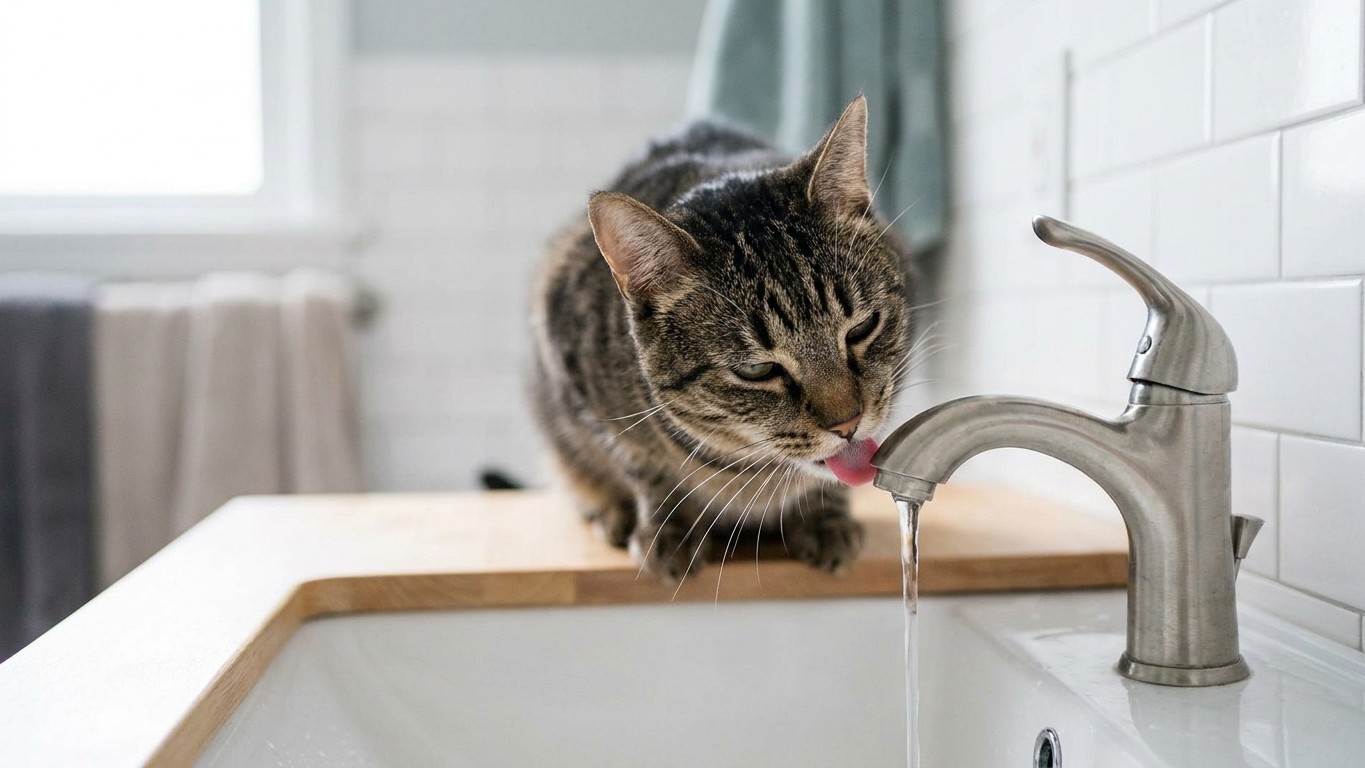
My cat Miso spent months leading me on a morning ritual I didn’t fully understand. Every day, the bowl was full. Every day, she ignored it. Then she’d follow me to the bathroom, plant herself by the sink, and wait. The moment the tap ran, she’d drink. Enthusiastically. The bowl, meanwhile, sat untouched. I thought she was just being dramatic. Turns out, she was being a cat, and the reasons behind it are rooted in thousands of years of feline evolution.
Key takeaways
- Your cat’s ancestors drank from moving streams, not stagnant pools—and that ancient instinct is still hardwired into her brain
- Whisker fatigue, poor visibility of still water, and the smell of stale water all play a role in bowl rejection
- Chronic mild dehydration from ignored bowls can contribute to serious health issues like kidney disease and urinary problems over time
Standing water is suspicious, by nature
Even though a domestic cat lives a comfortable indoor life, her ancestors were wild animals drinking from rivers and streams, and those old instincts remain intact, telling her that standing water isn’t always safe. Water sitting still in a puddle, or a bowl, is prone to dangerous things growing in it, and wild cats evolved to avoid exactly that. The tap, by contrast, signals movement, and movement signals safety. Your cat isn’t being contrary. She’s running an ancient risk assessment every single morning.
Cats have great night vision, but their ability to see standing water in a bowl is actually poor. Rather than relying on sight, they prefer to use their excellent hearing to sense the familiar sound of running water. This explains why so many cats will sit bolt upright the second they hear a tap turn on in the next room. The sound itself is a cue. A quiet bowl in the corner, on the other hand, essentially disappears from their awareness after the novelty wears off.
There’s also the matter of smell. Standing water absorbs odours from food, the environment, and even the bowl itself. To a cat’s sensitive nose, that can make the water smell stale or uninviting. Running water stays oxygenated and cooler, which often makes it taste fresher. And then there’s something most owners never consider: cats have really thick saliva since it is also used to clean themselves, and drinking out of the same water over and over can cause the water to have a stale taste or cause a build-up of saliva. That bowl you refilled this morning? To your cat, it may already taste wrong by lunchtime.
Whiskers, bowl size, and where you put the thing
A cat’s whiskers are so sensitive that cats can get easily overstimulated, something called whisker fatigue. This is such a problem for some cats that they won’t drink out of a bowl or fountain where their whiskers might touch the sides. Drinking from a running tap sidesteps this entirely; the cat can position her face however she likes, whiskers safely clear. To avoid whisker fatigue, swapping small, high-sided bowls for wide, shallow ones can make a real difference, and it’s one of the simplest fixes to try before investing in anything fancier.
Many cats also avoid drinking water that’s placed right next to their food bowl. This behaviour likely comes from a survival instinct: African wildcats usually avoid eating their prey near their water source, because the water could become contaminated by the remains of prey. Our domestic cats carry exactly the same natural instinct. So if your setup has the food and water bowls side by side, as most of us were told to arrange them, you may be unknowingly sabotaging your cat’s willingness to drink. Moving the water bowl to a completely separate spot in the house can, for some cats, prompt an immediate change in behaviour.
Bowl position matters beyond proximity to food, too. Domesticated cats are still very much driven by the instinct to protect themselves from potential predators, which is why many like being up high and don’t like exposing their backs. A bowl on the floor can leave them feeling vulnerable, whereas running water from a tap is excellent because they can perch on the counter. It’s a reminder that for cats, the act of drinking is never purely practical, it’s always a small security calculation.
Why hydration actually matters more than you think
Cats naturally have a low thirst drive because their ancestors consumed moisture-rich prey. Modern dry diets can leave cats mildly dehydrated if they don’t drink enough water, which can contribute to urinary tract issues and kidney stress over time. Cats that eat only kibble are likely to be slightly dehydrated for their entire lives, because without a strong thirst drive, cats only drink when they are very thirsty and already slightly dehydrated. That chronic, low-grade shortfall is easy to miss, until it isn’t.
Signs of dehydration include lethargy, weakness, poor appetite, dry mucous membranes, and in more severe cases, eyes that are sunken into their sockets. A simple home check: gently take a small portion of your cat’s skin around their shoulders, pull it up, and let go. If your cat is well-hydrated, the skin will snap back into place quickly. If it falls back slowly, your cat could be dehydrated. If the skin remains up in a tent position, it can be a sign of severe dehydration and you should seek veterinary care straight away. Always consult your vet if you’re concerned, dehydration in cats can be a symptom of underlying conditions including kidney disease, diabetes, or hyperthyroidism, and a professional assessment is the only way to rule these out.
What to actually do about it
Running water signals that the water is fresh and safe, especially compared to still water that’s been sitting in a bowl all day. Running water can also encourage cats to drink more. A cat water fountain replicates that appeal without you needing to leave the tap running all morning. Some cats increase their water intake when provided with water fountains, though individual preferences among cats for these vary. If your cat turns her nose up at the fountain you spent £40 on, you are not alone, and the solution might be as simple as trying a different style, a quieter motor, or a different bowl material.
While the movement of water from the tap can be appealing, some cats may actually avoid drinking tap water due to its taste or smell, as tap water often contains chemicals like chlorine, which cats are highly sensitive to. Filtered water in the fountain can resolve this neatly. Wet cat food contains approximately 70 to 80 per cent water, meaning cats eating wet food daily are getting some of their necessary hydration from their meals. Cats who eat only dry food miss out on this extra water intake and will need to drink considerably more to compensate. Mixing a little water into wet food, or adding a splash of plain, low-sodium chicken broth, can quietly top up intake without any drama from your cat.
One thing worth knowing: International Cat Care recommends placing a cat’s water bowl in a low-traffic, quiet spot, and not next to the litter box, or their regular food bowl. Multiple bowls in different rooms also helps, as it turns hydration into a passive habit rather than a deliberate journey your cat has to make. Vets recommend cleaning the water bowl every day or two using hot water and dish soap, and some sources suggest filling the bowl right to the brim, since cats often find it easier to drink without craning their necks into a deep vessel. Small adjustments, significant results.
There’s one more quirk worth knowing about cats and water vision: because a cat’s eyes are set for tracking movement, the surface of a full, still bowl can be genuinely difficult for them to judge. Many cats will dip a paw in before drinking, not to test the temperature, but to create ripples that help them see where the water actually starts. If you’ve ever watched your cat do this and wondered what on earth they were thinking, now you know. They were solving an optical puzzle.
Sources : quora.com | astibine.com