
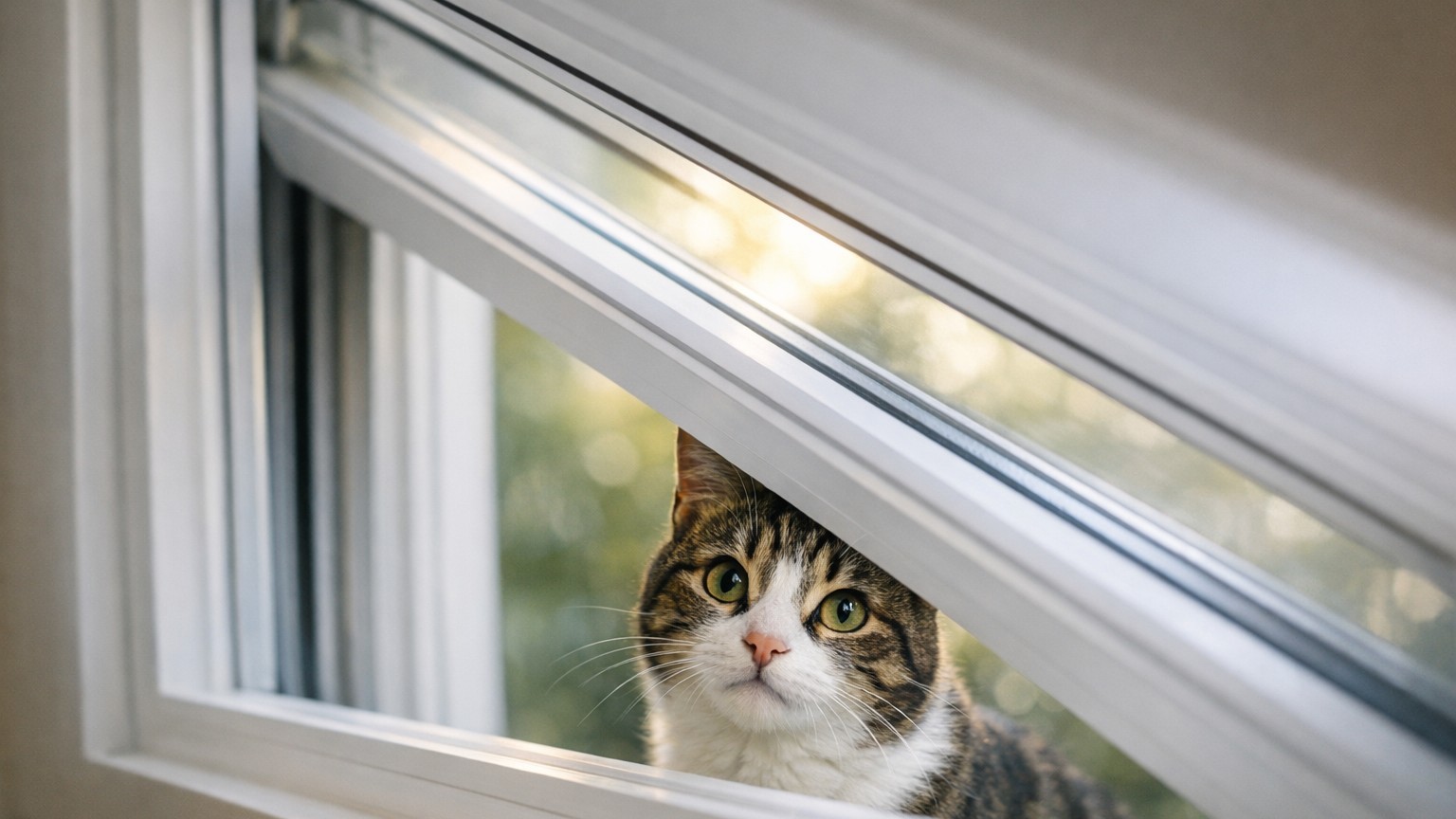
Tilted windows are one of the most common causes of serious injury in indoor cats during summer, and most owners have absolutely no idea. The window is open only a crack, the cat is pottering about the flat, and everything seems fine. Then you come home to an animal that has been wedged in the frame for hours, with a broken pelvis, paralysed hind legs, or worse. Vets across the UK and Europe see these cases with grim regularity. This is not a freak accident. It is a predictable one.
Key takeaways
- A gap that seems impossibly small can trap a cat’s body in a way they cannot escape
- The compression can cut off blood supply to vital organs and trigger a secondary crisis hours later
- Veterinarians treat dozens of these cases every year, with some resulting in permanent paralysis or death
The trap that looks like fresh air
Tilt windows (sometimes called hopper windows), which open inward from the top, create a narrow gap that looks harmless but can become a deadly trap for cats. The physics of it are almost cruelly simple. In most cases, cats manage to squeeze their head and upper body through the gap but then become stuck with their hindquarters in the slanted opening. A cat’s skeleton is wonderfully flexible, built to compress and contort, but that same flexibility is what gets them into trouble. Once wedged in a tilt window, their positioning makes it impossible to back out safely.
What happens next is where things turn genuinely dangerous. When cats realise they are stuck, they panic. Their strong instinct for self-preservation makes them try to free themselves by every means available. Unfortunately, this makes things worse: by wriggling, they slide deeper and deeper into the gap and become entirely dependent on someone finding them. This condition has a clinical name in veterinary literature: it has been referred to as “Kippfenster-Syndrom” in the German literature, or “bottom-hung window trauma” in research publications.
Every summer, Blue Cross sees a shocking number of cats and kittens being brought in with serious and sometimes fatal injuries after falling from open windows and balconies. Research has found that statistically, June, July and August are the most dangerous months. The timing is no coincidence: that is exactly when owners throw open their windows for ventilation and assume a small tilt is a safe compromise.
What actually happens inside the body
The trauma occurs when cats become trapped, often around the thoracolumbar area, leading to varying degrees of reduced blood flow that can affect the spinal cord, muscles, nerves and kidneys, depending on the severity of the entrapment. The longer a cat remains stuck, the more severe the consequences. The abdominal aorta, the main artery located below the spine, is often compressed so severely that it causes circulatory failure in the parts of the body beyond it.
Then comes a second, less obvious danger. If the vessels suddenly become unblocked when the cat is freed, toxins and blood clots can flood the entire circulatory system. This is known as reperfusion syndrome. A cat that appears to recover when you pull them free may still be in life-threatening danger an hour later. Even if there are no visible injuries, a vet check is non-negotiable after this kind of entrapment. Internal injuries can lead to a life-threatening situation even hours or days after the accident.
Owners should be aware that sudden respiratory distress is one of the main causes of death with bottom-hung window trauma. In one published study of 71 cats, the majority of those that died presented with sudden respiratory distress. The injuries that survive the immediate crisis include paralysis and damage to the spine or hind legs severe enough to require amputation. These are not edge cases. Every year, the University Clinic for Small Animals at Vetmeduni Vienna treats around 70 to 80 cats suffering bone fractures or internal injuries after window accidents.
If you find your cat stuck: what to do right now
Speed matters enormously, but so does how you approach the rescue. A panicked cat in pain will scratch and bite, so protect yourself first. Reach under your cat with one hand to pull them out gently, holding them firmly from above with the other hand to prevent further injury in the panic. Talk to them in a calm voice and offer reassurance while you work. Do not yank. Do not try to push them back through the gap from the outside without first widening the window opening to release the pressure.
Once they are out, go to a vet immediately, even if your cat walks away and seems perfectly normal. Monitor for signs of pain, difficulty walking, or breathing problems in the hours and days that follow. Common warning signs include panting, low body temperature, bleeding from the mouth, broken teeth, or any swelling around the body. Your vet will want to perform a thorough examination, and an X-ray should always be carried out on cats that have been trapped in a tilting window, to identify or rule out internal injuries or broken bones.
Protecting your cat without sweltering through summer
The good news is that you do not have to choose between your cat’s safety and a bearable temperature indoors. The solutions are practical and, for the most part, cheap. Blue Cross advises fitting tip and tilt windows that allow air in without offering access outside to curious cats, or using netting or a screen across windows when they are open. Dedicated cat-safe window screens, sold by several UK suppliers, fit onto the frame and allow ventilation without any gap that a cat could squeeze through. Standard fly screens, sold in DIY shops, are not a safe alternative: basic fly screens are insufficient for cat safety. Cats can easily tear through standard screening materials or push screens out of their frames.
If you use a tilt window, a thick towel wedged firmly into the gap on both sides reduces the narrowest portion, but this is a temporary fix at best, not a substitute for a proper grille or screen. The most reliable approach is simply to keep tilt windows fully closed whenever your cat is in the room unsupervised. Young cats, elderly cats, overweight individuals, and indoor-only cats are at particularly high risk, partly because they tend to be more impulsive or less practised at judging spatial risks. One RSPCA branch reported three cats falling from windows within the space of 24 hours, which tells you something about how predictably this pattern repeats itself across the country each year.
One thing worth knowing: the University of Veterinary Medicine Vienna treats 70 to 80 cats with injuries from falling from windows each year, and that is a single institution in a single city. The real number across the UK is almost certainly far higher, simply because most owners still think the tilted window is the cautious choice. A purpose-built cat safety screen costs less than most vet consultations. That comparison, when you run it, tends to settle the matter quickly.
Sources : ncbi.nlm.nih.gov | pmc.ncbi.nlm.nih.gov