
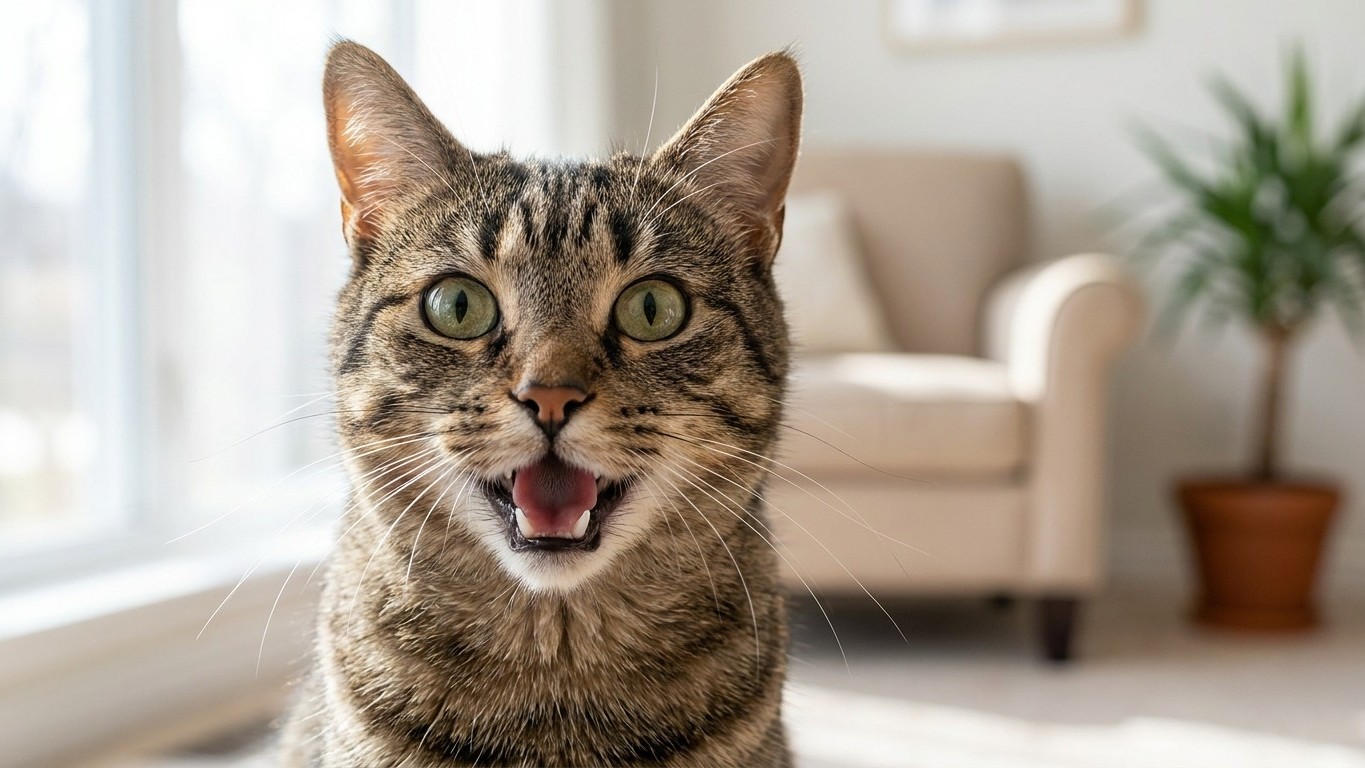
Your cat almost certainly meows at you differently than it meows at your partner, your housemate, or the person who came to fix the boiler. That’s not a hunch, it’s now backed by a growing body of research, and the latest findings from 2025 are rather striking in what they reveal about feline Intelligence and social strategy.
Key takeaways
- Cats meow more than twice as frequently to male caregivers—but the reason might surprise you
- Your cat has learned exactly how responsive you are and adjusts its meowing strategy accordingly
- Adult cats barely meow to each other in the wild—they invented meowing specifically to manipulate humans
The study that changed how we read a cat’s meow
A study published in the journal Ethology revealed that domestic cats meow more frequently when male caregivers walk through the front door. The team, led by Yasemin Salgırlı Demirbaş from Ankara University in Turkey, studied 31 cats in their home environments between 2022 and 2024, with owners using a chest-mounted camera to film the first five minutes after returning home, all cats were at least eight months old and had lived with their owners for six months.
On average, cats produced 4.3 meows in the first 100 seconds of greeting men, compared to just 1.8 with women. That’s more than double. This increased frequency was the same across the board, regardless of the cat’s age, breed, sex, or even the size of the household. Of all the behaviours the researchers tracked, head-rubbing, yawning, tail posture, stretching, meowing stood out as the only behaviour that differed between male and female owners.
The researchers interpreted this difference not as a reflection of any inherent trait in men or women, but as evidence that cats may be responding to subtle patterns of interaction. One leading explanation is that male owners might be less inclined to notice or respond to their cats’ needs immediately upon returning home, prompting the cats to use more frequent vocal cues to get attention. Female owners, by contrast, may tend to engage more quickly or communicatively with their cats, reducing the need for repeated meowing.
Think of it as targeted lobbying. Your cat has quietly clocked how responsive you are, and it adjusts its volume accordingly. As study co-author Kaan Kerman of Bilkent University put it, the findings reveal “cats’ ability to categorize bonded individuals and modulate their responses”, and that “cats are not automata and possess cognitive abilities that enable them to live alongside humans in an adaptive manner.”
A language invented entirely for us
Adult cats rarely meow to one another in natural feline social groups; they readily use vocalizations when interacting with people, a behaviour thought to have developed through domestication. Wild cats communicated primarily through scent and body language. Humans, frankly, are terrible at picking up on either. Cats have learned that we’re not very good at picking up on their subtle signals, which is why cat behaviourists believe they use meowing as a more effective way to communicate with people and have their needs met.
Many cats even develop a repertoire of meows to express different needs and feelings or elicit different responses, your cat might trill at you in greeting, squeak a friendly request to go outside, or demand food with a loud meow. The meow, is not a fixed signal. It is a living, flexible tool, shaped by years of living alongside a specific human.
A separate 2025 study from the Museum für Naturkunde Berlin and the University of Naples Federico II adds another dimension to this picture. The research shows that a domestic cat’s purr reveals far more about its individual identity than its meow, while meows are highly flexible and vary strongly depending on the situation, a cat’s purr remains stable and individually recognisable. The meows of domestic cats showed far greater variability than those of their wild relatives, and researchers suggest that “living with humans — who differ greatly in their routines, expectations, and responses, likely favoured cats that could flexibly adjust their meows,” supporting the idea that meows have evolved into a highly adaptable tool for negotiating life in a human-dominated world.
What your cat actually hears when you talk back
The communication is, it turns out, genuinely two-way, but with some important caveats. Ethologist Charlotte de Mouzon at Université Paris Nanterre explored whether cats could distinguish between cat-directed speech (the higher, softer tone people use when addressing their pets) and regular adult-directed speech used between humans. Ten out of 16 cats showed no response to a stranger’s voice, but then perked up when their owner’s voice was played, suggesting they could distinguish their owner from the stranger. Half the cats also appeared to react when their owner switched to cat-directed speech, hinting that they knew they were intended to be the receiver of the message.
Cats seemed entirely unresponsive to a stranger’s voice, regardless of whether the tone was cat-directed or not, a different outcome to similar experiments with dogs, which can tell when they are specifically being addressed even by a stranger. Your cat, then, has a relationship built on familiarity, not general goodwill towards humanity.
Women tended to give cats more attention, were usually better at assessing cat emotions, and were more likely to mimic cat vocalizations too, and there’s something almost mathematical about the cat’s response to that. If you respond to a chirp, you get fewer anxious meows. If you tend to walk in and head straight for the kettle without so much as a glance at your cat, expect to be loudly reminded of your priorities.
What this means in practice
None of this means cats prefer one person over another in some absolute sense. Cats likely have no inherent preference towards men or women; rather, more meowing towards men is a sign of cats’ social flexibility. They are reading the room, or reading the human, and calibrating accordingly. That’s a more sophisticated cognitive operation than their reputation for aloofness would suggest.
The research was conducted only in Turkey with a small sample size, and further studies across different countries and cultures are needed to confirm whether these gender-based differences in meowing are truly universal. The team also speculate that cultural factors may have influenced their findings, noting that people in different cultures interact with cats in different ways, and that in this case, men in Turkey may be less likely to be chatty with their cats. A key follow-up question is whether the same pattern holds in British households, where, in my experience of cat-owning culture, the gap between male and female talkativeness towards pets may be considerably narrower.
For anyone who lives with a cat, the practical takeaway is straightforward: respond to your cat’s vocalisations more consistently, and you may well find that they become less insistent over time. If humans respond with words and attention to their cats’ chirps and meows, they can create a back-and-forth almost like a conversation. The meow was never random noise. It was always a specific message, addressed to a specific person, and now science is beginning to prove it. Worth remembering, too, that a sudden change in your cat’s usual vocal behaviour can signal pain or illness, so if your usually quiet cat becomes persistently vocal or vice versa, a check-up with your vet is always the sensible first step.
Sources : livescience.com | onlinelibrary.wiley.com