
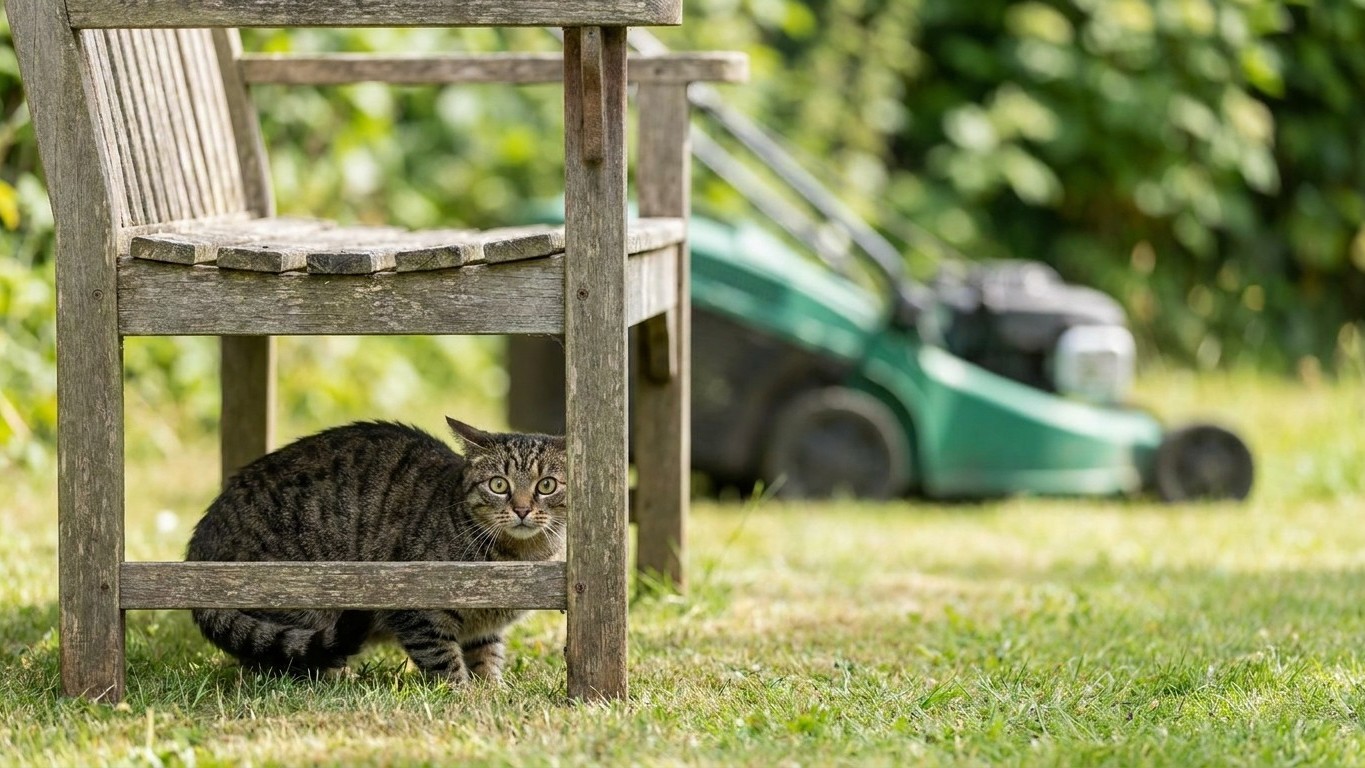
The first mow of May arrives, the lawnmower roars to life, and your cat vanishes. You check behind the sofa, under the bed, maybe even knock on the neighbour’s door. An hour later, your garden is beautifully trimmed, and your cat slinks back in as though nothing happened. Most owners chalk it up to typical feline weirdness. But the disappearance is anything but random. It’s a predictable, biology-driven response to something your cat finds genuinely alarming — and once you understand why, you’ll also realise there are very real welfare reasons to keep them well away from your freshly cut lawn.
Key takeaways
- Cats hear lawnmower noise up to 1.6 octaves higher than humans, with 30 ear muscles that amplify and pinpoint the terrifying sound with precision
- The timing is cruel: May brings both peak mowing season and when cats roam most, increasing risks of being lost in dangerous territory
- Freshly cut lawns hide triple threats—toxic slug pellets and fertilizers, sharp grass seeds that burrow into ears and paws, and active machinery
A Noise That Hits Differently When You’re a Cat
The lawnmower is, from a cat’s perspective, an extraordinary assault on the senses. Lawn mowers are a well-documented trigger for fear and anxiety in cats, whose heightened sense of hearing means loud noises often produce unwanted fearful behaviours, primarily because cats may not Understand what the source of the noise is. That last part matters enormously: it’s not just the volume, it’s the incomprehensibility. A cat can’t rationalise a petrol engine the way you can.
The biology behind this is striking. Cats can hear much higher-pitched sounds than humans, up to 64 kHz, which is 1.6 octaves above the range of a human and even one octave above the range of a dog. Their ears are also physically designed to collect and concentrate sound. A cat’s ear can amplify sound waves two to three times for frequencies between 2 and 6 kHz, and thanks to around 30 sets of muscles, compared to our 6, a cat can rotate its pinna up to 180 degrees to locate the faintest of noises. So while you’re happily mowing away thinking nothing much of the din, your cat is receiving the full brunt of an amplified, rotating mechanical roar that pinpoints itself with terrifying precision.
Cats and dogs that are scared may become aggressive (the fight reaction), run away (the flight reaction), stay still (freeze), or display appeasement or attention-seeking behaviours. Most cats opt for flight, and fast. Cats are often found hiding under beds, appliances, or in closets, but have even been known to climb into walls in an attempt to get away from a terrifying sound. The fact that your cat disappears from the garden rather than the house is simply geography: outdoors, the escape routes are broader, and so the bolt is less visible to you.
There’s a particular cruelty in timing here. May in the UK marks the start of serious lawn maintenance, and it’s also the month when cats are spending more time outside as the weather warms. Cats are more likely to go missing in spring, when mating behaviour, wildlife, and outdoor activity tempt them to roam. The mower’s sudden appearance doesn’t just scare them away for an hour, it can send them much farther than you’d expect, and in some cases, into genuinely risky territory.
The Hidden Dangers Lurking on Your Freshly Mowed Lawn
Here’s the other reason to keep cats away from mowing time, one that has nothing to do with noise. Cats and dogs should be kept in the house when you are mowing the lawn, tidying borders with a grass trimmer, cutting hedges, tilling and sawing. This isn’t just caution for caution’s sake. Powered garden tools pose a real physical danger to any small animal that wanders into their path, and a frightened cat running unpredictably is especially vulnerable.
But the risks don’t end when the mower stops. Increased gardening activity often means more use of chemicals such as weed killer, slug pellets and insecticides, along with the return of seasonal plants that may be harmful to cats. Traditional slug pellets containing metaldehyde are extremely toxic to cats. Even a small amount can cause serious symptoms, including tremors, seizures and overheating, and can be fatal without urgent treatment. These pellets are often scattered after mowing, while owners are distracted and cats are creeping back outside, a particularly unfortunate combination.
Then there’s the matter of lawn fertilisers, which millions of British gardeners apply in spring. Iron salts are often added to kill moss, and chemicals called phenoxy acids are used to kill weeds, these can cause more serious signs in cats depending on the amount eaten. Cats may even get mild effects after walking on a freshly treated lawn and then licking their paws. If your lawn has had a weed-and-feed treatment, the advice from vets and lawn care professionals is consistent: keep cats off until the grass is fully dry, and check product instructions carefully for recommended exclusion periods.
Grass seeds are a third hazard that peaks precisely in late spring. The sharp, small, arrow-shaped grass seed is found on many different types of grasses that can grow in fields, gardens, and parks as they dry out and scatter seeds. Usually present during the late spring and early summer months, grass seeds are easily dislodged from long grass to attach themselves to your cat’s coat as they brush past. Once attached, they don’t just sit there. Usually from foxtail plants, these seeds have a pointed shaft and an arrow-like appearance that easily gets caught in an animal’s fur and can end up burrowing into the skin. Because of the backwards-facing barbs they can only travel in one direction and become stuck within the layers of the dermis. These seeds also contain bacteria that can cause further injury to the animal by causing a larger infection.
The most common areas these seeds affect are the paws and ears. Grass seeds that get caught in the ear hair can soon make their way down the ear canal and end up next to the very delicate eardrum. The signs of this are usually pawing of the ear, head shaking, rubbing the head or ear on the ground and inflammation of the ear flap. If left, the grass seed may penetrate the eardrum and cause more problems. If your cat comes back in from the garden in May doing any of these things, consult your vet promptly, seeds can require sedation and specialist equipment to remove safely.
What to Do When the Mower Comes Out
The good news is that none of this needs to be complicated to manage. The single most effective step is simply keeping your cat indoors before you start the engine. Secure the cat flap or close the door, don’t assume they’ll stay away on their own, because spring’s abundance of birds and smells will draw them back out quickly. If your cat is already outside, bring them in first. This protects them from the noise, the machinery, any lawn treatments you’re applying, and the grass seeds that scatter as the blades pass through.
After mowing, if you’ve applied any chemicals, cats should never be allowed to roam on a recently fertilised lawn. Allow a minimum of 48 hours after application before allowing your cat onto the lawn. Always read product labels for specific guidance, some formulations have longer exclusion periods depending on ingredients. Chemical-free methods such as hand weeding, mulching, or using boiling water on weeds in paved areas can reduce the need for potentially harmful products.
For cats with a more severe reaction to the mower noise, those who bolt for hours rather than minutes, or who seem visibly distressed even after the machine has stopped — it’s worth raising this with your vet. Noise phobia is a problem that can stem from an early age. If cats are not exposed to the everyday sounds of people and other animals early on, it’s far more likely that they will grow up to be fearful of them. A kitten reared in a fairly noisy, bustling home will be less likely to develop a noise phobia than one raised in a quiet environment. Gradual desensitisation, using recordings of machinery at low volume with positive reinforcement, can help over time, but always with guidance from a qualified vet or behaviourist.
Spring in the Garden, Safely
Once mowing is done, the lawn is dry, and you’ve given the garden a thorough once-over, there’s plenty you can do to make it genuinely welcoming for your cat. You can make your garden more cat-friendly by providing shaded resting areas, quiet hiding spaces and planting safe options such as catmint. These small adjustments mean your cat can enjoy the garden on their terms, which is, let’s be honest, the only way they’ve ever agreed to anything.
One more thing worth knowing: it’s a good idea to check your cat regularly for grass seeds, particularly around their paws, ears and between their toes, not just after walks, but after any time spent in the garden from May onwards. Long-haired cats benefit from having the feathery fur around their ears, eyes and paws trimmed short to reduce the risk. It takes about thirty seconds and can save a great deal of pain — and a surprisingly large vet bill.
Sources : gardenbetty.com | kingstonanimalhospital.com.au