
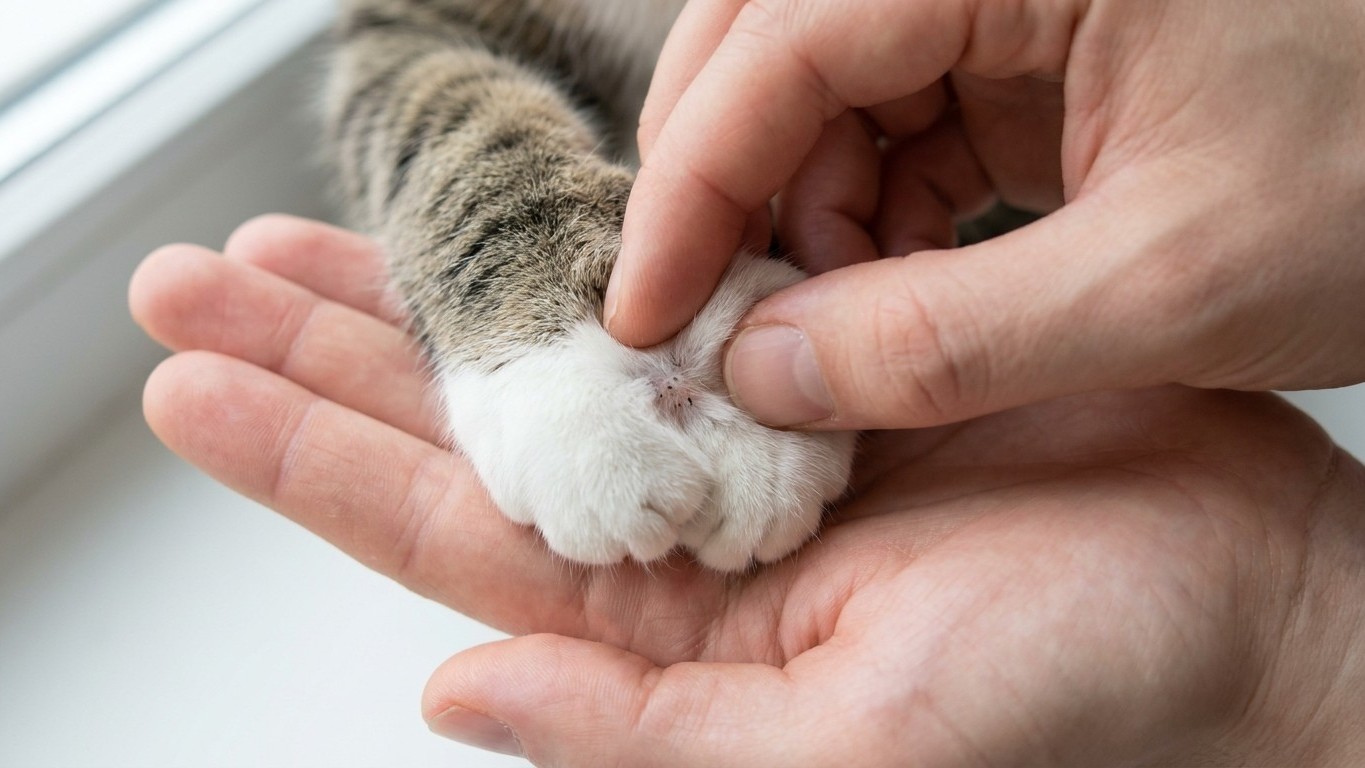
Grab your cat’s paw and part the fur between the toes. If you spot tiny bright orange dots clustered there, no flea treatment on the market will touch them. What you’re looking at are almost certainly harvest mites, and they’re a completely different beast from the fleas most owners assume are behind every summer scratch.
Harvest mites belong to a family with a proper reputation for causing chaos in gardens and grassland. Also known as red bugs, trombiculid mites, scrub-itch mites, berry bugs or, in their larval stage as chiggers, are mites that are commonly found in forests and grasslands, and are relatives of spiders. They’re not insects at all, which is exactly why fipronil-based flea sprays and standard flea drops often do little to shift them. Trombiculid mites are red-orange in colour and are barely visible to the naked eye, though the larvae swell to about three times their original size when they’ve finished feeding. That swelling is what turns them from an invisible nuisance into something you can actually spot with the naked eye during a quick toe check.
Key takeaways
- Tiny orange dots between cat toes signal a completely different parasite than fleas—one that standard flea drops can’t touch
- Warmer summers are pushing harvest mite season earlier than ever, and vets are seeing July cases that owners mistake for flea infestations
- A single weeping pit instead of orange specks could indicate a dangerous grass seed migration that requires immediate veterinary removal
Why they love your cat’s feet (and why July matters)
Most people associate harvest mites with autumn, and there’s good reason for that timing folklore. Harvest mites most frequently infect humans and animals in the fall season, hence the name “harvest” mites. But British vets are increasingly seeing them turn up much earlier. One Oxford veterinary clinic notes that diagnosis is typically made on a history of intense itch in late summer or early autumn, though they are seeing cases as early as July. Warmer, wetter summers seem to be nudging the mite season forward, which explains why so many owners reach for flea treatment in July only to find it makes zero difference.
The reason toes get hit so hard comes down to basic mite behaviour. The mites typically sit on vegetation and leaves, waiting for an animal to brush past so they can attach and start feeding. A cat padding through damp grass or woodland edges is walking straight through mite ambush territory, and the thin skin between the toes (along with the delicate fold at the edge of the ear, charmingly nicknamed “Henry’s pocket”) offers easy access. It’s actually the larval stage that attaches to feed, biting through the skin and releasing digestive enzymes, and it’s those enzymes which cause the intense irritation and itching. The larvae aren’t burrowing in like a tick; contrary to popular belief, they don’t burrow deep into the skin and live underneath it, instead living on the skin’s surface. They gorge for a couple of days then drop off, but the itch they leave behind can linger far longer than the mite itself. The larvae remain attached for 2-3 days before dropping off the animal to continue their development into adult mites.
Left unchecked, a cat’s own response often does more damage than the mite. During feeding they pierce the skin with small hooked fangs and inject powerful enzymes that irritate the skin and result in intense itching, causing the cat to chew or scratch itself and inflict self-wounds. The resulting skin lesions vary from crusted spots to areas of hair loss to raw and moist bleeding areas. That’s the point at which a mild summer itch tips into a genuine vet visit, because broken skin invites secondary bacterial infection.
The other culprit lurking in long grass
Orange dots aren’t the only thing a toe check might turn up. Grass seeds and awns are a separate, equally common July troublemaker, and they’re more dangerous because they don’t just irritate, they migrate. Grass seeds get stuck in a pet’s fur, and because of their structure they can only move one way, so once they stick into the hair they move forward and the sharp pointy end can penetrate the skin. Between the toes is their favourite entry point on a cat. The grass seed gets hooked into the fur, especially in the grooves between the toes on top of the paw and between the pads beneath, and then starts making its way toward the skin.
Spotting the difference matters for treatment. A grass seed injury tends to look like a localised swelling rather than a scattering of orange specks. Vets look for swellings in the skin between toes or pads, likely to be red and inflamed with a small hole oozing reddish fluid. The frustrating part is that the seed itself often vanishes from view almost immediately. Even grass seeds between toes become “invisible” once they get through the skin. If your one-second check reveals a weeping little pit rather than orange dots, that’s your cue to ring the vet rather than reach for a mite treatment, since removal can cost anywhere from hundreds to thousands of pounds depending on where the seed lodges and how hard it is to find.
What actually helps, and what doesn’t
Here’s the frustrating truth for harvest mites specifically: there are currently no products licensed for the treatment of harvest mites in cats in the UK. Some prescription flea and parasite products, particularly fipronil-based sprays, do seem to knock them back even without an official licence for this use, but spot-on treatments for fleas and ticks do not appear to kill harvest mites reliably. This is exactly why a chat with your vet beats a guess at the pet shop shelf. They can prescribe something appropriate off-license and check whether secondary infection or an allergic reaction has crept in, since some cats develop genuine hypersensitivity after repeated exposure.
In the meantime, simple home care makes a real difference to comfort. Bathing red or sore skin with warm salt water, using roughly one teaspoon of salt to 500ml of boiled, cooled water, can help calm irritation, and the same salt water rinse is often recommended for a suspected grass seed wound while you wait for a vet appointment. Limiting outdoor access during peak mite activity helps too. If you let your cat outdoors, try to limit this to early morning and after dusk, when mites are less active.
Next time your cat starts frantically nibbling a paw in the middle of summer, resist the automatic reach for flea drops. That thirty-second toe part could save you weeks of guesswork, and it’s the one habit every cat owner in mite-prone gardens should adopt before the height of the season, not after the scratching has already drawn blood.
Sources : lakeconews.com | vcahospitals.com