
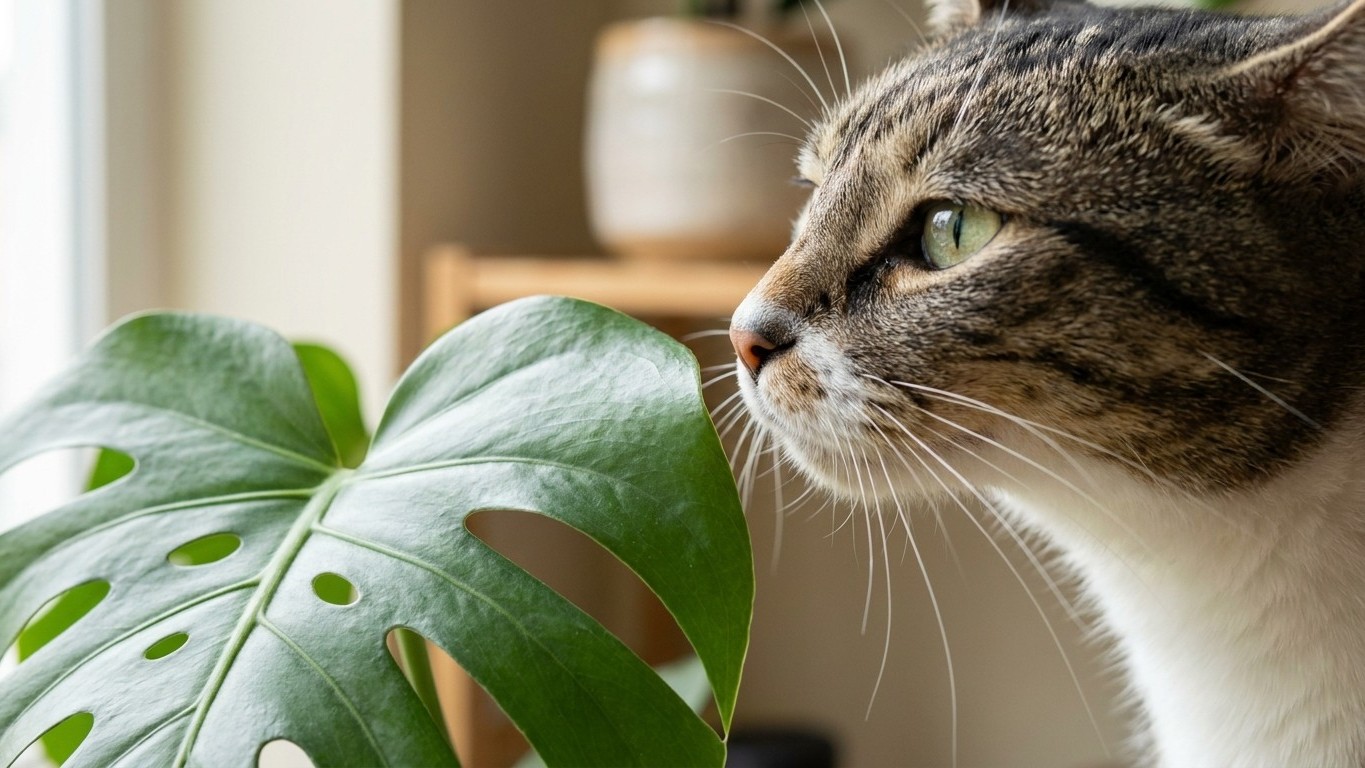
Those satisfying holes in a monstera leaf might scream “houseplant of the decade” to us, but to a cat’s mouth they signal something rather more painful: thousands of microscopic, needle-shaped crystals about to be released into soft tissue. What looks like a curious nibble is, biologically speaking, the plant firing off its own chemical defence system, and vets see the aftermath in their consulting rooms more often than you’d think.
The ASPCA lists Monstera deliciosa, also known as the Swiss cheese plant or cutleaf philodendron, firmly on its toxic plant register for cats. The toxic principles are insoluble calcium oxalates, and clinical signs include oral irritation, intense burning and irritation of the mouth, tongue and lips, excessive drooling, vomiting and difficulty swallowing. That’s the official line, and it’s worth taking seriously even though, as I’ll explain, it’s rarely a five-alarm emergency.
Key takeaways
- Monstera leaves contain specialized cells that explosively release glass-like crystals when bitten, causing instant mouth pain
- This isn’t a systemic poison like lilies—the damage is mechanical, not chemical, so organ failure won’t happen
- Most cats recover within hours, but knowing when to call a vet separates comfort care from actual emergencies
What actually happens the moment your cat bites down
Inside monstera leaves, stems and roots sit specialised plant cells called idioblasts, essentially tiny biological syringes stuffed with bundles of needle-sharp crystals known as raphides. When a cat bites into a monstera leaf, the physical pressure ruptures the idioblasts, which then explosively discharge the raphide crystals directly into the soft tissue of the mouth and tongue, and this happens essentially instantly. That’s why most cats don’t sit there calmly munching away. One bite, one shocked yowl, paw at the face, done.
Because the crystals are insoluble, they don’t behave like a typical poison working its way into the bloodstream. Because the calcium oxalate in monstera is insoluble, it stays local, doesn’t dissolve and doesn’t enter the bloodstream in meaningful quantities, which is why monstera does not cause kidney failure, liver failure, or systemic organ damage. The damage is mechanical, thousands of tiny cuts and embedded splinters in the gums, tongue and throat, rather than a chemical assault on internal organs. That distinction matters enormously when a vet is deciding how worried to be.
The symptoms that follow are the body’s fairly logical response to having glass-like shards jammed into its mouth. Drooling flushes the irritant, vomiting tries to expel anything swallowed, and pawing at the face is simply pain. Most cats will stop chewing quickly because the sensation is unpleasant, but even brief exposure can cause noticeable signs. Swelling of the lips and tongue can make eating and drinking uncomfortable for a while, and in rare cases swelling extends far enough to affect swallowing.
Why this isn’t the lily emergency, but isn’t nothing either
Here’s where I want to reassure the panicking cat owner scrolling this on their phone at midnight: monstera is not in the same league as a true lily. This is the key difference between monstera and true lilies (Lilium and Hemerocallis), which cause acute Kidney Failure in Cats, whereas monstera causes mouth pain and vomiting, which is uncomfortable but self-limiting. Lily pollen brushed onto fur and later groomed off can kill a cat within days through kidney failure. Monstera, by contrast, tends to punish the offender immediately and then let go.
Most cats bounce back within a day. Most cats who chew a monstera leaf are uncomfortable for a few hours and recover within 24 hours with no treatment, though a small number need supportive care for dehydration if vomiting is repeated. Emergency hospitalisations for monstera alone are genuinely rare. That said, I’d never tell an owner to simply shrug it off. Oral pain in cats is a welfare issue in its own right, even when it doesn’t threaten life, because it can put a cat off eating, drinking and grooming exactly when it needs those routines most.
What I find genuinely fascinating (and a little unsettling) is how ordinary this defence mechanism is across the houseplant world. Monstera belongs to the Araceae family, and calcium oxalate raphides are shared by a huge cast of familiar sitting-room favourites. The same calcium oxalate mechanism is found in several other common houseplants the ASPCA classifies as toxic to cats: pothos, philodendron, peace lily, dieffenbachia, alocasia, and dumb cane, all belonging to the Araceae family, sharing the same toxin and similar symptom profiles. If your cat has had a run-in with any of these before, expect a near-identical performance from monstera.
What to actually do if you catch the crime scene
If you walk in on your cat mid-chew, don’t panic, but don’t ignore it either. Rinse the mouth gently with fresh water if your cat will let you (forcing this is pointless and stressful for both of you), and offer plenty of water afterwards. Encourage your kitty to drink water, which should help flush as many of the crystals as possible from the digestive system. Never induce vomiting yourself. Do not induce vomiting unless instructed by a veterinarian.
Watch closely over the following few hours. Persistent drooling beyond that window, refusal to eat or drink, laboured breathing, or swelling that seems to be getting worse rather than settling are your cue to phone a vet without delay. This is genuinely one of those situations where a quick call beats a Google search: describe exactly what you saw, roughly how much was chewed, and let a professional judge whether a visit is warranted.
None of this means you need to banish every trailing vine and split leaf from your home. Plenty of us live perfectly happily alongside cats and monstera by being sensible about placement, and there’s real merit in the classic advice: high shelves, hanging baskets, or a room the cat simply can’t get into. Offering your cat alternative non-toxic houseplants, such as cat grass or catnip, can redirect their chewing behaviour too, and honestly, most cats find a proper patch of cat grass far more rewarding to demolish than a leathery monstera leaf anyway. A determined climber will always find a way to a coveted plant eventually, so treat prevention as harm reduction rather than a guarantee.
One quirky detail worth knowing: the only part of a monstera that’s actually meant to be eaten is its ripe fruit, which is safe and even edible for humans once fully matured, because the plant relies on animals eating that fruit to spread its seeds. Every other part exists to be avoided, crystals and all, which is precisely why your cat’s curious nibble on a leaf tells such a different story once you look at what’s happening at a cellular level.
Sources : treezpedia.com | fernandfeline.com