
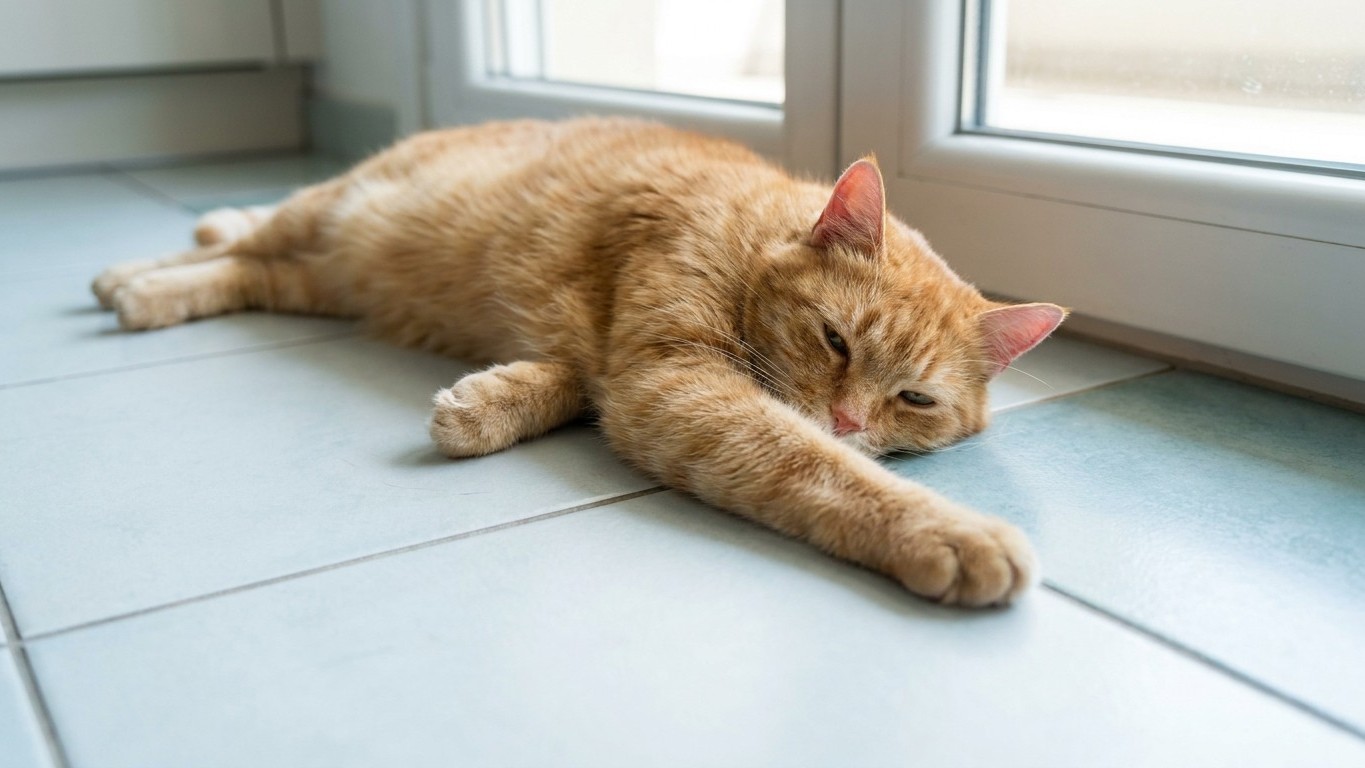
Your cat is lying flat on the cool kitchen tiles, eyes half-closed, breathing a little faster than usual. It’s the middle of a warm British summer, and honestly, the thought that crosses your mind is: she’s just tired from the heat. That thought, entirely understandable, can cost a cat its life. Feline heatstroke moves faster than most owners realise, and the deceptive part is that cats are extraordinarily good at hiding distress until the situation has already become critical.
Key takeaways
- Cats can only cool themselves by licking and seeking shade—their survival toolkit is dangerously limited
- The three warning signs escalate rapidly from lethargy to panting to disorientation, and the final stage gives you minutes, not hours
- One in four cats with severe heatstroke don’t survive, but knowing what to do before reaching the vet can make the difference
A body that cannot cool itself
Cats have a very limited ability to sweat, so instead, they control their temperature by licking themselves and seeking shade on warm days. That’s the entirety of their cooling toolkit. Unlike people, who have sweat glands all over their bodies, cats can only sweat a little between their foot pads, and they have a reduced ability to dissipate heat even compared to dogs, because dogs can engage in evaporative cooling by panting.
Normal body temperature for a cat ranges between 38.1–39.2°C (100.5–102.5°F). However, if your cat’s body temperature goes above 40°C (104°F), they are at risk of heatstroke, which can cause severe dehydration, seizures, blood clotting problems, organ damage, coma, and death. What makes this particularly alarming is the speed at which things deteriorate. Heatstroke in cats can develop rapidly, within 15 minutes of exposure to extreme heat.
The most common cause of heatstroke in cats in the UK is being accidentally trapped in a hot, poorly ventilated space such as a shed, greenhouse, conservatory, or garage. Cats being cats, they will happily wander into a sun-warmed shed on a July afternoon and not realise the door has swung shut behind them. Unlike dogs, it’s very unusual for cats to develop heatstroke due to overexerting themselves during exercise. The danger is almost always environmental, a warm, still space they cannot escape.
The three signs that should never be dismissed
The first warning is lethargy. Your cat looks sleepy, reluctant to move, and seeks out the coolest surface in the room. Early signs include seeking cool surfaces like tile floors or sinks and increased grooming. Your cat might show mild low energy, slightly faster breathing, and warm ears. On their own, each of these is easy to wave away. Together, on a warm day, they are a cue to act immediately.
The second sign is panting. Cats rarely pant unless they’re overheated or stressed. Any panting that doesn’t improve within minutes of moving to a cooler area needs veterinary attention. This is the detail Most Cat Owners miss, because we’re so accustomed to seeing dogs pant that it feels benign. It isn’t, not in a cat. Unlike dogs, cats rarely pant, so if they are, it’s a serious red flag.
The third sign, the one that signals the emergency has already arrived, is a change in gum colour combined with disorientation. Severe heatstroke shows as heavy panting, drooling, bright red or purple gums, and vomiting. Your cat may seem confused, walk unsteadily, or collapse. Seizures can happen in advanced cases as the brain overheats. If you see unsteady walking or notice your cat’s gums are no longer their normal pale pink, you are not looking at heat exhaustion anymore. You are looking at a full heatstroke emergency, and the window for intervention is measured in minutes, not hours.
Inflammation caused by heatstroke sets off several reactions that affect every major system of the body, causing the breakdown of essential proteins and enzymes. This puts the cat at risk of organ failure and potentially death. A study from the Journal of Feline Medicine and Surgery found that 1 in 4 cats with severe heatstroke do not survive, underlining the urgency of early intervention.
What to do before you reach the vet
The priority the moment you suspect heatstroke is to begin cooling and get to a vet simultaneously. It’s important to start brief cooling at home (such as applying cool damp towels and water to the ears and paws), but head directly to a veterinarian for emergency care. Two things to avoid absolutely: never use ice-cold water or ice baths to cool a cat with heatstroke, as cooling too quickly can cause shock and worsen the situation. Cooling your cat down needs to be gradual to avoid shock and not cause your cat additional stress, as stress can increase their body temperature further.
In practical terms: move your cat to a cool, well-ventilated space, dampen a towel with cool (not cold) water and lay it gently over their belly and paws, and offer small sips of water only if they are conscious and alert enough to swallow safely. While transporting your cat to the vet, keep the vehicle’s air conditioning on full or open the windows to allow airflow to help cool your cat down. Phone ahead if you can, it allows the practice to prepare.
At the clinic, the veterinary team will immediately take blood samples as well as start pulse oximetry to determine the oxygen saturation of the blood and start an ECG to monitor the heart. In most cases, supplementary oxygen will be needed. Prolonged high body temperature can damage a cat’s kidneys, liver, heart, and brain. Kidney problems are common after heatstroke and may not show symptoms until days later, which is why your vet will want to monitor your cat even after their temperature has returned to normal.
The cats most at risk this summer
Obese, long-haired, old, young, and brachycephalic or flat-faced cats, such as Persians, are most at risk of developing heatstroke because they find it harder to cool down. The flat-faced connection is worth understanding. Cats get rid of significant amounts of body heat through their nose as they breathe out. Brachycephalic cats such as Persians struggle to release heat this way because they have much less space inside their nose. This puts them at a much higher risk of heatstroke, even on seemingly cool days.
Prevention, practically speaking, requires checking enclosed spaces before shutting them. Always check sheds, greenhouses, conservatories, and cars before shutting them, and never leave your cat in a hot room or somewhere with poor ventilation. Fresh water in multiple locations across your home matters too, especially during British heatwaves when indoor temperatures can climb surprisingly fast. Cats are notoriously bad at not drinking enough water, so you may need to supplement your cat’s fluid intake with some wet food during the hot months.
One detail that catches many owners out: it doesn’t always have to be “hot” for a cat to develop heatstroke. Exercising excessively in warm weather or being left in a warm or humid environment that is poorly ventilated can cause animals to quickly overheat. A grey, muggy British afternoon with the conservatory door closed is more than enough. If your cat seems quieter than usual, ears warm to the touch, and reluctant to move, don’t wait for a third sign to appear. Get them somewhere cool, and call your vet.
Sources : rvc.ac.uk | rock-hill.carolinavet.com