
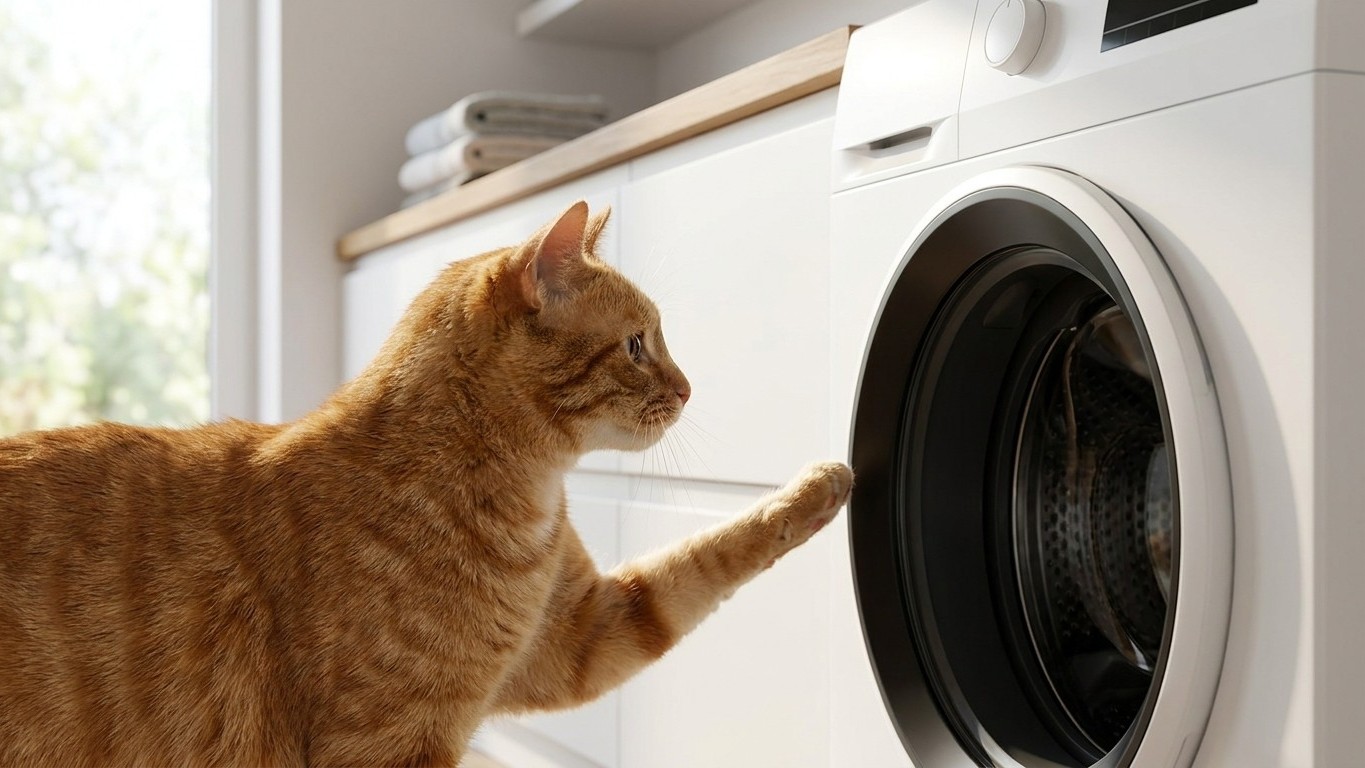
My cat, Biscuit, is a ginger tabby with absolutely zero respect for the concept of personal space or household safety. Last Tuesday, I walked back into the utility room three minutes after finishing a hot wash cycle, reached for the laundry basket, and found him curled up in the warm drum, blinking at me as if I were the one intruding. He hadn’t been there when I loaded the machine. He’d slipped in the moment I left the door ajar to let it air out. My stomach dropped. Not because he was hurt, but because I understood, in a horrible flash, exactly what could have happened if I’d come back thirty seconds later with an armful of washing.
The thing is, this isn’t unusual cat behaviour at all. Washing machines, especially those that have been recently used, often retain some warmth, and this warmth can be enticing to cats, particularly during colder months, leading them to seek refuge within the drum. Biscuit wasn’t being reckless. He was being a cat. Cats are often skittish and may seek refuge in enclosed spaces when they feel threatened or stressed, and a washing machine drum can provide a temporary sense of security. The dark, snug interior of a front-loading drum is, from a feline perspective, essentially a five-star burrow.
Key takeaways
- A curious cat slipped into an open washing machine drum—and the vet’s explanation of what could have happened was horrifying
- Documented cases show trapped cats suffer chemical burns, aspiration pneumonia, and head trauma; some don’t survive even with treatment
- One two-second safety habit could prevent most pet-in-appliance incidents, but almost no one does it
What the vet told me that made everything worse
I rang my vet that same afternoon, more to settle my nerves than anything else. What she told me over the next five minutes left me genuinely cold. She explained that the risks of a cat trapped in an active washing machine are not limited to the obvious. Animals entrapped in functioning washing machines are at risk for near-drowning, aspiration pneumonia, chemical damage to body tissues, thermal injury, and head trauma. That list, read back to me now, is almost unbearable to sit with.
Both patients in documented clinical cases exhibited clinical signs of respiratory distress shortly after entrapment, most likely associated with pulmonary oedema caused by inhalation of water while in the washing machine. In one of the two published cases, one cat died the day after presentation as a result of aspiration pneumonia and head trauma, despite supportive care. The other survived but required months of ongoing treatment for skin damage caused by the detergent. Not a near-miss that ended cleanly. A long, painful recovery.
The detergent angle is one most people don’t consider. Cats trapped in front-loading washing machines can suffer equally severe injuries; in addition to trauma, washer entrapment can lead to near-drowning, aspiration pneumonia, and chemical injury from detergent, bleach, and/or fabric softener. Modern laundry products are concentrated. Even a short cycle exposes a trapped animal to chemical burns inside and out.
There’s one small mercy in modern appliance design, though it doesn’t make any of this less serious. Modern machines use significantly less water than older models, which is the main reason cats in documented incidents survived, a washing machine from 20 years ago would have filled with enough water to drown a trapped animal. The architecture of newer drums has, quietly, saved a few lives.
Why cats are so drawn to laundry appliances in particular
While many cats don’t like water and will usually avoid the washing machine, these machines can be too interesting to overlook for curious kitties. For cats that love to stay warm and snuggly, the dryer is the perfect spot to hang out. The washer, still radiating heat after a cycle, competes for that same appeal. Cats don’t distinguish between “safely warm” and “recently boiling hot”. They follow the heat gradient without any ability to process what the machine actually does.
The hiding instinct runs even deeper than comfort-seeking. Survival instinct drives cats to hide both to hunt and to avoid being hunted, it’s a natural self-preservation tool. A laundry drum ticks every evolutionary box: enclosed, dark, elevated scent from clothing, residual warmth. To a cat’s brain, it is objectively excellent. To ours, knowing what the spin cycle does, it is a nightmare scenario.
While on the hunt for a small and cosy space to hide in, a cat might end up exploring the inside of a washer or dryer. This can be a dangerous place for a cat, since a pet parent might not notice their cat sneak inside during laundry day. That last part is key. The entry is silent. Biscuit made no noise whatsoever getting in. If I hadn’t gone straight back to the machine, I genuinely wouldn’t have known he was there.
What actually keeps a cat safe around laundry appliances
The most effective change is also the simplest, and I say this as someone who previously left the drum door open routinely to let moisture escape. Never throw laundry into the drum without looking inside first, this single habit prevents the majority of pet-in-appliance incidents. Open the door, look inside, then load. This takes approximately two seconds and could save your pet’s life. Two seconds. That’s the entire intervention.
If you need to air out the drum after a cycle, you don’t have to choose between ventilation and safety. If you need to leave the washer or dryer door open to air out, use a child safety appliance lock that lets the door be ajar without it being open wide enough to allow your cat access. These locks are inexpensive, widely available, and designed precisely for this kind of situation. Many modern machines also have child locks that can be useful to keep adventurous cats out.
The broader habit shift is about access, not just checks. Keeping your cat out of the laundry room while loading the washer or dryer prevents unobserved entry into your appliances. A closed door to the utility room costs nothing. A sign on the machine, even a sticky note, works as a prompt for anyone else in the house who does the laundry. If you have determined pets, make a sign to stick on doors of appliances to remind kids, spouses, and guests to check for cat.
If your cat was accidentally in the machine when a cycle began, even briefly, the advice from veterinary professionals is unambiguous: get to a vet immediately, and don’t wait to see if symptoms appear. Thoracic radiographs should be taken at admission and repeated at regular intervals up to 48 hours after the incident to monitor for progression of pulmonary oedema, since radiographic signs may not be immediately apparent and typically worsen with time. In these cases, looking fine is not the same as being fine. Please always consult your vet as the very first step.
Biscuit is currently asleep on a heated cat mat I bought him the day after the incident. It is warm, it is safe, and it is emphatically not inside a domestic appliance. The warm-drum instinct hasn’t gone anywhere, but now I make sure there’s somewhere better for him to indulge it. What struck me most, reading the clinical literature afterwards, was how utterly routine this type of incident is among cat owners. The drum was open. The cat was curious. The owner wasn’t watching. That sequence happens in households across the country every single day, and most of the time nobody ever finds out how close it came to going badly wrong.
Sources : amcny.org | dialavet.com