
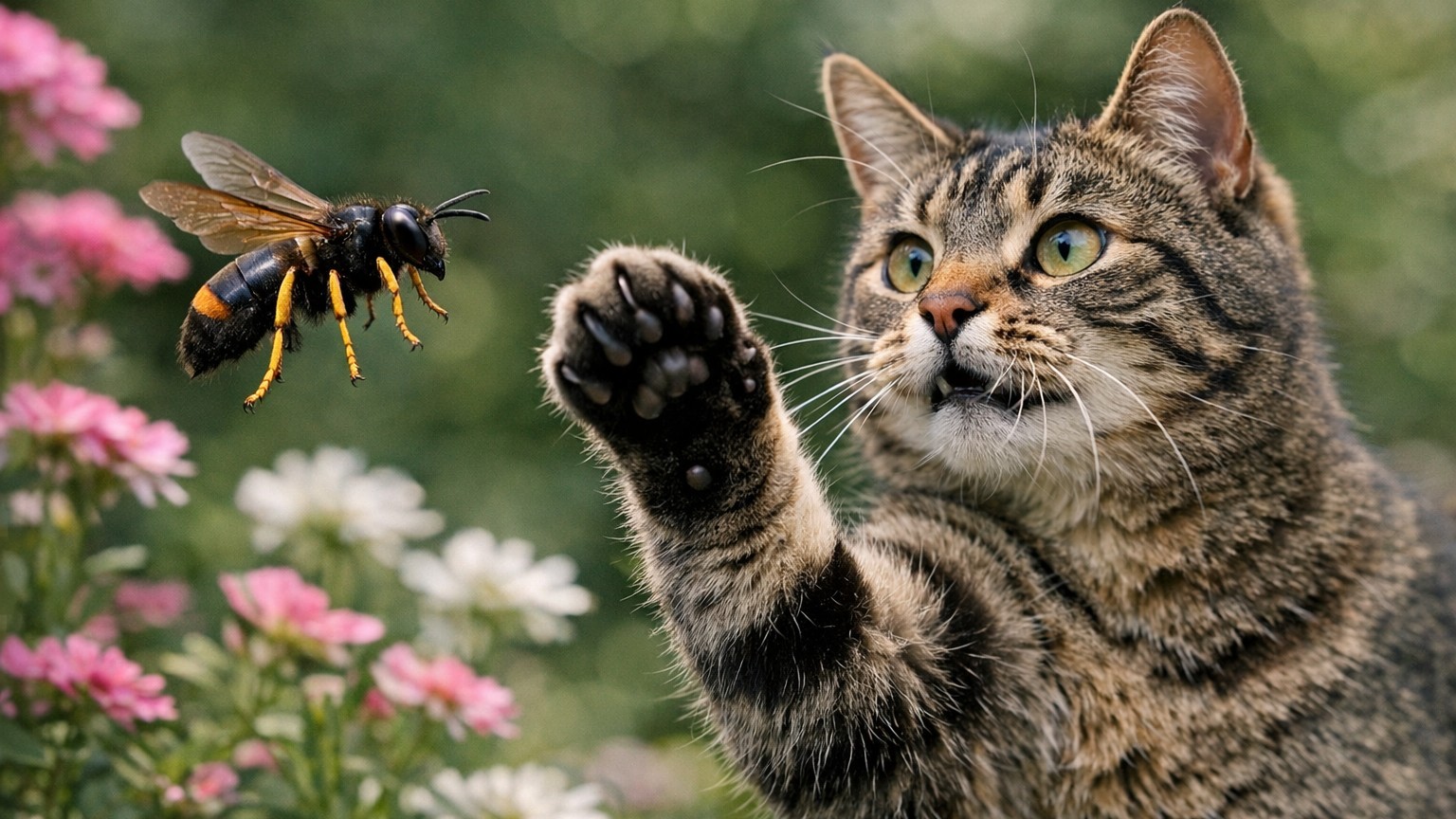
The Asian hornet (formally known in official UK guidance as the yellow-legged hornet, Vespa velutina) is no longer a distant threat arriving on the news in autumn. 544 credible sightings have been reported in the UK in 2025, with 163 nests already found, a stark escalation from just a handful of detections per year not long ago. For cat owners, this surge is a genuinely new garden hazard that deserves more than a passing glance.
Key takeaways
- Asian hornets have successfully overwintered in the UK for the first time—this is no longer just a visitor problem
- Your cat’s instinct to hunt flying insects could trigger multiple stings with venom injections that may prove fatal
- Stings to the face, throat, or mouth can trigger anaphylactic shock in cats, with signs appearing within seconds
A wasp? Not quite, and the difference matters
Most of us were taught to dread the common wasp and leave it at that. The Asian hornet, however, is a different creature entirely. European hornets measure 20–35mm, Asian hornets 25–30mm, while common wasps are only 12–17mm, so an Asian hornet is closer in size to a European one than to a typical wasp. The confusion is understandable at a distance, but the markings are distinctive once you know what to look for. Asian hornets are predominantly dark brown or black with a single orange-yellow band and distinctive yellow-tipped legs, while our native European hornet has a reddish-brown thorax, yellow banding across all abdominal segments, and brown legs.
Originating from Asia, it was unintentionally introduced to France in 2004 and has since spread rapidly across neighbouring countries. The first yellow-legged hornet found in the UK arrived in a consignment of cauliflowers, but these insects can get here in various ways, not just hitchhiking in produce, but also on ferries and in caravans, and potentially carried by the wind. DNA evidence has confirmed for the first time that the species had successfully bred and overwintered in the UK. That is the shift that changes everything. This is no longer just a visitor; it is attempting to settle.
Misidentification is rife. Misidentification is a big issue, the name change from Asian hornet to yellow-legged hornet is intended to help, as their yellow legs are a striking feature, along with the dark body and single broad band across the lower abdomen. The Asian Hornet Watch app, developed by the UK Centre for Ecology and Hydrology and commissioned by Defra, contains photo guides to help. If you spot one, report it immediately — do not attempt to deal with the nest yourself.
Why your cat is at real risk
Here is the part that catches most pet owners off guard. Cats are natural hunters of flying insects. To a cat or dog, a small flying buzzing object will seem like a great thing to play with, and they just can’t help but swat at it. The problem is that the Asian hornet does not surrender after a single sting. Both wasps and hornets can sting repeatedly as their stingers do not come out after they sting an animal, which can lead to more severe reactions as each time the pet is stung, more venom is injected under their skin.
Smaller pets are likely more vulnerable due to their size relative to the venom dose, and multiple stings could prove serious or fatal without intervention. The concern escalates further when considering where cats tend to get stung, on the face, paws, or inside the mouth while snapping at the insect. Being stung on the face, throat or mouth can be life-threatening, and if a pet is allergic to the venom and has an anaphylactic reaction, they could die if treatment isn’t received quickly enough.
Cats react differently to anaphylaxis than dogs do, a fact even many pet owners are unaware of. A cat’s lungs are the most common area impacted by anaphylactic shock, which can affect breathing, and other major body systems affected include the gastrointestinal system. The most common signs of anaphylaxis occur within seconds to minutes. Signs to watch for include open-mouth breathing, drooling, vomiting, facial swelling, pale gums, and sudden collapse. Signs of anaphylaxis can happen very fast, and some pets die before they make it to a veterinarian for treatment. If you notice any of these signs after your cat has been outside near flowering plants, ivy, or wooded borders, treat it as an emergency.
What to do if your cat is stung
Speed is everything. As soon as you suspect anything, bring your cat or dog indoors so they’re not at risk from more stings, especially if they’ve disturbed a nest. Check the face, paws and inside the mouth. Don’t treat your pet with over-the-counter human medications without speaking to your vet first, as they may contain ingredients that are toxic to dogs and cats. A cold compress can help reduce localised swelling on a paw or limb, but that is the limit of safe home first aid.
If in doubt, call your vet for advice. This is not the moment to consult an internet forum and wait. If you suspect your pet has gotten into a hornet or wasp nest, seek immediate veterinary care, as their health can decline rapidly. Your vet may administer antihistamines, corticosteroids, or epinephrine depending on the severity of the reaction, and cats that experience anaphylaxis should be monitored closely by a veterinarian for at least 48–72 hours after the reaction, because clinical signs can improve and then quickly reappear after several hours.
Protecting your garden, and your cat
The bigger picture here matters for every household with an outdoor cat. Research from France has shown that during the course of a season, a single yellow-legged hornet nest can consume over 11 kilograms of insects, including bees, wasps, other pollinators and spiders, and this can have a devastating effect on local biodiversity as the hornets have no natural predators and can expand their territories rapidly year-on-year. So the ecological stakes are already high before your cat enters the equation.
Asian hornets build large nests, up to 60cm or more in diameter, typically high in trees, often above 10 metres. They are not lurking in your compost bin like wasps. But they do hunt actively around flowering plants and hive sites, which is precisely where a curious cat likes to spend a summer afternoon. The Asian hornet is a skilled predator, especially of honeybees, and aggressive in its hunting style, returning to the scene and hovering in wait, or “hawking”, once a food source has been discovered. A cat drawn to the same patch of flowering ivy or buddleia can easily wander into that hunting zone.
The Animal and Plant Health Agency investigates confirmed sightings and destroys nests : Asian hornet nest destruction is handled by government agencies, not private pest controllers, because containment is a national priority. Report sightings via the Asian Hornet Watch app (available on iOS and Android) or the UKCEH online tool. Do not disturb a suspected nest under any circumstances.
One final thing worth knowing: the Asian hornet nest is estimated to release between 180 and 500 queens, compared to just one reproductive queen in a honeybee colony. That extraordinary reproductive output is precisely why containment is so difficult, and why reporting every sighting, however uncertain you are, genuinely makes a difference to the national effort to keep this species from establishing permanently on British soil.
Sources : ceh.ac.uk | ladbible.com