
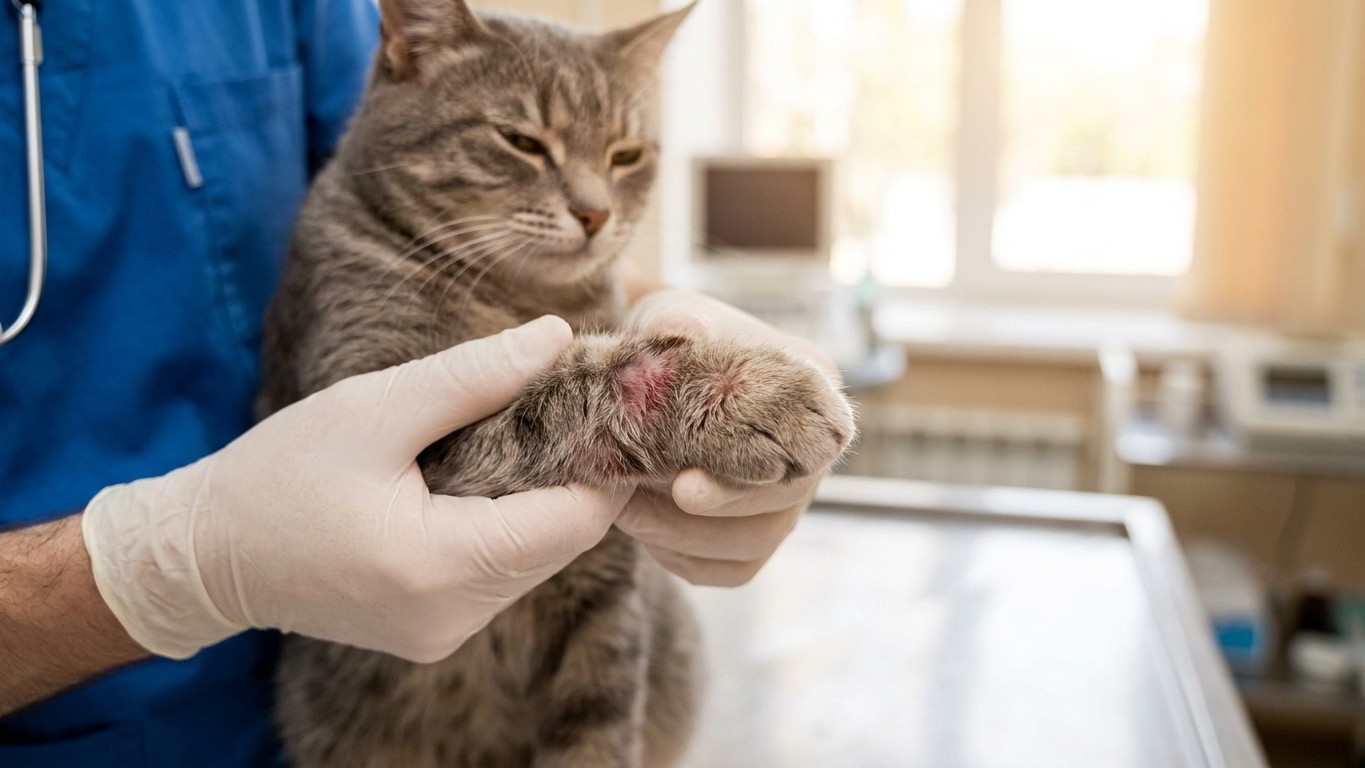
Your cat trots back through the cat flap looking sorry for herself, one front paw puffed up like a little balloon. Your first instinct? Bee sting. It happens all the time in summer gardens. But then the vet parts the fur, and what they find underneath is something altogether more alarming, and far more common than most cat owners realise.
If you asked most cat owners what they thought was one of the most common problems vets deal with in cats in general practice, many would answer fleas, worms, or perhaps cat flu. The correct answer is actually cat bite abscesses. That swollen paw almost certainly wasn’t a bee. The real culprit was probably the tabby from three doors down.
Key takeaways
- That innocent-looking swollen paw has likely been festering for days beneath the fur
- The real culprit is probably a bite from another cat, not a bee—and it contains dangerous bacteria
- Delaying treatment can lead to serious complications including infection spreading through the bloodstream
What’s Actually Hiding Under the Fur
A cat abscess is a pocket of pus that forms beneath the skin when bacteria get trapped inside a wound. The cat’s immune system tries to wall off the infection by sending white blood cells to the area, and the resulting fluid collects into a swelling that grows over two to seven days. By the time you notice the paw is puffy, that process has already been quietly underway for days.
A cat’s teeth and claws deliver bacteria deep into muscle tissue. Their skin heals quickly, sometimes too quickly, sealing in any contamination from the original injury. And their grooming behaviour often hides puncture wounds before owners notice them. This is the biological trap that makes cats so uniquely prone to abscesses: the very thing that makes them efficient healers also imprisons the infection.
Paw abscesses in particular typically involve a foreign object, a thorn, splinter, or piece of debris stuck between the toes. Cats limp, lick the paw obsessively, and refuse to put weight on it. But a bite from another cat is just as likely. Bite wounds on the feet may be swollen but more obviously your cat will be limping. If you suspect a bite, look closely through the fur checking for small tufts of fur possibly with a little clotted blood and a small hole in the skin. These can be very difficult to find, and sometimes all you will find is an area of tenderness.
The bacteria responsible are not random garden-variety germs. A group of bacteria called Pasteurella is particularly common, and in studies this has been found in up to 90% of cat bite abscesses. These bacteria thrive in low-oxygen environments, exactly the sealed, warm pocket created under a cat’s rapidly closing skin. Pus can infiltrate and expand deeper between muscle layers, rarely causing the obvious “lump” on the skin, which is why a swollen paw can look deceptively modest on the outside while concealing a serious infection within.
What the Vet Does Next (and Why It Can’t Wait)
The swollen area will be closely inspected, and the overlying fur may be clipped away so that the surface of the skin can be clearly seen. That moment, the clippers parting the fur to reveal a tight, angry lump with a tiny scab at its centre — is usually when the penny drops for cat owners. What looked like a sting is clearly something that has been brewing for days.
Abscesses are usually diagnosed by a physical exam. Your vet will likely palpate (feel) all over your cat’s body. They will take your cat’s temperature and get a thorough history about their exposure to other cats and the outdoors. Your vet may recommend aspirating fluid from any swollen regions to determine the cause of the swelling. A fine needle drawing a small amount of fluid can immediately confirm whether the swelling is pus, a cyst, or something else entirely.
Speed genuinely matters here. Treatment should be speedy, as delays can cause more tissue death (necrosis), bacteria entering the bloodstream, fever, loss of appetite, and even vomiting. Signs that indicate an emergency include significant swelling, extreme pain when touched, fever, low energy, and foul-smelling discharge from the wound. If your cat has stopped eating, seems lethargic, or flinches sharply when you touch the paw, get to the vet the same day, don’t wait to see if it settles.
One thing to resist absolutely: attempting to drain the abscess yourself. If discharge appears to be coming from an abscess, don’t attempt to puncture or drain it yourself. You could cause your cat serious pain or distress. Call your veterinarian and have your cat examined as soon as possible.
Treatment and the Road to Recovery
The treatment will differ based on how deep and severe the infection is. In most cases, your vet will clean the abscess area as much as possible and may prescribe antibiotics to fight the infection as well as pain relief to reduce your cat’s Discomfort if appropriate. In rarer cases, the abscess may need to be treated surgically. Most cats are seen as outpatients and go home the same day, which is reassuring when you’re sitting in the waiting room catastrophising.
You will also need to bathe the affected area twice daily in mildly salty water, to clean away any pus that might gather. This part of aftercare is more important than it sounds, keeping the wound open and draining properly is what prevents the abscess from resealing over a lingering infection. During healing, it is essential that your cat does not lick or chew at the abscess. Saliva is contaminated with bacteria and will only prolong and prevent healing. If you cannot keep your cat from licking at the area, an Elizabethan collar may be needed. Yes, the cone of shame. Your cat will be furious. Do it anyway.
Even if the abscess appears to be improving, it’s important to finish the full course of antibiotics to ensure the infection is fully resolved. Stopping early because your cat seems fine is how infections come back, sometimes worse than before. Depending on the size of your cat’s wound, most abscesses will heal in a matter of one to two weeks.
Prevention: The Bigger Picture
As many abscesses are the direct result of cats fighting, it can be hard to prevent if you intend to keep letting your cat outdoors to explore. That said, you can still take preventative measures such as neutering male cats and keeping a cat first aid kit handy, checking your cat every time they come back inside for any signs of injury.
Cat abscesses often remain unnoticed for some time as they can be concealed by fur, especially if your cat has a long, fluffy coat. Giving your cat a once-over every month is a great way to spot any unusual signs early on. Run your hands along the legs, between the toes, around the tail base and over the head, the areas most commonly targeted in fights. You’re not just looking for lumps; you’re feeling for heat and tenderness, which often appear before any visible swelling.
There’s one more layer to this worth knowing. Cats with compromised immune systems, such as those affected by feline immunodeficiency virus (FIV) or feline leukaemia virus (FeLV), can be more susceptible to abscess formation, as their body does not properly fight off infection. Bite wounds are the main cause of abscesses in cats, and other diseases such as feline leukaemia and FIV can be spread through a bite. So a swollen paw that turns out to be a bite wound is worth a conversation with your vet about whether a test for these viruses makes sense, especially if your cat’s outdoor territory overlaps with unknown cats. The abscess heals in a fortnight. The broader health picture is worth a longer look.
Sources : dialavet.com | petwellbeing.com