
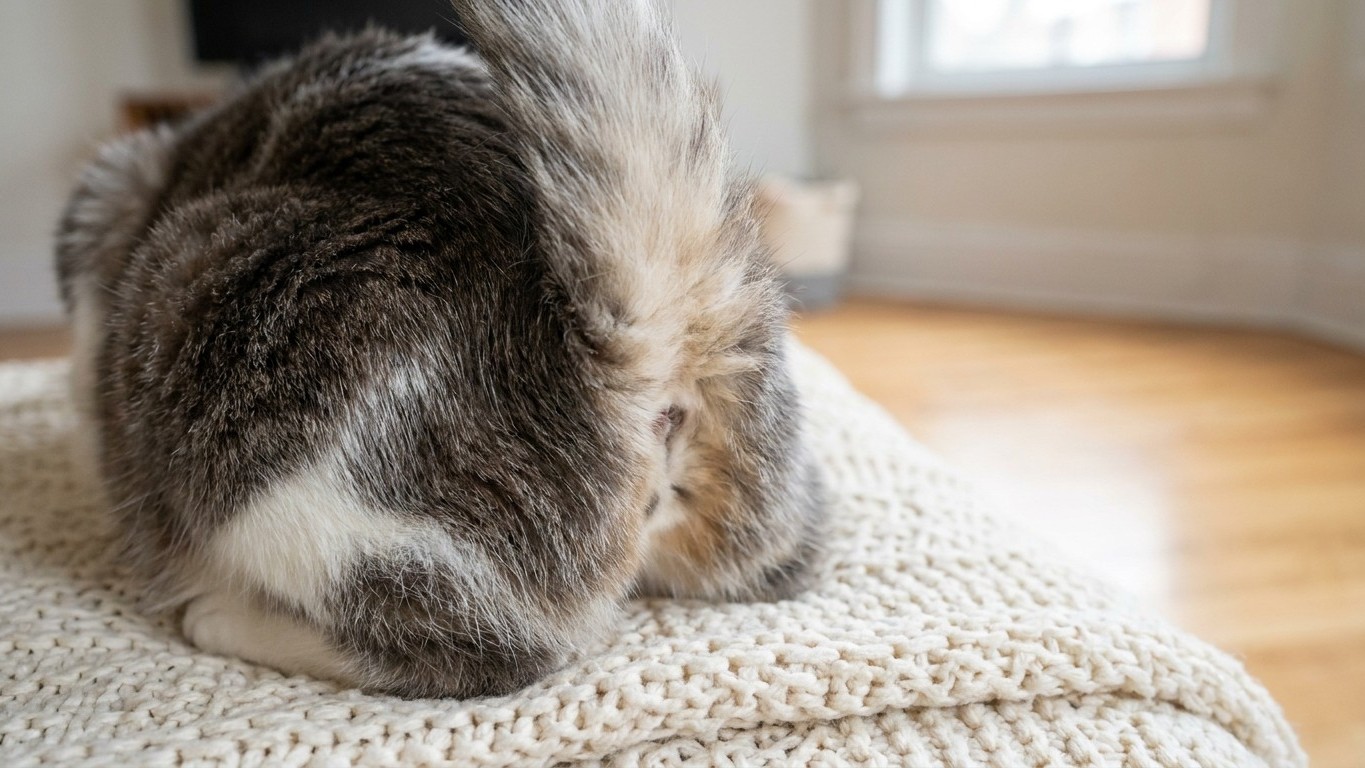
Fly eggs, tiny and pearl-white, clustered right at the base of the tail, exactly where a stiff, arthritic hip makes it almost impossible for a cat to twist round and clean himself. That’s what turns up in the fur of older cats more often than most owners realise, and it can happen faster than you’d think. Eggs can hatch into maggots in as little as 12 hours under warm conditions. A nightly comb down the back and flanks feels thorough, but if the tail never gets lifted, the one spot a creaky cat can no longer reach goes unchecked for days on end.
Key takeaways
- A grooming blind spot develops when arthritis makes it painful for cats to twist and clean their rear end
- Fly eggs can hatch into maggots in under 24 hours under warm conditions—and you might never notice without lifting the tail
- One veterinary-backed habit takes 10 seconds and could catch flystrike before it becomes dangerous
Why the tail base becomes a blind spot
Osteoarthritis in cats is far more common than most people assume, and it hides in plain sight. The prevalence of OA among the domestic cat population is estimated to be around 40% of all cats, and around 90% of cats over the age of 12. A landmark radiographic study found something even starker: 82% of cats over the age of 14 years had evidence of osteoarthritis on X-rays. Yet almost nobody spotted it at home. Only 13 out of the 100 cat owners in this study reported seeing any lameness in their pets. Cats are simply brilliant at masking pain, which is exactly why the fur can tell you what the cat’s behaviour won’t.
Grooming is one of the first casualties. Researchers tracking the same 100 cats found a direct statistical link between joint disease and self-care: decreased mobility and grooming were associated with osteoarthritis, and the behavioural changes of cats with OA include decreased mobility, less grooming, and increased elimination directly over the edge of the litter box. Hips, shoulders and the lower spine are the joints most commonly affected, and all three make the twisting, stretching motion needed to clean the tail base and back end genuinely painful. A cat that once folded himself into a pretzel to reach every inch may now manage his shoulders and flanks perfectly well while quietly giving up on the one area behind him.
What actually settles in under 24 hours
Soiled, matted fur around the rear end isn’t just unsightly, it’s an open invitation to blowflies. Vets describe this as flystrike, or myiasis, and the mechanics are unpleasant but worth understanding. Flystrike develops particularly in the warmer months when flies lay eggs on your animal’s fur, and these then hatch into maggots and begin to eat your pets’ flesh. The trigger is almost always the same combination of warmth, moisture and odour. Fly strike begins when certain species of blowflies or bottle flies are attracted to moisture, warmth, or odor on an animal’s body, and the flies land and deposit eggs directly on the skin or in nearby fur, typically in areas that are damp, soiled, or wounded.
Arthritis sits right at the centre of the risk list. Your pet might be at risk if they are unable to clean themselves properly, for example, an older animal suffering from arthritis might not be as flexible as they once were. Once eggs are laid, the clock starts ticking, and the outcome can turn serious with startling speed: as well as being painful this can quickly lead to infection, toxic shock and even death. I’ve spoken to enough veterinary nurses over the years to know this isn’t scaremongering. It’s the reason why finding those white specks under a tail, rather than a fully-fledged maggot infestation, genuinely counts as a lucky catch. Left another day, in mild British summer warmth, the picture would look very different.
What to actually do about it
The RSPCA’s guidance is refreshingly simple and applies just as much indoors as out. In warm weather, check your pet all over their body, especially around their rear end and tail area, at least twice a day. That means physically lifting the tail, not just running a comb along the visible topcoat. If you do find soiling, don’t wait until morning: if your pet’s back end is dirty, clean it immediately with warm water and ensure the area is dried thoroughly. Fur that’s badly matted may need clipping rather than combing, and you may need to clip their fur, but ask a specialist if you’re not sure how to do this. If you ever spot eggs or actual maggots, don’t attempt to manage it alone. If you think you can see either fly eggs or maggots on your pet, ring your vet immediately to make an appointment.
Beyond the emergency response, the smarter long-term fix is treating the arthritis itself rather than just the symptom of poor grooming. Pain relief genuinely changes behaviour: in one clinical study, all cats were observed by their owners to display positive changes in both mobility and activity levels after meloxicam administration, with over 90% also showing positive changes in both temperament and grooming behaviours. Meloxicam is the most popular medication prescribed by veterinary surgeons in the UK for musculoskeletal pain in cats. If your cat is over seven or eight and you’ve noticed him grooming less thoroughly, sleeping more, or hesitating before jumping onto the sofa, that’s worth a conversation with your vet rather than putting it down to “just getting old”. A short course of pain relief, a ramp to a favourite windowsill, or simply a lower-sided litter tray can restore enough flexibility that he starts cleaning that tail base himself again.
One small habit worth adopting alongside the evening comb: run a hand gently under the tail itself and check the skin, not just the fur, especially through spring and summer when the RSPCA flags the highest risk window as running between April and October. It takes ten extra seconds and it’s the difference between spotting a problem while it’s still just a few pale specks, and finding it after it’s already become something far harder to treat.
Sources : ncbi.nlm.nih.gov | sciencedirect.com