
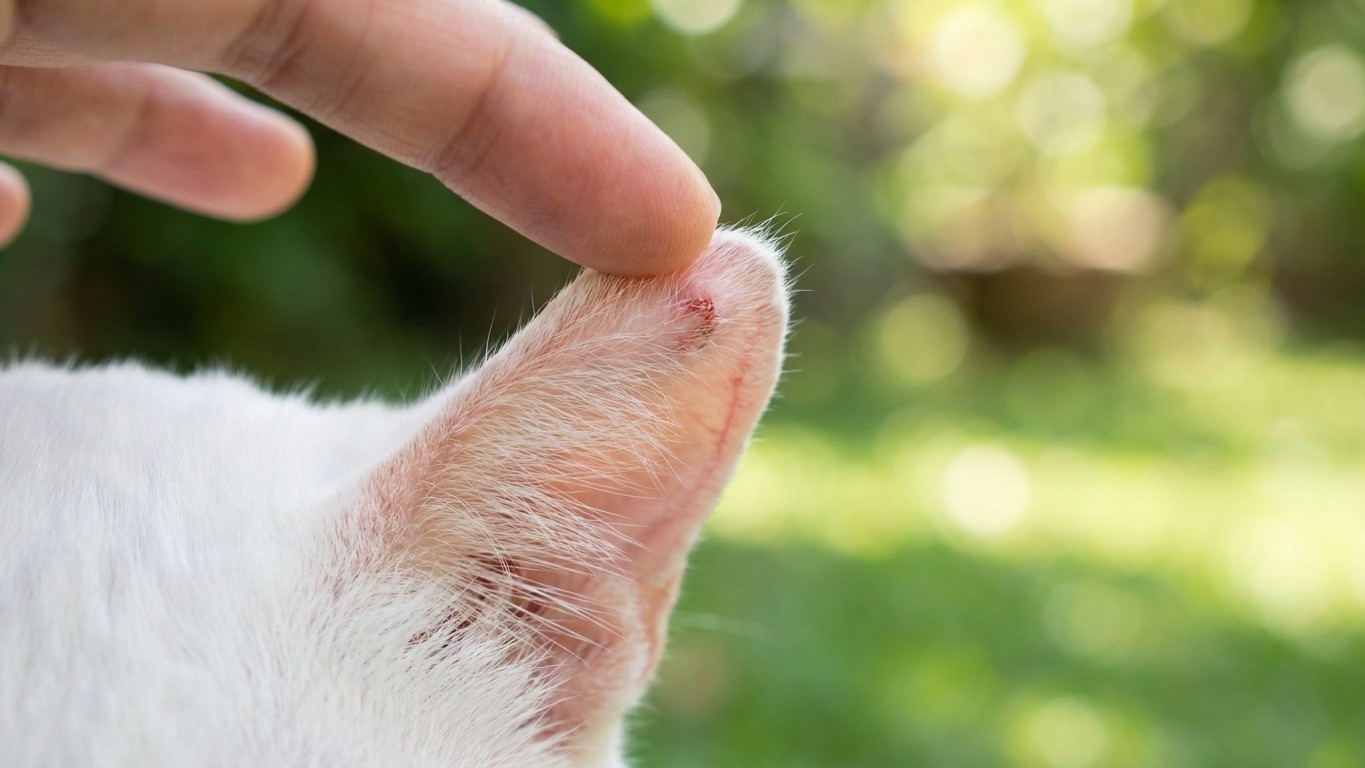
A small dark scab on the tip of a white cat’s ear rarely looks alarming. It flakes off, the skin looks normal again, and life goes on. But that innocent-looking crust can be the first visible sign of actinic keratosis, a sun-damage condition that, left unchecked, can progress into squamous cell carcinoma, the most common skin cancer in cats.
Key takeaways
- A simple scab on pale ears hides a dangerous progression that vets spot immediately
- White and light-colored cats carry a surprisingly high cancer risk most owners never see coming
- The sneaky pattern: lesions disappear, owners relax, then they return worse the following summer
Why white ears are a magnet for sun damage
Cats with white fur, or even just white patches on their ears, face a risk that darker cats simply don’t. Cats that are predominantly white in colour, or have white spots about their bodies, are more likely to be affected because there is no melanin to protect the skin from the sun. Ear tips, eyelids and the bridge of the nose are the classic trouble spots, and there’s a straightforward biological reason why: SCC tends to arise in sparsely-haired and lightly-pigmented areas of the skin, particularly the eyelids, top edge of the nose, lips, ears, and other areas with greater exposure to ultraviolet rays.
The numbers are genuinely striking. Researchers writing for veterinary dermatology specialists found that white-coated cats have a more than 13 times higher risk of developing cutaneous squamous cell carcinoma compared to coloured cats. Interestingly, pigment seems to offer real protection elsewhere too: a decreased risk has been reported in Siamese, Himalayan, and Persian breeds, likely related to their protective pigment. A pale ginger tabby with sparse fur on the ear tips can be just as vulnerable as a snow-white moggy, so this isn’t purely a “white cat problem”, it’s a pigment problem.
From sunburn to something far more serious
What starts as ordinary sun-related redness has a habit of quietly escalating. Early signs include redness and scaly skin on ear tips with little hair, and later, crusting, discharge, and slow-healing sores can appear. This isn’t a one-off sunburn that heals and disappears. Initially, actinic keratosis may present as a solar dermatitis, comparable to a degenerating sunburn, with redness and some scaling, and these lesions tend to worsen from summer to summer, making the skin increasingly vulnerable. Some cats even develop odd little cutaneous horns on the affected skin, a proliferation of the outer layers of the ear that vets recognise as a warning sign of that ongoing damage.
The truly sneaky part is how these lesions can appear to resolve on their own, only to return. A Cornell feline health specialist described the pattern well: at first, a skin lesion will appear fairly benign, looking like a little scab or maybe a small scratch, and over time it may flake off and the cat’s skin will look normal, but eventually the lesion will reappear, becoming gradually more ulcerative. That’s exactly the trap so many owners fall into. The scab seems to heal, so the worry fades, right up until the next summer, when it comes back larger and angrier.
The good news, if there is one, is that this cancer behaves differently to many others. Although feline cutaneous SCC is characterised by significant local aggressiveness, its metastatic potential is generally limited, estimated at approximately 5% of cases, with most metastases found in regional lymph nodes. It’s locally destructive rather than a cancer that races around the body, which is precisely why catching it early makes such a dramatic difference to outcome.
What actually happens at the vet’s
Vets don’t diagnose skin cancer by eye alone. Since a vet is unlikely to be able to tell what type of skin cancer a cat has just by looking at it, they may take a tiny sample with a needle and syringe (a fine needle aspirate), a larger sample under anaesthetic, or remove the lesion completely. If the biopsy confirms squamous cell carcinoma on the ear, treatment options depend heavily on how early it’s caught. Vets may recommend removing part or all of the ear, an operation called a pinnectomy, which can cure the problem if the ears are the only area affected, and cats won’t lose their hearing. For smaller, earlier lesions, gentler options exist too, including cryotherapy and specialist radiotherapy for cats referred to an oncologist.
I won’t pretend a pinnectomy is a pleasant thing to hear about your cat needing. But most owners are surprised at how well cats cope, and how normal they look once healed, especially compared with the alternative of leaving an aggressive lesion to spread.
Protecting those pale ears before July does its damage
Prevention here genuinely Matters More Than treatment, because this is one of the few feline cancers with a crystal-clear, avoidable cause. The primary cause of feline cutaneous squamous cell carcinoma is prolonged exposure to ultraviolet radiation from the sun, which damages skin cells and leads to cancer development. The advice from veterinary bodies is refreshingly practical:
- Limit sun exposure by keeping cats indoors, especially during the sunniest hours of the day.
- Fit UV-blocking film or a shade to sunny windowsills your cat loves to bask on.
- Ask your vet about feline-safe sunscreen for outdoor cats, though be aware fastidious groomers often lick it straight off.
On that last point, vets are honest about the limits: cats’ grooming habits usually limit the usefulness of sunscreen, but if sun exposure can’t be avoided, sunscreen can be tried, provided you use only a product your vet confirms is safe for cats. Never reach for a human tube from the bathroom cabinet; some ingredients are toxic if licked off.
Here’s the practical takeaway worth remembering next time you’re stroking your white cat’s ears in the garden this July: run your fingers gently over the tips and edges every few weeks, not just when you spot something. Look closely at the ear tips, bridge of the nose, eyelids, and lips for crusting, redness, scaling, or sores that don’t heal, since early solar damage can be genuinely subtle. Book the appointment the moment something persists beyond a fortnight, rather than waiting to see if it “just” heals on its own. That single habit is often the difference between a straightforward vet visit and a much harder conversation months down the line.
Sources : pro.dermavet.eu | vet.cornell.edu