
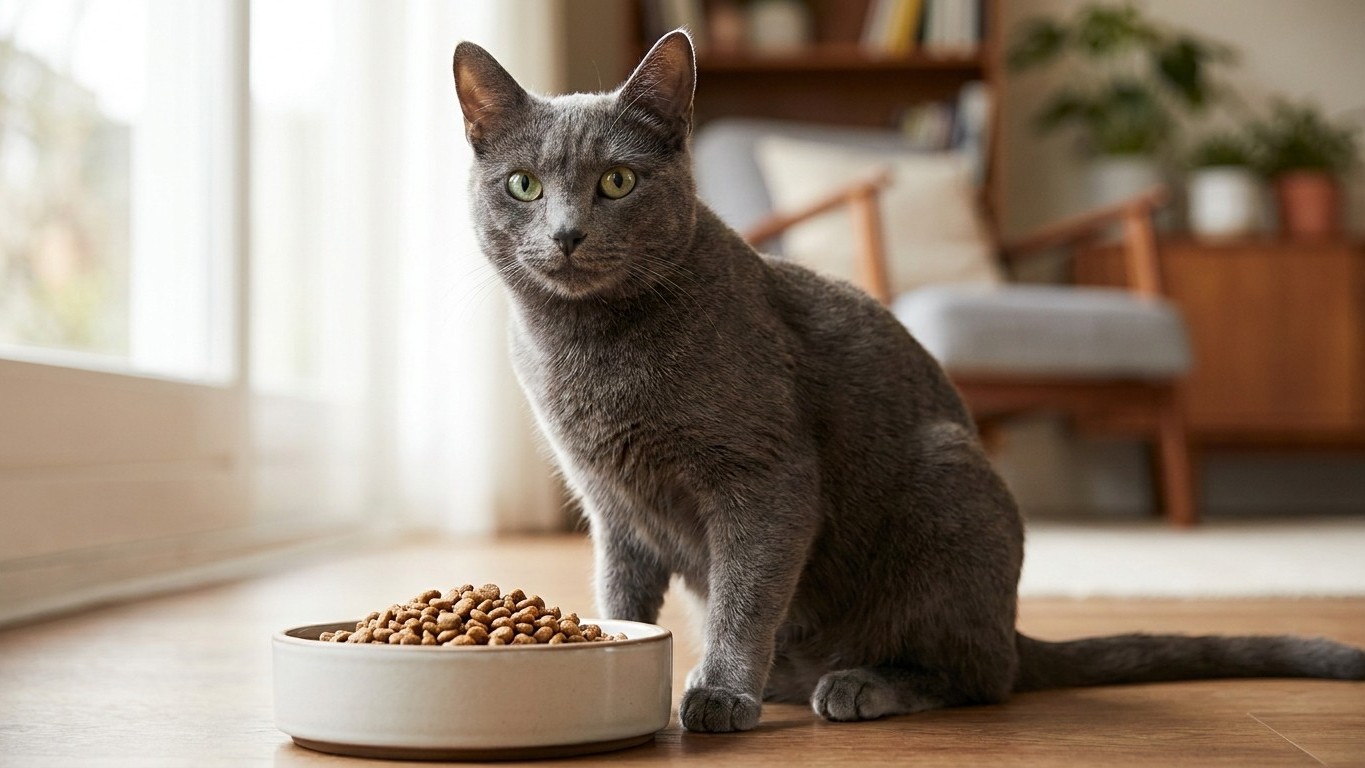
Cats and dogs might share a food bowl in some households, but their bodies process nutrients in completely different ways, and that gap can quietly wreck a cat’s heart. The most striking example is taurine, an amino acid that cats are unable to make themselves, just as people can’t make their own vitamin C, and must ingest it to stay healthy. Dogs, on the other hand, can generally synthesise what they need from other ingredients, so dog food simply isn’t formulated with a cat’s needs in mind. Feed that kibble for a few days by accident and nothing much happens. Feed it for months, as a stopgap “just to tide him over”, and you’re gambling with something far more serious than an upset tummy.
Key takeaways
- Dog food lacks a nutrient cats cannot survive without, and vets have known about the consequences for decades
- By the time you notice your cat struggling to breathe, its heart may have been failing silently for months
- There is genuinely good news: this heart disease is often reversible—but only if caught in time
Why a cat’s heart depends on a nutrient dog food ignores
Taurine sounds obscure, but its role in feline biology is huge. Taurine is important in heart, brain, and reproductive health and it is necessary for vision and bile acid production, which aids in food digestion. Cats are obligate carnivores, and in the wild they’d get plentiful taurine from prey animals’ muscle and organ tissue. Taurine is plentiful in most animal tissues, and being carnivores, domestic, feral, and wild cats that hunt for food get adequate amounts of taurine from their diet. Commercial cat food is legally required to top up taurine levels because cooking and processing destroy some of it naturally. Dog food has no such obligation, because dogs don’t need dietary taurine the same way. Since taurine is known to be ‘essential’ for cats, cat food must have taurine supplemented in quantities established by AAFCO and the NRC, but to date there are no stated requirements for supplementing dog food with taurine.
This isn’t a new discovery, either. Vets have known about this danger for decades, and it’s actually one of the great success stories of pet nutrition science. In 1987, researchers published a landmark paper reporting that dilated cardiomyopathy in cats was associated with taurine deficiency and could be reversed by providing supplemental taurine. That single piece of research changed the entire pet food industry. Some commercial cat foods at the time contained insufficient amounts of taurine, causing dilated cardiomyopathy and other health issues, which led pet food companies to add more taurine to their manufactured foods, and taurine-associated dilated cardiomyopathy in cats has all but disappeared. The condition still turns up occasionally, though, and the pattern is depressingly familiar. It is occasionally diagnosed when cat owners feed unbalanced diets, such as boiled poultry or vegetarian diets, and, as countless worried owners have discovered too late, dog kibble fed long-term fits that same unbalanced category.
What dilated cardiomyopathy actually does inside the heart
The mechanics of this disease are genuinely unsettling once you understand them. In DCM, the heart chambers become dilated while the walls of the heart become thin, and these thinner walls are weak and cannot perform the heart’s normal work, including pushing blood to the rest of the body. Picture a balloon that’s been over-stretched: it still looks like a balloon, but it’s lost its spring and can’t squeeze properly any more. That’s roughly what’s happening to a taurine-starved feline heart, chamber by chamber, month after month, often with barely a visible symptom on the outside.
And that’s the cruel part. Cats are notorious for hiding illness, an evolutionary hangover from being both predator and prey in the wild, and heart disease exploits that instinct ruthlessly. Many cats do not show symptoms of DCM until the condition is severe and they’re in congestive heart failure. When signs do finally show, they’re frightening: rapid or laboured breathing, open-mouth breathing or panting, weakness, lethargy, pale gums, or even collapse and fainting. By the time an owner notices any of that, the heart has often been struggling in silence for a long time. If not diagnosed and treated, cats with DCM will either develop a life-threatening heart arrhythmia or progress to congestive heart failure, which is a medical emergency and can have a guarded prognosis.
Vision can take a hit too, and this damage doesn’t reverse. Taurine deficiency can cause retinal degeneration, a progressive loss of vision cells in the retina, resulting in gradual vision loss and eventual blindness. A vet examining a cat’s eyes during a routine check might spot subtle retinal changes long before an owner notices their cat bumping into furniture at dusk.
Diagnosis, and the genuinely good news about recovery
If you suspect your cat’s diet has been inadequate, don’t wait for a full collapse before booking an appointment. A vet will typically start with a thorough conversation about exactly what’s gone into the bowl. Your vet will want to know exactly what your cat has been eating and for how long. From there, diagnosis usually combines several tools: echocardiography, considered the gold standard for diagnosing DCM and measuring heart chamber dimensions and myocardial contractility, alongside chest X-rays to evaluate heart size and detect fluid in the lungs, plus routine bloodwork and urinalysis to rule out other disease. Blood taurine levels can also be checked directly, though cats with taurine deficiency might have normal bloodwork and urinalysis, which might prompt a vet to additionally check blood taurine levels if deficiency is suspected.
Here’s the genuinely encouraging bit. Unlike a lot of heart disease, this form is often reversible if caught in time. Treatment requires supplementation with taurine, which may be lifelong but is typically only needed for a few months until improvement is noted, and with supplementation, cats diagnosed with DCM have a good prognosis and can show improvement in as little as a few weeks. The diet itself gets overhauled too, moving the cat back onto a complete and well-balanced diet, one approved by AAFCO, the organisational body that ensures the safety and quality of pet food and requires correct levels of taurine in the feed. Cats in full heart failure will usually need more than nutrition alone. Cats with established congestive heart failure will require concurrent cardiac medications, typically diuretics, ACE inhibitors, positive inotropes like pimobendan, and occasionally antiarrhythmics, alongside taurine supplementation.
Sight, sadly, doesn’t bounce back the same way heart function can. Retinal degeneration caused by taurine deficiency is irreversible, though supplementation can halt further progression and preserve whatever vision remains. That asymmetry, a heart that can heal against eyes that can’t, is worth remembering next time you’re tempted to reach for whatever’s in the cupboard because the cat food’s run out. Keep a small emergency stash of proper cat food on hand, and if borrowing from the dog bowl ever becomes a habit rather than a one-off, get your cat’s heart checked, not just because it’s sensible, but because with this particular disease, time really is the difference between a full recovery and a heart that never quite pumps the same way again.
Sources : avmajournals.avma.org | wagwalking.com