
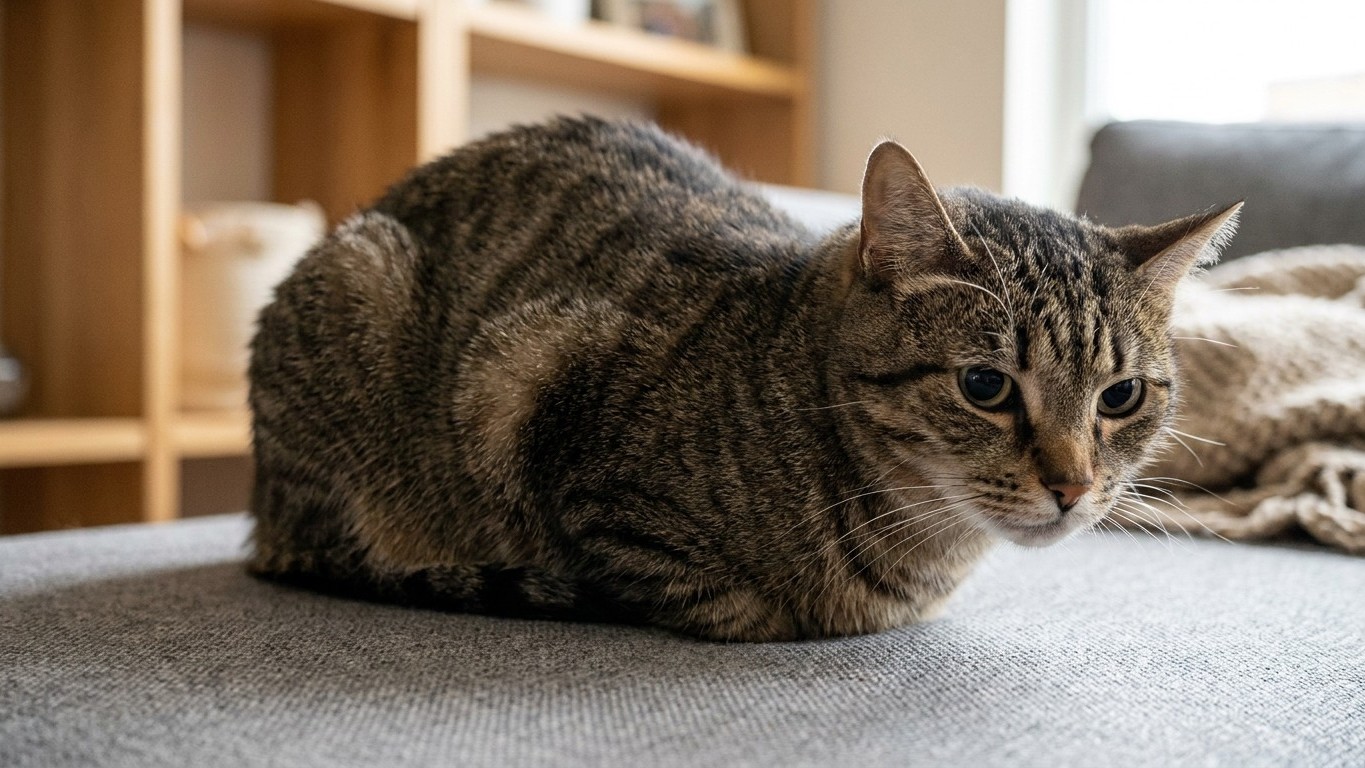
Every evening, your cat settles into a neat little parcel on the sofa, paws tucked under, tail wrapped close, purring softly as you watch telly. You think: happy cat, relaxed cat. But veterinary Professionals have been raising the alarm for years about exactly this scenario. Purring is usually thought of as a sign of contentment, but some cats purr when they are frightened or hurting. And that tidy, bread-loaf sitting posture, so endearing it spawned its own internet meme, can, in certain contexts, be one of the most misread signals of feline pain there is.
Key takeaways
- Your cat’s most endearing relaxation pose could secretly signal internal distress—and vets are sounding the alarm
- Purring isn’t always happiness: the vibrations might be your cat’s attempt at self-healing while suffering
- The subtle differences between a content cat and a hurting one are easy to miss—here’s exactly what to watch for
The master of disguise in your living room
Cats still have many of the behavioural traits that served their wild ancestors well, such as a tendency to hide signs of illness. In the wild, cats are both predators and prey, and predators target animals who are easy to catch, such as those who are hurt or ill. Hiding signs of an illness is an evolutionarily sound strategy that contributes to cats’ ability to survive in the wild. Your sofa-bound tabby has never stalked a mouse in its life, but that ancient wiring is still very much running in the background.
This survival instinct means that by the time a cat is visibly limping, skipping meals, or acting out, the pain may have been present for a while. That’s the uncomfortable truth: the cat you think is simply enjoying a quiet evening may have been quietly managing discomfort for weeks, even months. Cats rarely show pain in dramatic ways, they may not cry, limp, or vocalize until discomfort is severe.
The purr, specifically, deserves a rethink. Cats produce the purr through intermittent signalling of the laryngeal and diaphragmatic muscles, purring during both inhalation and exhalation with a consistent pattern and frequency between 25 and 150 Hertz. Various investigators have shown that sound frequencies in this range can improve bone density and promote healing. a cat may be purring precisely because it hurts, the vibrations acting as a kind of internal physiotherapy. It’s thought that your cat’s purrs might have comforting and reassuring effects that help the cat feel better when they’re in pain or sick. A purring cat, then, is not always a happy cat. It may simply be a cat doing its best to cope.
The loaf position: comfort or complaint?
The so-called “cat loaf”, all four paws tucked beneath the body, spine straight, eyes half-closed — is genuinely a sign of contentment most of the time. Cat loafing is a normal behaviour in the majority of cats, especially if your kitty assumes this posture on a comfortable and warm spot such as on the carpet where a ray of sun is beaming in through the window. But there is a darker twin to the classic loaf, and the difference is subtle enough to miss entirely.
The “meatloaf” position is similar to the loaf position, however this is not a relaxed position. Cats will typically have a rounded spine, leaning forward, bearing weight through their front paws, and the head may or may not be looking down at the ground. A cat in pain often assumes a tight ball-like shape with a hunched or arched back, head low (at or below shoulder level), and their front legs tucked under their chest. It looks different and more tense than the usual “loaf” position. This is a common way to distribute their weight forward and alleviate pressure from sore rear legs or hips.
Cats with abdominal pain, such as liver disease or chronic kidney disease, may also sit in the loaf position in order to help take pressure off internal organs. Cats who sit in this position often suffer from limb pain due to injuries, ingrown nails and over-grooming, which may also lead to “partial loafing.” Context matters enormously. If your cat is repeatedly found randomly loafing in the middle of the floor or on a cold, uncomfortable surface, it’s time to investigate further.
Reading the signs alongside the posture
Posture alone is never the whole story. A cat in pain also changes how it interacts with you and its environment. The International Society of Feline Medicine identifies several behavioural patterns that typically accompany painful sitting postures: withdrawing or hiding, facing the back of an enclosed space, showing no interest in surroundings, refusing to play, and reacting aggressively or defensively to touch.
Purring may actually increase in a cat experiencing pain. The eyes can be very telling in cats with pain. This is true both for eye pain itself and for pain elsewhere in their body. Often, pain elsewhere in the body will result in larger (dilated) pupils. Cats who are in pain generally breathe faster and more shallowly than normal. In some instances, they may even pant. Panting in a cat, unlike in a dog, is almost never normal and always warrants a call to your vet.
Changes in grooming are another quiet red flag. An arthritic cat may shift its weight awkwardly, choose to lie down wherever it’s placed rather than moving to a preferred spot, or slink low to the ground when it does move. You might notice your cat sitting in unusual positions in the litter box, or grooming less because twisting into normal grooming postures hurts. These changes tend to develop gradually, which makes them easy to dismiss as “just getting older.”
The tail tells its own tale. A cat in pain often holds its tail low and close to the body, either tucked underneath or wrapped tightly around itself. This contrasts with the loose, relaxed tail position of a comfortable cat. And a lap cat who suddenly can’t stand being held may be experiencing pain when they are touched or petted.
What you can actually do
Researchers at the Université de Montréal developed a practical tool called the Feline Grimace Scale, which allows both vets and owners to assess acute pain by observing five facial features. The scale assesses the position of the cat’s ears, head, and whiskers, whether its eyes are open or closed, and muzzle tension. “All of these things reflect whether there’s tension in the face,” says Dr. Daniel Pang, PhD, associate professor of anesthesia and analgesia at the University of Calgary Faculty of Veterinary Medicine. The Feline Grimace Scale is a valid, fast, reliable and easy-to-use tool for feline acute pain assessment by both veterinary health professionals and cat owners. There is a free app and downloadable training manual available at felinegrimacescale.com, worth bookmarking.
One of the most useful things you can do before any vet appointment is film your cat at home. One of the best things cat owners can do to improve the outcome of their veterinary visit is to bring short videos and pictures of what their cat is doing at home. “The veterinarian really needs as much information about what’s going on as possible. Most diseases manifest through behaviour. I want to see these behavioural changes that owners see, because the veterinarian is not going to see any of that from the clinic.”
Never attempt to manage suspected feline pain with human medication. Veterinary evaluation is essential, as human pain medicines are toxic to cats and proper diagnosis leads to safe, effective treatment. While medical treatment for cats in pain remains behind that for dogs, modern studies and medical advances have brought new medications to the market specifically for treating cats in pain, so there is no reason for a cat to suffer needlessly.
The chronic pain picture in cats also has a demographic dimension worth knowing: chronic joint pain, particularly from osteoarthritis, creates a different pattern than acute pain. Rather than an obvious hunched posture, arthritic cats often just stop doing things. About 68% to 71% of owners with arthritic cats report changes in jumping activity. If your middle-aged or senior cat has quietly stopped leaping to its favourite perch, that “laziness” deserves a second look, and a vet conversation.
Sources : felinegrimacescale.com | winchestervetclinic.com