
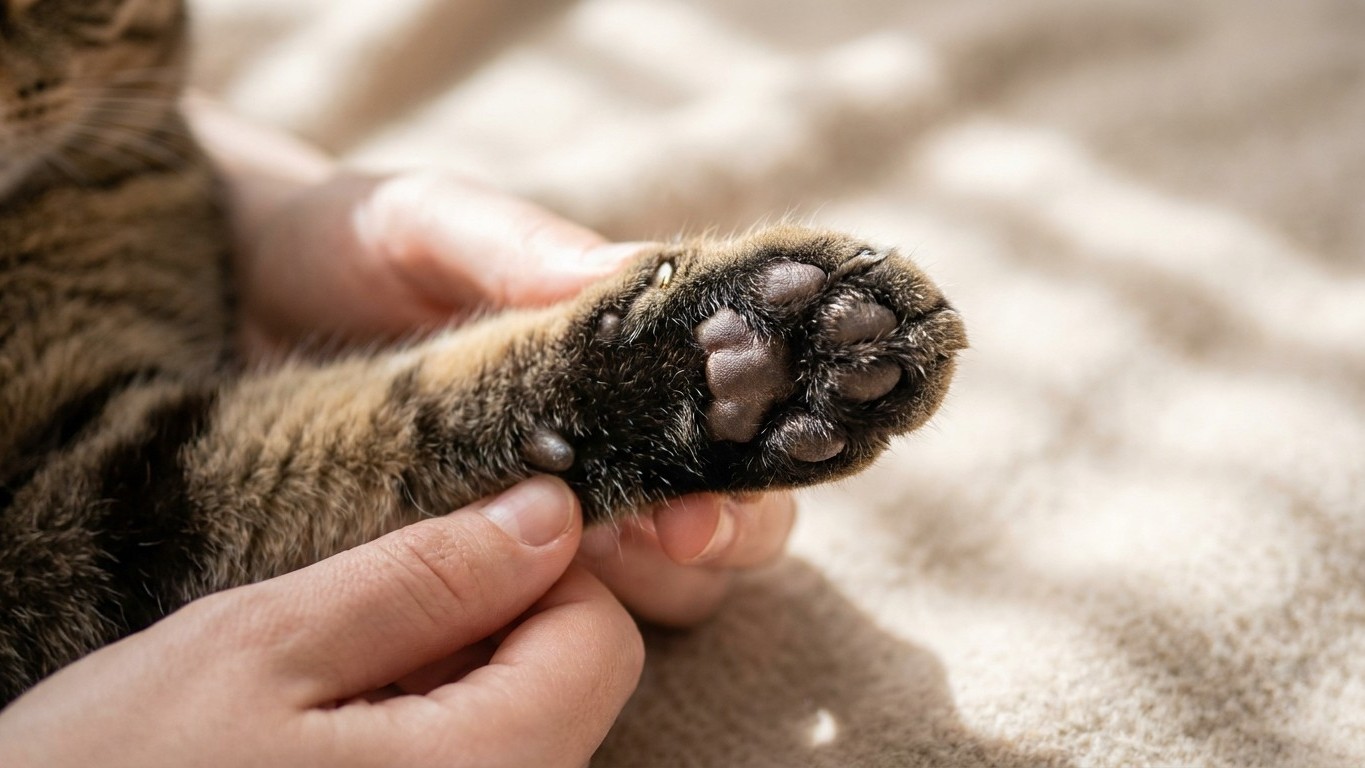
That innocuous patch of long grass at the edge of your garden? Right now, in late spring and early summer, it’s ripening into one of the most underrated hazards for outdoor cats in the UK. Grass seeds, the kind that look like tiny arrows or fish hooks at the tips of mature stems — are engineered by nature to travel. Unfortunately, the route they choose is often straight into your cat’s paw.
Key takeaways
- Nature’s perfect invader: grass seeds have barbs that only allow one-way movement deeper into skin
- Your cat won’t necessarily cry out—constant paw licking and tiny swellings between toes are the real alarm bells
- A seed the width of a matchstick can lead to hospitalisation or, in rare cases, become fatal if left untreated
A seed built to burrow
Grass seeds are the sharp bristles at the end of long grasses. In late spring and early summer, mature grass seeds harden and start to fall off, shaped a bit like arrows or fishing hooks, with pointy tips at one end and barbs at the other. That shape is no accident, these small seeds, often from foxtail-type plants, have a pointed shaft and an arrow-like appearance that easily gets caught in fur and can end up burrowing into the skin. Because of the backwards-facing barbs, they can only travel in one direction and become stuck within the layers of the dermis.
Think of it like a ratchet mechanism. Each time your cat moves, flexes a paw, or shifts her weight, the seed advances a fraction deeper. Unlike splinters or burrs, grass awns do not work themselves out, their barbs keep driving them deeper, carrying bacteria with them. As the seed gets deeper into the skin, it brings harmful bacteria with it and creates a path of infection known as a draining tract. This is the part that escalates from a mild annoyance to a genuine veterinary emergency.
Serious complications can develop if undetected seeds continue to work their way from their entry point to deeper parts of the body, including the lungs and eyes. In rare but documented cases, left untreated, they can even reach internal organs and become fatal. A single tiny seed, the width of a matchstick, can hospitalise a cat for days.
Why paws are the primary target, and how to spot the signs
Seeds can be a problem for cats if they get stuck in between their toes, with the arrowhead shape causing them to bury in and start moving up the leg. If your cat seems suddenly painful on one leg, won’t let you touch their paw, or if you can see a swelling in between the toes, make an appointment with your vet. Paws are the frontline because they’re the first point of contact with long grass, and the soft skin between the toes offers almost no resistance to a hardened, pointed seed.
The tricky part is that cats are stoic creatures. They may not yowl or limp dramatically at first. Constant licking of the paw, along with swelling or a lump, are the telltale early signs. If you see even a small pimple-like swelling in between your pet’s toes, they may have a foxtail stuck in their paw. That tiny bubble of inflammation is the body trying to wall off a foreign invader it cannot expel.
Paws, though, are only the beginning of the story. Once stuck in the fur, grass seeds will only move deeper, working their way into narrow spaces like the ear canals, between the toes, or even under eyelids. Scratching or pawing at an ear, shaking their head, or holding their head to one side, these can all signal a seed that has lodged deep in the ear canal, and a seed there is not something you can safely fish out at home. It’s not safe or practical to try and remove a grass seed lodged in your cat’s throat or ear canal at home.
If left untreated, a grass seed injury might lead to symptoms such as becoming extremely quiet or very restless, loss of appetite, and breathing difficulties. At that point, you’re no longer dealing with a seed, you’re dealing with a systemic infection.
What happens at the vet, and why speed matters
Speed genuinely changes outcomes here. The deeper a foxtail migrates into the body, the more likely surgery will be required to find and remove it. For seeds in the feet, a small surgical procedure is needed to open up the swelling in order to find and remove the seed, and sometimes your vet will put a poultice on the paw for 24 hours before the procedure to help “draw” the swelling.
Seeds in the mouth and throat may be removed with fine forceps, while those in the nose, airways, and ears require an endoscope, a camera and magnification that makes the seed easier to see and grasp with tiny “claws” which pass safely through the endoscope. For seeds that have migrated further, treatment could range from local anaesthetic to a full general anaesthetic to remove the seed, flush out infection, and prescribe medication.
The financial reality is sobering too. Grass seed removal may cost from hundreds to thousands of pounds, depending on where they lodge and how hard they are to find. Awns can even create tracts that continue to leak pus weeks after the initial exposure. Catching a seed while it still sits close to the skin surface is, quite literally, worth its weight in vet bills avoided.
Practical steps to protect your cat this season
The good news is that this is one of those hazards where consistent habits genuinely make a difference. In late spring and early summer, mature grass seeds harden and start to fall off, so this is the window when vigilance counts most. A quick check of your cat’s paws and coat each time she comes in from the garden takes about two minutes and can head off a week-long veterinary saga.
Trim any fine, feathery hair around the ears, eyes, and feet of long-haired cats to reduce the “funnelling effect” that traps and directs grass seeds. For cats that are particularly adventurous, try to keep your cat indoors if you notice local long grasses have dried out and are scattering seeds. If your cat has a grass seed in their paw, bathing in salt water will help to clean the wound and may also help to draw the seed out, but this is a first-aid measure, not a substitute for professional removal if the seed has already broken the skin.
When you do your checks, focus on the areas seeds most love to hide: check between the toes, under the paw between the pads, armpits, groin, around the face, around the ears, and under the ear flap. And remember, even grass seeds between toes become “invisible” once they get through the skin. If you feel a small lump but see nothing, that absence of visible evidence is not reassurance. Always consult your vet if you have any doubt.
One thing many cat owners don’t realise: short-haired cats are far from immune. Smooth coats can still trap a single seed between the toes, and because there is less fur to act as a buffer, the seed may reach skin faster. The length of your lawn, meanwhile, is one variable you can actually control, keeping grass regularly mowed in areas your cat frequents removes the most dangerous, seed-bearing stems before they get the chance to harden and disperse.
Sources : theconversation.com | kingstonanimalhospital.com.au