
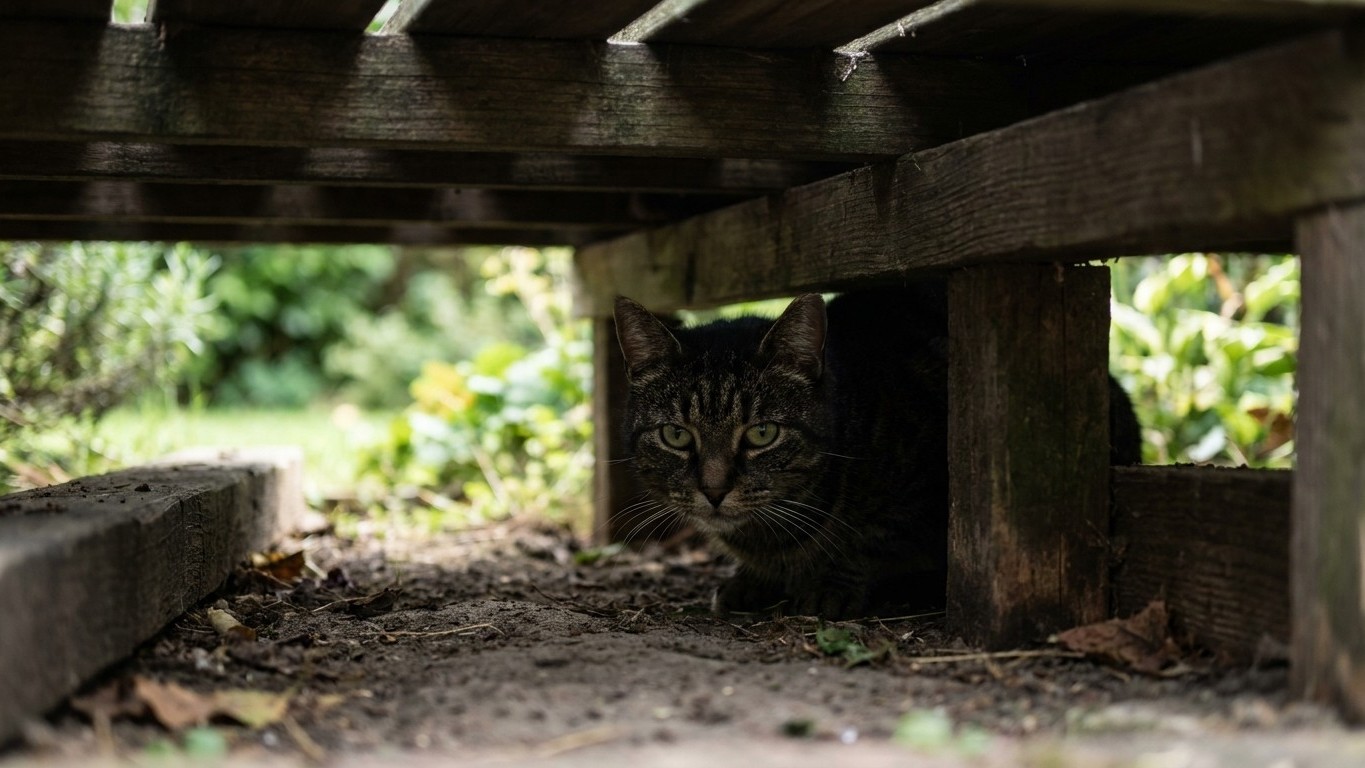
A cat that bolts at the first firework rarely runs far. Research into thousands of lost-cat cases shows that most lost cats stay within a very short distance of where they went missing, often within just a few houses. So while you’re pinning posters three streets away and widening the search radius by the hour, your cat is quite possibly frozen solid under next-door’s shed, close enough to hear you but too terrified to move. And here’s the bit that catches most owners out: hiding away and not responding has nothing to do with whether your cat loves you, whether it recognises your voice, it has everything to do with the fact that a frightened cat will hide in silence.
Key takeaways
- Most escaped cats hide within just a few houses of home, not streets away—but they stay completely silent
- A frightened cat’s survival instinct locks them in place; they won’t respond to your voice no matter how much they love you
- Scent, routine, and patience work far better than calling—discover the exact techniques that recover lost cats
Why a spooked cat goes quiet instead of running home
It seems backwards. Surely a cat that trusts you would come running the second it hears your voice? But panic switches off that whole social circuit. Cats are territorial and their primary protective measure from predators is to hide in silence, seeking areas of concealment such as under a deck, under a house, under a porch, or in heavy brush, because meowing would give up their location to a predator. This is sometimes called the “silence factor”, a term coined by American lost-pet researcher Kat Albrecht after two decades of tracking recovery cases. When a cat is frightened or displaced into unfamiliar territory, its instinct is to find the nearest hiding spot and stay completely silent, even when its owner is calling for it nearby.
Even a normally bold, chatty moggy can go into this frozen state. Even confident, outgoing cats usually hide when they’re frightened, as the instinct to seek shelter overrides their normal personality once they panic in unfamiliar territory. That’s why the cat who usually strolls out demanding dinner the moment your key turns in the lock might sit rigid and silent under a parked car for days, watching you walk past calling his name. He’s not sulking. He’s not confused about who you are. He’s in survival mode, and in that mode, staying invisible matters more than being reunited.
Fireworks are a genuine UK welfare problem, not a one-off scare
This isn’t a rare fluke scenario either. Firework fear in cats is startlingly common. Data from the PDSA Animal Wellbeing Report shows that a high proportion of UK pets are afraid of fireworks, with 40% of dogs, 34% of cats and 18% of rabbits affected. Cats Protection’s own annual survey backs this up: of the cat owners who have seen their cat experience fireworks, 65% say that their cat is adversely affected by them, including hiding (24%) or trying to escape/run away (14%). Multiply that across the roughly 11 million owned cats in Britain and you get a genuinely large number of gardens hosting a terrified, silent cat on any given bonfire night or New Year’s Eve.
The physical exit route is usually mundane, not dramatic. A gap under a fence panel, a cat flap left unlocked, a window cracked for ventilation. Once outside, an escaped cat isn’t exploring; it’s fleeing. A cat that escapes is usually not exploring the neighbourhood with confidence; most are scared, overwhelmed, and looking for the nearest tight, dark, quiet place to hide. That first hiding spot tends to be shockingly close to home. It’s often close to the door, window, garage, deck, porch, fence line, or opening where the cat got outside, and many escaped cats stay within nearby yards or structures at first, especially under decks, porches, sheds, bushes, or vehicles.
What actually coaxes him out (spoiler: it’s rarely a voice)
Calling doesn’t hurt, but it isn’t usually the thing that ends the ordeal. Movement in a frightened cat tends to happen when the world goes quiet, not when someone is shouting his name across a garden. A scared indoor cat may not move much during the day; movement is more common during quiet nighttime or early morning hours when people, dogs, traffic, and noise settle down. That’s why search advice consistently points towards the small hours rather than a daytime doorstep call-out, and towards senses other than hearing your voice.
Scent and routine do far more heavy lifting than most owners expect. Familiar smells signal safety in a way that a raised, anxious voice simply doesn’t. Practical steps that consistently show up in lost-cat recovery guidance include:
- Putting out unwashed bedding, a worn t-shirt or the litter tray near the escape point, since a cat’s nose is far more sensitive than ours
- Setting out strong-smelling food such as tuna or chicken at the same time each evening, then checking quietly rather than calling loudly
- Using a wildlife or trail camera, which can show whether the cat is returning to food, what time it’s moving, and whether it’s using a repeated path
- Placing a humane trap when the cat is confirmed nearby but won’t come out, appears only at night, or is too scared to approach people
Searching itself should start absurdly close to home before it goes wide. Searching too far away first can waste time while the cat may still be hiding nearby, so it’s best to start close to the escape point. Check under decking, behind bins, inside sheds and garages that neighbours might not think to open, and don’t be shy about asking to physically look rather than just asking “have you seen him?” A cat pressed flat behind a stack of plant pots is invisible to a glance over the fence.
Patience matters more than most owners are prepared for. Many cats will hide for a long time if they are afraid, and may only be found or return home after days or even weeks, so you shouldn’t give up. If your cat has form for firework fear, the more useful long-term fix is prevention rather than rescue: a secured cat flap or none at all on fireworks nights, curtains drawn before dusk, and a chat with your vet well before November about calming aids if the anxiety is severe. A microchip with up-to-date details, meanwhile, is the one thing that turns a frightened stray hunkered three gardens away into a phone call home rather than a permanent worry.
Sources : kcpetsearchandrescue.com | holistapet.com