
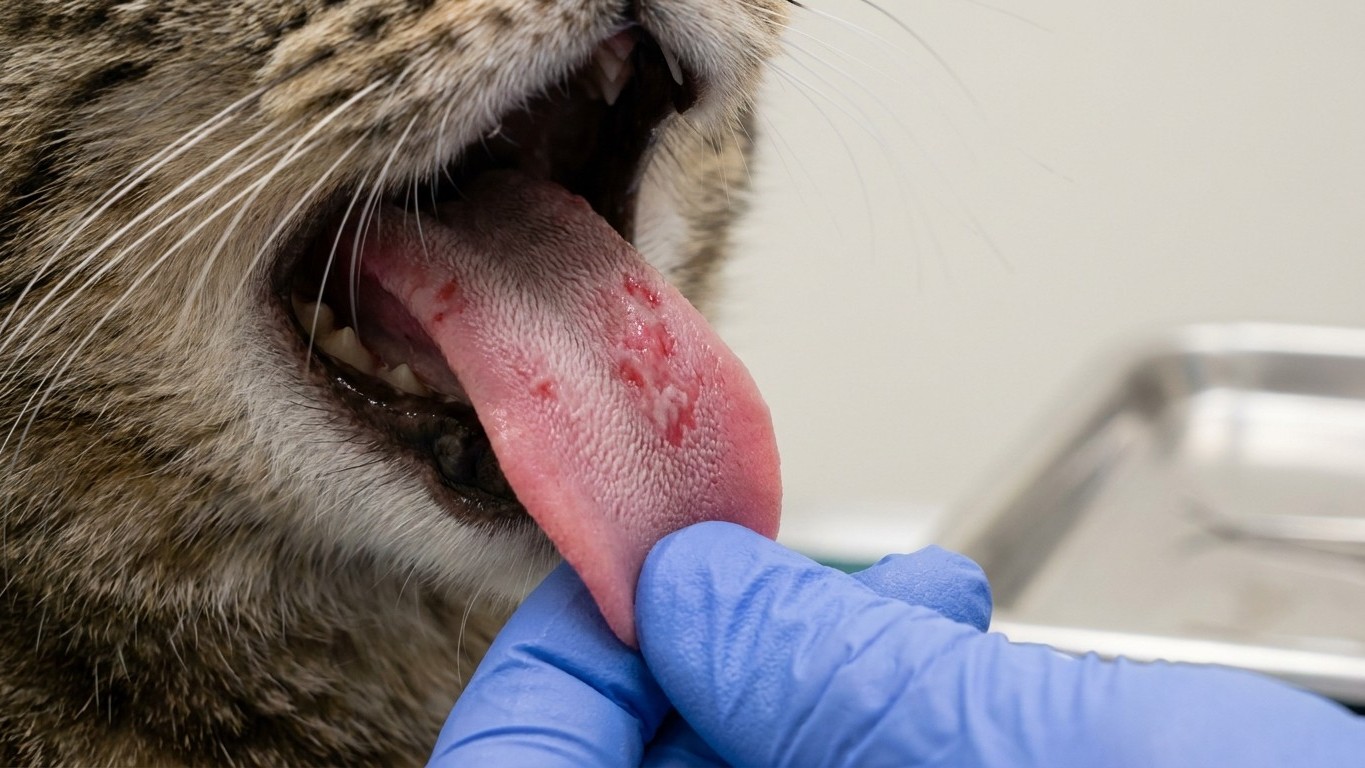
A kitchen counter that “looks dry” can still carry enough antibacterial residue to blister a cat’s tongue within hours. That’s exactly what happened to one owner whose cat jumped onto a surface wiped down minutes earlier with a disinfecting wipe. By the time the cat was seen at the vet’s, her tongue showed the tell-tale red, raw patches of chemical burn. The culprit almost certainly wasn’t the visible wetness on the counter. It was a residue owners rarely think twice about: benzalkonium chloride, a compound found in the vast majority of household antibacterial wipes and sprays.
Key takeaways
- A surface can look bone-dry but still carry enough chemical residue to cause severe mouth ulcers in cats within hours
- The invisible film left by ordinary supermarket antibacterial wipes can burn a cat’s delicate tongue down to the muscular layer
- Most owners never connect the incident to cleaning because symptoms take 6+ hours to appear—long after the product is forgotten
Why a “dry” surface still poisons cats
Benzalkonium chloride (often shortened to BAC) belongs to a family of cationic detergents used because they kill bacteria efficiently on hard surfaces. It’s found in disinfectant liquid and wipes, antiseptic cleaners, patio cleaners and automatic hand-soap dispensers. The trouble starts once a cat walks across a treated surface, or worse, rubs her cheek or tongue against it directly. Cats are fastidious groomers, and that instinct becomes a liability here: cats are very sensitive to these substances and toxicity can occur in this species following relatively small exposures, and cats that come into contact with these products often develop ulceration of their mouth and throat.
The counter didn’t need to feel wet for a problem to develop. Cationic detergents are irritants and can make cats sick if they have licked treated surfaces or walked on them and then ingested the chemical when grooming or licking their paws. A wipe can leave a thin invisible film long after the shine has evaporated, and a cat’s rough tongue and constant paw-licking are perfectly designed to pick it straight up.
What makes this particularly sneaky is the delay. Owners often rule out the cleaning product as a cause simply because nothing happened straight away. The most common signs were hypersalivation or drooling (53.9 per cent), tongue ulceration (40.4 per cent), hyperthermia (40.4 per cent) and oral ulceration (22.9 per cent), with the mean time recorded for onset of the first clinical sign being 6.4 hours, according to a UK study of 245 poisoning cases logged by the Veterinary Poisons Information Service. That’s a huge gap between the moment of contact and the moment a cat starts drooling or refusing food, easily long enough for the incident to be forgotten entirely.
What the vet actually sees on the tongue
Vets describe the injury as immediately recognisable once you know what to look for. Signs of benzalkonium chloride exposure include drooling, a red and inflamed tongue with a painful mouth, high body temperature, reduced appetite and coughing or breathing difficulties. In more severe presentations, the tissue damage goes deeper than surface redness. A case report published in Acta Veterinaria Scandinavica described a kitten that arrived with severe glossitis, lameness in the hindlimbs and episodes of vomiting and diarrhoea after BAC exposure, and laboratory research on the chemical’s effects found ulceration of the oral epithelium and tongue that extended to the muscular layer, with necrotic epithelium on the exposed submucosa of the proximal oesophagus in the most extreme cases.
Why does this hit cats so much harder than dogs or people? Feline tongues are thinner and more delicate, and the same review noted that cats have long been reported as more sensitive than dogs to quaternary ammonium compounds, with irritation such as oral ulcerations, stomatitis and pharyngitis observed after contact with concentrations of 2% or lower. Most household wipes sit well within that range, so no exotic industrial-strength product is required. An ordinary antibacterial wipe bought from any UK supermarket can, in the wrong circumstances, do this.
The good news buried in the grim statistics is that death is rare. The same VPIS dataset found that only 1.2% of the 245 cases died or were euthanized. Recovery, however, is not instant or pain-free. Treatment is supportive, involving analgesia, rehydration and syringe feeding if necessary, and recovery may take several days. Watching a cat unable to eat properly for the best part of a week, purely because of a kitchen wipe, is a sobering reminder of how much damage a “safe” household product can cause.
Making the kitchen genuinely cat-safe
None of this means banishing disinfectant from the house. It means rethinking how and where it’s used around an animal that treats every surface as a potential nap spot. The advice from International Cat Care is refreshingly practical: don’t allow your cat to access the area where a disinfectant has been used until it’s dry, and don’t allow your cat to walk over a recently treated surface. That sounds obvious until you remember that “dry” and “residue-free” are not the same thing, particularly with wipes designed to leave a lingering antibacterial layer behind.
For counters cats regularly use as a launchpad or lounging spot, it’s worth switching tactics entirely. If your cat walks on kitchen surfaces, other cleaning methods might be safer, and steam cleaning or a diluted washing-up liquid solution are both gentler, effective alternatives that avoid quaternary ammonium compounds altogether. It’s also worth checking labels rather than assuming: antibacterial wipes intended for cleaning or for use on people should never be used to clean your cat directly either, even in an emergency spill situation.
If you do spot drooling, pawing at the mouth, or a cat suddenly reluctant to eat after any cleaning session, don’t wait to see if it passes. Wash the product off with water and call your veterinary team immediately, and bring the product packaging with you so the vet can identify exactly what they’re dealing with. One small, overlooked detail, that the counter only looked dry, was enough to turn a routine bit of housework into an emergency trip. Worth remembering next time the antibacterial wipes come out before the cat’s had a chance to settle somewhere else.
Sources : pubmed.ncbi.nlm.nih.gov | link.springer.com