
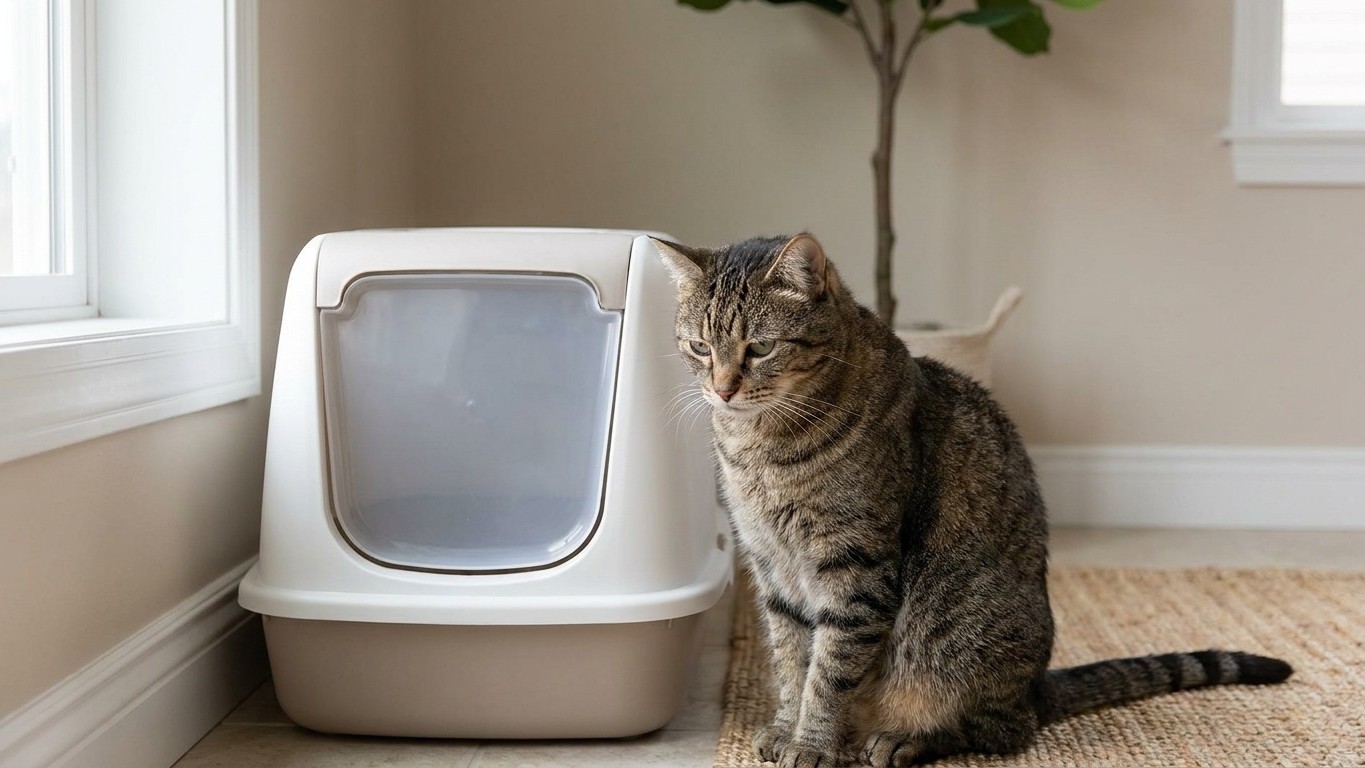
The rug was ruined, my temper was frayed, and I genuinely believed my cat had decided to punish me for the sheer inconvenience of a busier September morning. Turns out I had the story backwards. The vet I saw that week didn’t blame my cat’s attitude, my rug, or even bad litter tray hygiene. She pointed at something far less obvious: the sudden shift in household routine that comes every year when children go back to school, and the very real physiological stress response that shift can trigger in a cat’s bladder.
Key takeaways
- Cats are incapable of revenge or spite—litter box accidents signal distress, not defiance
- A cat’s bladder acts as its ‘stress organ,’ becoming inflamed and painful during routine disruptions
- Punishing a stressed cat makes the problem worse; the real solution is identifying triggers and rebuilding predictability
Cats Don’t Do Spite, Whatever It Looks Like
It’s tempting to read a puddle on the rug as revenge, especially when it appears right after a change you know your cat wasn’t thrilled about. But cats simply aren’t wired that way. If your cat is urinating on your bed or in your shoes, it’s not because they’re mad at you, getting back at you for bringing home a new puppy, or trying to defy your rules. That’s just not how cats think. Unlike humans, cats aren’t capable of spite or revenge. Choosing to wee outside the tray is, for a cat, driven by something else entirely, and it’s rarely about you personally.
For cats, choosing where to pee or poop is driven entirely by instinct. They simply want to go where they feel safe and secure. When that sense of safety wobbles, so does their bathroom behaviour. And a household suddenly filled with slamming doors, early alarms, rushed breakfasts and an empty house from 8am onwards is exactly the kind of wobble that can tip a sensitive cat over the edge.
The Bladder Is a Cat’s Stress Organ
This is the bit that genuinely surprised me. Vets increasingly describe the feline bladder as a kind of emotional barometer. The root cause of cystitis signs is stress. While humans with chronic stress may suffer from gastrointestinal symptoms, headaches or irritability, the cat’s main “stress organ” is its bladder. Instead of a tension headache, a stressed cat can develop a genuinely inflamed, painful bladder wall, a condition called Feline Idiopathic Cystitis, or FIC.
The mechanism behind it is oddly fascinating. When a cat with FIC experiences stress, their body produces excessive amounts of certain stress chemicals, and not enough of others, making them less able to cope. One effect of this chemical imbalance is that the bladder’s protective lining becomes patchy, and the bladder wall becomes inflamed and painful because it’s no longer protected from urine. So the cat isn’t being awkward when it avoids the tray, it’s often in genuine discomfort, and it may start associating the tray itself with that pain.
Some cats are simply built more vulnerable to this. Affected cats have smaller adrenal glands, and have a reduced ability to deal with stress compared to normal cats, producing less cortisone than normal. This is thought to be one of the factors that leads to the increased permeability of the lining of the bladder, and the resulting increased sensitivity of the bladder wall to inflammation following contact with urine. Add a few extra kilos and a strictly indoor lifestyle into the mix and the risk climbs further, since predisposing factors have been identified, such as overweight body condition, restricted access to the outdoors, decreased activity level, lack of perches or hiding spaces, multi-cat households, inter-cat aggression, eating a diet of mostly dry food, and having a nervous disposition.
Back-to-school week ticks several of these boxes at once. The vet who examined my cat pointed out that routine change is one of the classic triggers vets see clustering around September and January, when family schedules reset overnight. Experts believe that stress plays a role, as cats who experience sudden changes to their routine or environment and cats that live in multi-cat households are more likely to develop FIC.
Why You Should Never Just Tell the Cat Off
Scolding doesn’t just fail to help, it can actively make things worse. Punishment adds fear on top of an already stressed animal, and fear is one of the very triggers driving the behaviour in the first place. Never punish a cat for urinating outside the litter box. Veterinary evaluation should always be the first step. That’s not a soft-hearted platitude, it’s the clinical consensus, because the cause is often a medical condition, stress, or an issue with the litter box itself, and the best way to stop inappropriate urination is to identify and treat the underlying cause rather than simply addressing the behaviour.
There’s also a genuine emergency to watch for, particularly in male cats. Predisposing factors aside, the inability to urinate, especially in male cats, is a critical emergency, and your cat must be seen by a veterinarian immediately. A cat straining repeatedly with little or no urine coming out is not being fussy, it may have a blocked urethra, which can be fatal within days without treatment. This is one welfare issue where hesitation genuinely costs lives, so any sudden change in toileting habits deserves a same-day call to the vet, not a wait-and-see approach.
What Actually Helps
Once the medical checks came back clear for my cat, the advice shifted towards rebuilding a sense of predictability. Keeping feeding times, play sessions and even the order of the morning routine as consistent as possible seems to matter more than any single product. Pheromone diffusers get mentioned a lot by vets too, since stress reduction in the form of pheromones can help, and products like Feliway, a synthetic analogue of a feline facial pheromone, have been shown to increase grooming, interest in food, and overall signs of decreased stress in cats exposed to it.
Practical tray management matters just as much. Multi-cat households in particular need generous provision, because the guidance is clear that you should have at least one litter box per cat plus one additional to that, so at least 3 litter boxes for 2 cats, even if they are bonded, positioned somewhere quiet and away from noisy appliances or busy hallways where a rushed school-morning stampede might spook a nervous cat mid-wee.
The rug, in the end, wasn’t really the story. My cat wasn’t cross with me, wasn’t being naughty, and certainly wasn’t holding a grudge about earlier bedtimes. She was reacting, in the only language her body had, to a house that suddenly felt less predictable than the one she’d spent all summer getting comfortable in. Worth remembering next September, before anyone reaches for the stern voice.
Sources : cats.com | justcatsclinic.com