
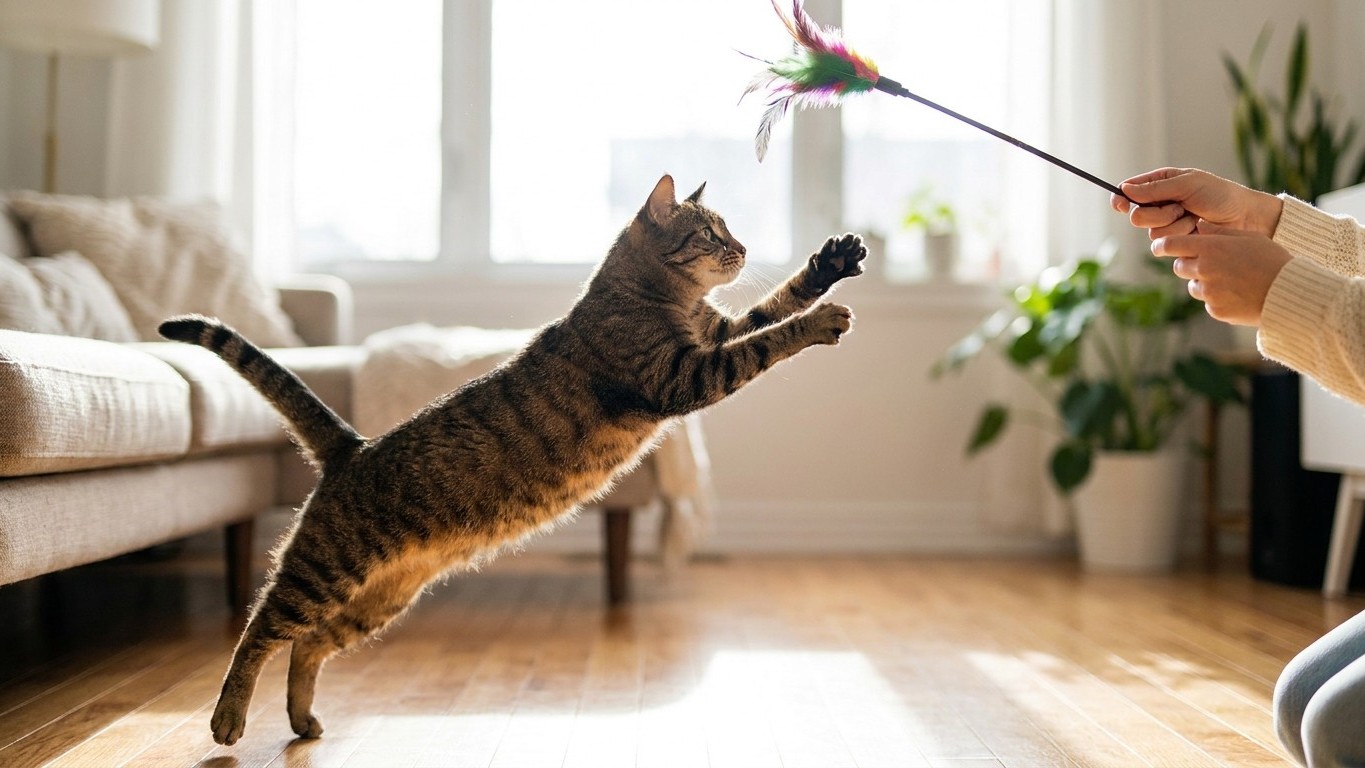
Shouting at a cat that’s just deposited a mangled mouse on your doormat achieves precisely nothing, aside from raising your own blood pressure. Scientists at the University of Exeter have found something that actually works: a short, structured play session before your cat’s evening meal, lasting just five to ten minutes, cuts the number of dead animals brought home by a quarter.
The study, published in Current Biology in 2021, tracked 355 cats across 219 UK households over twelve weeks. Households where 5–10 minutes of daily object play was introduced recorded decreases of 25% in numbers of animals captured and brought home by cats, relative to controls and the pre-treatment period. That’s not a marginal effect. It’s the difference between a cat that’s constantly restless and one that’s had its predatory itch properly scratched.
Key takeaways
- Why punishment backfires and what cats are actually driven by when they hunt
- The exact 10-minute play sequence that mimics a real kill and satisfies predatory instinct
- Three evidence-backed strategies that work better together than any single intervention
Why telling your cat off is a waste of breath
Cats aren’t hunting because they’re hungry. This drive to hunt is not motivated by hunger. Even if they are well fed at home, they will still have an inbuilt need to chase and catch things. That’s the bit most owners get wrong. You could serve your cat a five-star dinner every evening and it would still stalk a vole in the flowerbed an hour later, because the urge to chase, pounce and grab lives somewhere far deeper than the stomach.
As for why they bring the “gift” indoors rather than eating it on the spot, the current thinking has shifted away from the old romantic idea of a loving tribute. It is now thought that cats quite simply prefer to bring their prey back to their core territory where it is safer to eat it, or store it for a bit later. This ‘core territory’ is the house, often in the space they share with you. Your cat isn’t showing off. It’s just using the safest larder it knows, which happens to be your kitchen floor.
Punishment doesn’t touch any of this. It’s important not to punish your cat for catching wildlife or bringing their prey home. They won’t understand what they’ve done wrong. As hunting is a natural instinct for cats, shouting at them won’t deter them from doing it again. It will only cause them stress which could lead to other unwanted behaviours. A telling-off doesn’t stop the hunting instinct; it just adds a layer of anxiety on top of a perfectly natural behaviour, which can make a cat more highly strung, not less predatory.
What the ten-minute habit actually looks like
The Exeter researchers didn’t just tell owners to “play more” and leave it vague. Owners in the study simulated a hunting experience by moving a feather toy on a string with a wand so that cats could stalk, chase, and pounce. Crucially, the session didn’t stop there. As a reward, owners also gave cats a toy mouse to play with after each simulated hunt, thereby mimicking a real kill. That final step matters more than most owners realise. A cat that chases a feather wand for ten minutes but never gets to “catch” and shake something satisfying is left mid-sequence, a bit like being called away from the table just before pudding.
Timing it before dinner isn’t incidental either. The natural hunt-kill-eat sequence in wild felines runs stalk, chase, pounce, kill, then feed. Running a mock hunt right before the food bowl comes out lets the cat complete that loop in the order its brain expects, rather than leaving predatory energy with nowhere to go once the belly is full and the motivation to “hunt” for entertainment has already switched on for the evening.
One detail from the same study surprised even the researchers. Cats given their existing food in a puzzle feeder saw predation increase by 33 percent, a result the researcher admitted was surprising. The theory is that frustrated, hungrier cats simply went outside and hunted for real instead. It’s a useful reminder that not every “enrichment” gadget on the market does what the packaging implies, and that a plain ten-minute play session with a feather wand beats a fancy feeder hands down.
Stacking the odds further in the local wildlife’s favour
Play isn’t the only lever. Diet plays a surprisingly large role too. Feeding cats a diet in which proteins came from meat reduced the number of prey animals that cats brought home by 36%. Nobody is entirely sure why a meat-rich diet blunts hunting behaviour rather than fuelling it, but the effect was even bigger than the play intervention.
Timing outdoor access matters as well, since wildlife such as mice, voles, and birds tend to be more active at night and early in the morning, so preventing your cat from going outdoors during this time will reduce his chances of a successful kill. Combine a dawn-and-dusk curfew with the daily play habit and a meat-forward diet, and you’re addressing the problem from three angles at once, rather than hoping a stern voice will do the job alone.
For owners who’d rather protect garden birds specifically, there’s one more option worth knowing about. The Birdsbesafe collar was the most effective way to reduce the number of birds the kitties brought home, cutting the total by 42% on average. Colourful patterned collar covers work because birds have sharp daytime vision and spot the bright fabric in time to flee, whereas small mammals rely more on hearing and scent, so the same collar barely dents the mouse count.
If your cat’s doormat deliveries have you at your wits’ end, the fix isn’t a firmer voice. It’s a feather wand, a toy mouse, and ten minutes on the living room floor, timed for right before the food bowl comes out. Do it daily rather than sporadically, since the Exeter trial ran the intervention consistently over twelve weeks to see the effect, not as an occasional treat when guilt strikes. Your local wildlife, and your doormat, will thank you for it.
Sources : sciencedirect.com | thevetdesk.com