
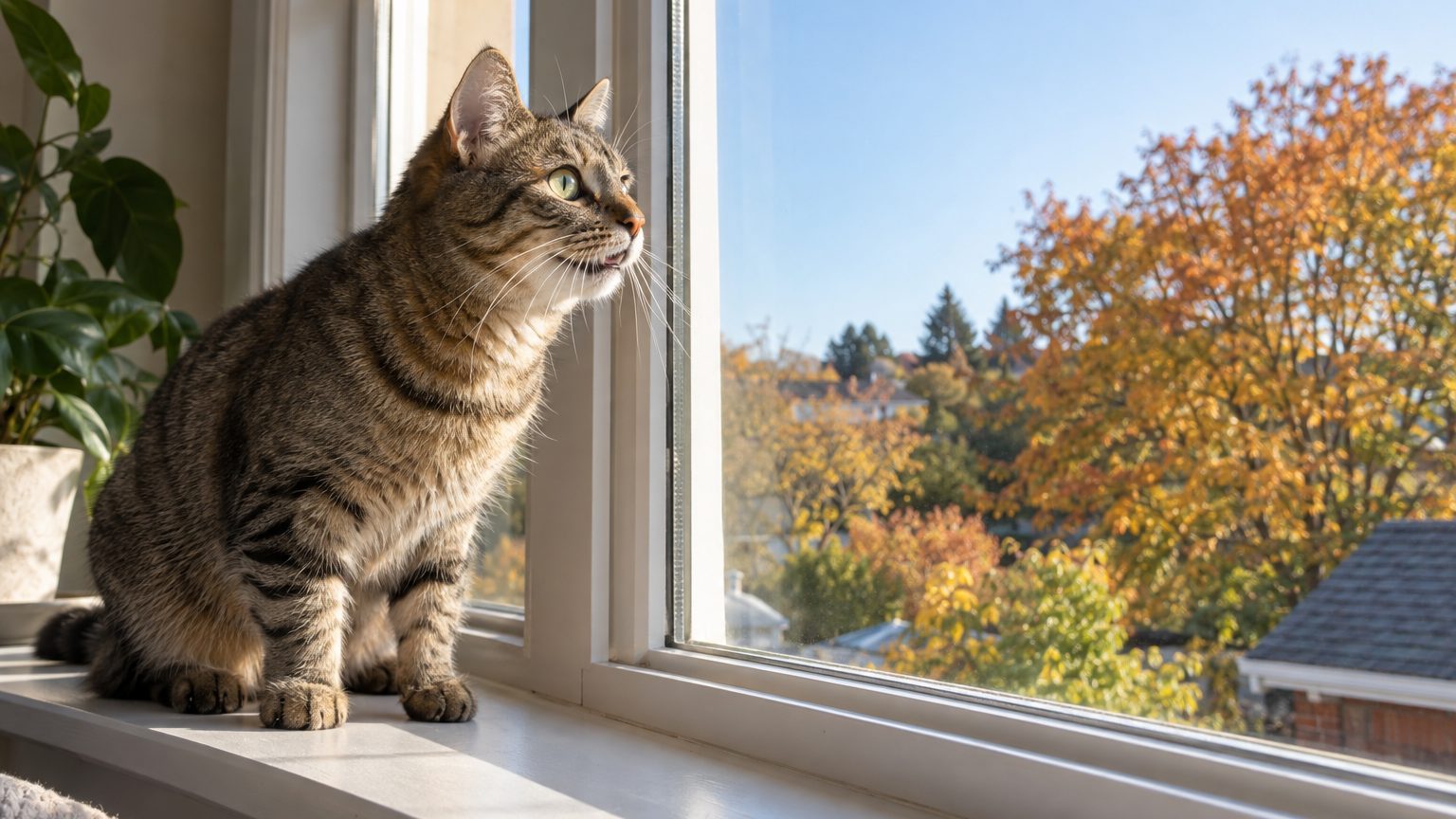
That rapid jaw-clicking, often with a high-pitched stutter somewhere between a squeak and a bleat, is almost always a sign of predatory arousal. Your cat has spotted prey it cannot reach (a sparrow on the feeder, a pigeon on the fence), and its brain is running the hunting sequence with nowhere to send the energy. Behaviourists call it chattering, chittering or twittering, and you will hear it from moggies and pedigrees alike.
Exactly why the jaw moves is still debated.
- Chattering is predatory arousal triggered when cats see prey they cannot reach, activating their hardwired hunting instinct.
- The jaw-clicking likely combines a rehearsal of the killing bite, mimicry, frustration, and nervous energy overflow.
- Prolonged chattering can lead to stress and redirected aggression toward other pets, so interactive play with wand toys provides a healthy outlet.
What is happening inside that little skull
Domestic cats are obligate carnivores, and they carry the full hunting routine inherited from their wildcat ancestors: stalk, chase, pounce, kill bite, eat. The sequence is largely hardwired, which explains why a kitten that never watched its mother hunt will still ambush a dangling piece of string. Thousands of years of sharing our homes have done little to switch it off. A bird on the other side of a pane of glass triggers the first half of the sequence and then denies the second.
Chattering seems to appear in exactly that gap. The cat usually locks its gaze on the target, ears swivelled forward, whiskers fanned, pupils wide and the tip of the tail flicking. Then the lower jaw begins to quiver, sometimes so fast the teeth audibly tap together. Some cats add a vocal “ek-ek-ek” on top, and a few seem to do little else for ten minutes at a stretch.
Four theories, none of them proven
The most popular explanation is a rehearsal of the killing bite. Cats dispatch small prey with a precise bite to the back of the neck, the canines slipping between the vertebrae, and the shivering jaw may be a flicker of that movement. It is neat and plausible and repeated everywhere, but nobody has tested it directly.
A second idea is mimicry. Researchers in the Brazilian Amazon documented a wild margay imitating the call of an infant pied tamarin, apparently to draw adult monkeys closer. Whether a house cat is deliberately imitating a starling is far less certain.
The third theory is plain frustration. The cat is wound up, the prey is out of reach, and the feeling has to leak out somewhere, much as a dog may whine at a closed gate when it has seen a squirrel. Excitement is the fourth candidate, and owners report the same tremor aimed at toys, flies and the odd moth on the ceiling. My own view is that these explanations overlap rather than compete, so the click is probably a mixture of anticipation, motor rehearsal and a surplus of nervous energy.
When the windowsill becomes a source of stress
Chattering itself is harmless. The trouble starts when a cat spends hours in a state of high arousal with no release. Frustration can spill over into redirected aggression, where the cat turns on the nearest available target, such as another cat, a dog or a person standing too close. Cats can stay on edge for hours afterwards, and in multi-cat homes a single incident at the window can sour a friendship for days.
The housemate usually pays the price.
If you see chattering followed by growling, flattened ears or a sudden swat at nothing in particular, give the cat space and let it calm down in its own time. Do not stroke it or pick it up, because an aroused cat can bite or scratch without meaning to. Block the view for a while with frosted film on the lower half of the glass or simply by closing a curtain.
Giving the instinct somewhere to go
The most effective fix is to complete the hunting sequence on purpose. A wand toy moved like a bird or a mouse, with pauses, skittering and the occasional dive behind furniture, lets the cat stalk, pounce and finally catch. Ten minutes once or twice a day is a sensible starting point. Finishing with a small meal or a few treats mimics the “eat” stage, and many cats settle noticeably afterwards.
Food puzzles and scatter feeding help too, since they make a cat work for its dinner rather than standing over a bowl. A bird feeder can be good enrichment, provided you put it either close to the glass or well away from it, as birds in the middle distance are the ones most likely to strike windows. Watch your cat’s body language, though. Some enjoy “bird TV” for an hour, while others tip into the tail-lashing, hissing state described above and are better off with the curtains drawn.
For cats that go outdoors, keeping them in at dawn and dusk, and during the nesting season in spring and early summer, protects the garden birds when they are most vulnerable.
Chattering that is not about birds
Jaw chattering with no prey in sight deserves a second look. A cat that clatters its teeth at random, drools, paws at its mouth, drops food or has bad breath may be dealing with dental disease or oral pain, which is common in cats and easily missed. Sudden tremors, repeated episodes or any behaviour that seems out of character call for a vet appointment, because only an examination can separate a sore mouth from simple excitement.
One last nuance: plenty of healthy, well-adjusted cats never chatter at all. Whether yours does seems to depend on temperament and individual wiring, so a silent jaw at the window is no cause for concern.