
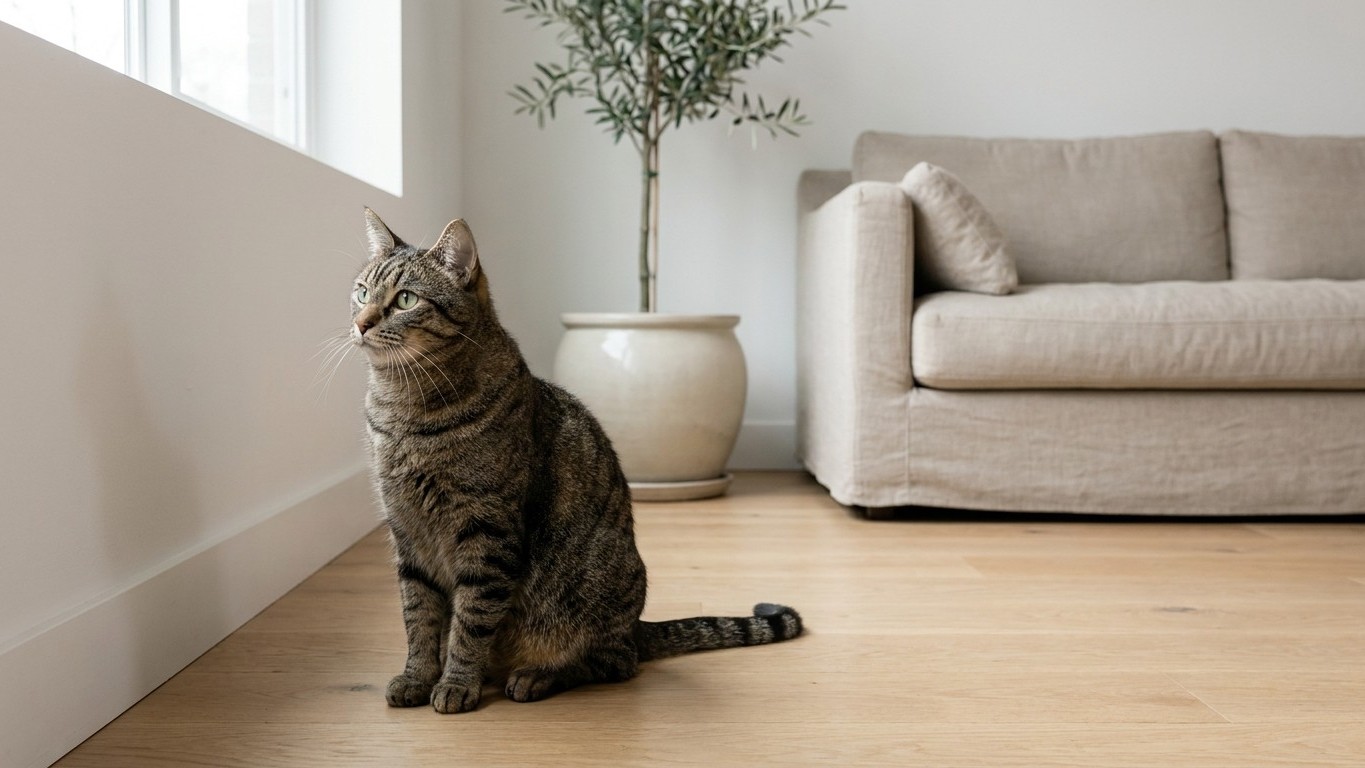
Your cat is frozen, eyes fixed on the wall, utterly motionless. No bug in sight, no shadow flickering, nothing you can detect. Most owners laugh it off as classic cat weirdness and carry on with their evening. But vets and feline behaviourists are increasingly clear on this: context matters enormously, and some episodes of blank wall-staring are worth taking very seriously .
Key takeaways
- Cats can hear frequencies 1.6 octaves above humans—that blank wall might be buzzing with invisible activity to them
- Seizures in cats often look nothing like you’d expect, and they can manifest as trance-like wall-staring episodes
- One specific behavior—head pressing against walls—is a red flag that demands immediate veterinary attention
What your cat is almost certainly picking up on
As highly adapted predators, cats have excellent vision, smell, and hearing, so often this behaviour is explained by them detecting something that we can’t. That blank stretch of plaster is, from your cat’s perspective, anything but boring. Cats can detect high-frequency sounds well beyond the human range. Pipes expanding inside walls, rodents behind baseboards, and HVAC systems all produce sounds your cat hears clearly. When your cat stares at a wall, what holds their attention is often what they hear.
Cats have incredible hearing ability, and while their hearing is about the same as humans on the low end, they can hear high-pitched sounds around 1.6 octaves above humans. These are sounds at frequencies that we cannot hear and aren’t even aware exist. Cats have sensitive hearing and can easily detect small sounds that pass us by. There are even stories of families finding rodents or raccoons making nests in their walls after being alerted to a specific spot by their cat staring at it. So before you assume something is wrong, consider whether you have any creaky pipes, thin walls backing onto a neighbour’s flat, or a persistent moth you haven’t noticed.
Vision plays a role too. Cats cannot see as many variations in colour as humans can, but their sight in low light and darkness is far superior to ours. In fact, cats have a reflective layer behind their retina that enables them to see using roughly 1/6 of the light that humans need. They also have a slightly wider field of view, at 200 degrees compared to our 180 degrees. A barely-there shadow moving across the skirting board at dusk is perfectly invisible to you and completely riveting to them.
When the staring is genuinely not normal
The trouble is that wall-staring can also be a window into something more troubling. Feline behaviour is something we may never fully understand, and it is very possible that cats may stare at walls for no other reasons than “because they are there”. However, several serious health conditions could explain this behaviour, so it’s not something we should simply ignore.
Seizures are one of the more significant possibilities, and they don’t always look how you’d expect. Cats more commonly suffer from partial seizures, which can be much harder to recognise. They can manifest as twitches, drooling, abnormal movement, and even growling or vocalising excessively. They can also cause affected cats to stare into space, so they may appear to be staring at walls. Absence seizures are rare forms of generalised seizures typically only showing minor, non-motor signs. Cats may not go into convulsions but instead act disoriented, unresponsive, and unaware of their surroundings, often staring into space for several seconds. If your cat seems to “come back” after one of these episodes looking dazed or slightly wobbly, film it if you can and get to a vet.
Then there is feline hyperesthesia syndrome, a condition that’s still not fully understood. If your cat has trance-like periods of staring at the wall in between episodes of manic behaviour, they could be suffering from feline hyperesthesia syndrome. Affected cats often meow or howl loudly, are sensitive to the touch, groom themselves frantically (especially at the tail base), and have enlarged pupils. The condition has only recently been recognised, and vets are not 100% sure what causes it, although it is likely linked to stress or anxiety.
In older cats, the picture can shift again. Among the most troubling age-related feline disorders is cognitive dysfunction, a progressively debilitating condition whose signs resemble those associated in humans with Alzheimer’s disease. The behavioural signs tend to become clearly noticeable in cats that are 10 years of age or older, and include long periods of staring blankly into space or at walls. Hyperthyroidism, a common condition in older cats where the thyroid gland produces too many hormones, can also cause hyperactivity, anxiety, and sometimes disorientation. Other symptoms include weight loss despite increased appetite, increased water consumption and urination, and a scruffy coat. These conditions are very manageable when caught early, which is precisely why they shouldn’t be brushed off.
The one symptom that needs urgent attention
There is a specific behaviour that sits in a completely different category from ordinary wall-gazing. There’s a difference between a cat who sits calmly and one who sits with Their Face Against the wall. Head pressing, literally pressing the head against a solid surface, is not normal and can indicate serious neurological disease. If you see this behaviour, contact your vet right away.
Other actions or symptoms that may accompany head pressing include disorientation, seizures, vision problems, pacing, and heightened vocalisation. Head pressing isn’t common in cats, but when it does occur, it can signal a serious medical condition such as a brain tumour, infectious disease, metabolic disorder, or poisoning. Don’t confuse this with bunting, that affectionate head-rub your cat gives the door frame or your shin is something else entirely and is no cause for concern.
How to tell the difference and what to do next
A quick practical test: gently call your cat’s name or make a soft noise while they’re staring. If your cat responds, stops staring, and resumes normal behaviour, it might indicate a less serious issue, such as temporary sensory perception or mild anxiety. However, if she doesn’t respond, appears absent or disoriented, it’s a more serious sign that could point to a neurological cause such as a focal seizure or cognitive dysfunction.
If your cat is staring at the wall and displaying any other symptoms, they should be brought in for an evaluation. Schedule a vet visit if your cat has started staring at the wall and is elderly, as old cats staring at the wall are more likely to be suffering with a medical problem. Seek veterinary attention if your cat’s staring is accompanied by symptoms like seizures, disorientation, behavioural changes, loss of appetite, or unusual physical movements. And always remember: if symptoms only occur intermittently, try to record a video so you can show your veterinarian exactly what happens.
For cats with confirmed cognitive dysfunction, it’s worth knowing that animal behaviourists note that cat owners can play a significant role in delaying the progress of feline senility. Suggestions include feeding an ageing cat a diet rich in vitamin E and antioxidants, avoiding bringing another animal into the household whose presence might be stressful, and making sure litter boxes are conveniently accessible with low sides for easy access. Small adjustments in the home environment can make a real difference to quality of life, though any changes to your cat’s diet or routine should always be discussed with your vet first.
One thing worth knowing: high blood pressure in cats is often a consequence of kidney disease or hyperthyroidism and can lead to retinal detachment and sudden blindness, which in turn causes disorientation and staring. A staring cat near a window that has recently started bumping into furniture deserves a blood pressure check at the surgery, it’s a quick, painless test that can catch a very serious problem before it becomes irreversible.
Sources : oreateai.com | therefinedfeline.com