
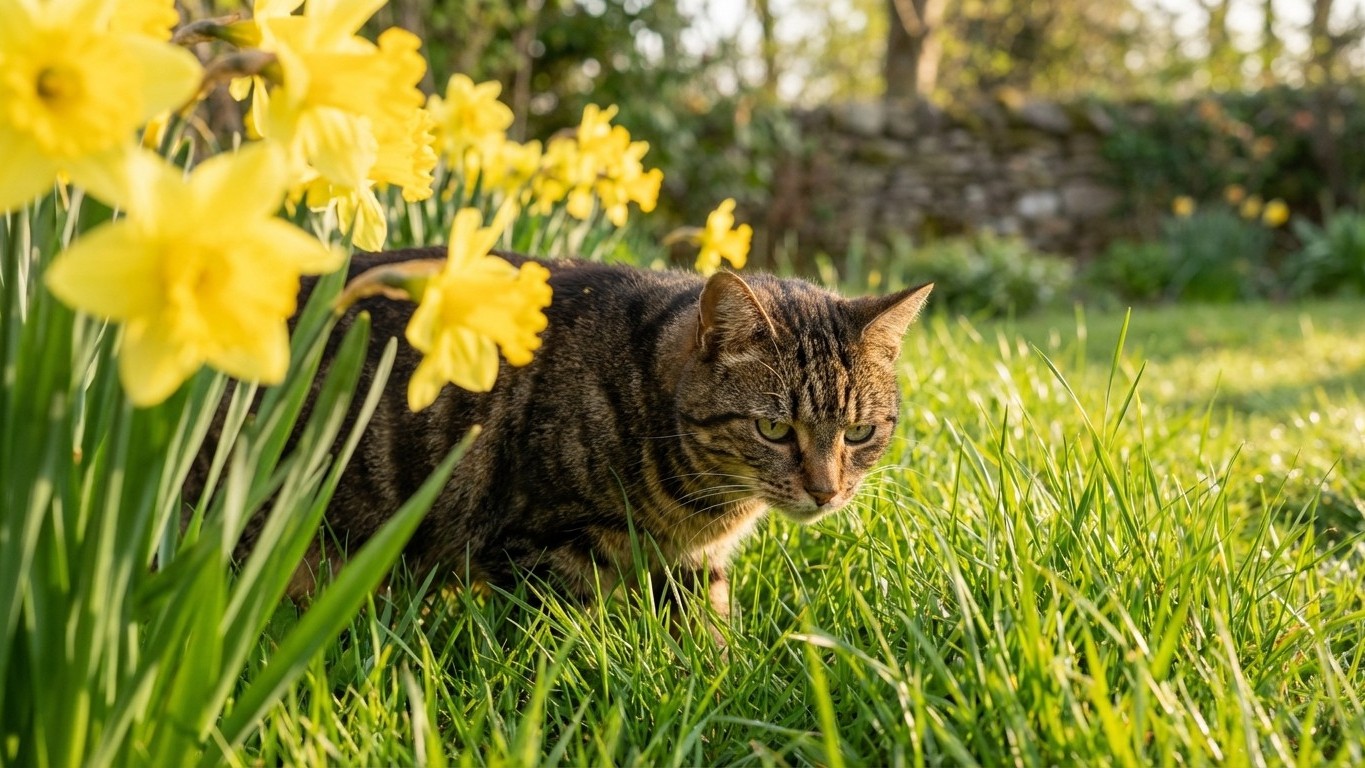
Cats eat grass. They always have. Watch any garden cat on a warm April morning and within minutes they’ll be crouching over a tuft of green, methodically chewing. For decades, most owners have accepted the explanation handed down like folk wisdom: the cat is purging itself, using nature’s own emetic. Perfectly normal. Nothing to worry about. The problem is, that explanation is largely a myth, and the combination of this misplaced confidence with a spring garden full of toxic plants and freshly sprayed lawns is landing more cats in emergency clinics than many owners realise.
Key takeaways
- The myth that cats eat grass to purge themselves has been debunked by science—but the real reason they do it is far more surprising
- One leaf of a lily plant can cause fatal kidney failure in cats within 72 hours, and spring is peak danger season
- Even ‘safe’ grass becomes lethal when treated with herbicides and pesticides that cats ingest while grooming their paws
The purging myth: what science actually says
It is a common misconception that cats eat grass only when they feel ill or nauseous. Cats are carnivores and cannot digest fibrous grass like cows and horses can, so it does frequently end up in their vomit and stool, but eating grass is actually a very common behaviour in cats, even in those who aren’t sick. Research from the University of California, Davis, surveyed over a thousand cat owners, and the results were striking. Eating plants is an extremely common behaviour, with 71% of cats caught in the act at least six times in their lifetime. Many online explanations posit that the behaviour helps cats throw up when they’re feeling ill, but only about a quarter of grass eaters were observed vomiting afterward, and 91% of respondents said their cat did not appear sick before eating plant matter. The vomiting, the researchers say, is merely an occasional byproduct of eating grass — not the objective.
So why do they do it at all? Eating plants is instinctual and comes with an evolutionary benefit to felines. The leading theory is that grass munching helps animals expel intestinal parasites by increasing muscle activity in the digestive tract. Today’s cats likely don’t have these parasites anymore, but the authors argue that the strategy probably first evolved in a distant ancestor. It’s a behavioural fossil, a reflex inherited from wild cats that hunted parasite-ridden rodents and had no workarounds. The data do not support the hypothesis that plant eating is a behaviour acquired for purging ingested hairballs or clumps of hair, either. The purging narrative, whichever version you prefer, simply doesn’t hold up under scrutiny.
Spring, when the garden becomes a minefield
None of this would matter much if every blade of grass your cat nibbled were harmless. But spring changes things dramatically. In spring, the Veterinary Poisons Information Service regularly receives enquiries about cats that have eaten spring flowers or bulbs, and a common source of plant exposure involves cut flowers and bouquets. This is the season when the plants most dangerous to cats are everywhere, in gardens, in parks, in Mother’s Day bunches left on the kitchen table.
Lilies are a prime example. Every part of the flower, leaves, stems and even the pollen, can cause fatal kidney failure, and their frequent appearance at Easter and in Mother’s Day bouquets makes them a significant, and often overlooked, seasonal hazard for cats. Without immediate veterinary treatment, lily poisoning is often irreversible and deadly. The scale of this danger is genuinely startling. The entire lily plant is toxic: the stem, leaves, flowers, pollen, and even the water in a vase. Eating just a small amount of a leaf or flower petal, licking a few pollen grains off its fur while grooming, or drinking the water from the vase can cause a cat to develop fatal kidney failure in less than three days.
Many common plants and flowers found in UK homes and gardens are toxic to cats, including lilies, daffodils, tulips, and crocuses. Daffodils, those cheerful yellow harbingers of spring that line every British country lane — carry a particular sting. Spring is synonymous with daffodils in bloom in gardens and parks across the UK, but this seemingly innocuous plant has the potential to make a cat very sick, or even kill it. The flower itself contains a vomiting-inducing alkaloid, while the bulb can cause cardiac arrhythmias or respiratory depression. Tulips, equally popular, are no safer: they contain allergenic lactones which, if swallowed, can lead to vomiting, diarrhoea and depression.
The invisible danger: treated grass
Here is the twist that catches many careful owners off guard. A cat that sensibly avoids flower beds can still end up at the emergency vet, simply by eating the lawn. Some types of grass are safe for cats to eat, but it may be dangerous if contaminated with herbicides or pesticides. Spring is precisely when British gardens and public green spaces get their first treatments of the year.
Cats are generally exposed to weed killers during, or soon after, their use by walking on treated grass or brushing against wet plants and then grooming. They may also walk in, or lick up, spills or drips from sprayed weeds, or chew treated plants. The grooming habit that makes cats so fastidiously clean is, in this context, the very thing working against them: every paw pad that crosses a sprayed lawn becomes a potential source of ingestion. Garden products like fertilisers, weed or moss killers, and lawn feeds vary in toxicity level. Cats may be at risk from eating sprayed plants or grass or drinking from containers, with symptoms ranging from mild tummy upset to more severe, such as heart and kidney problems, depending on the ingredients of the product and the amount ingested.
The slug pellet issue deserves its own mention. Slug bait pellets may contain metaldehyde, which is extremely toxic to cats. Slug bait is unfortunately appealing to pets and can cause serious symptoms like twitching and seizures. These pellets are scattered across British gardens every spring and summer, often in spots where cats roam freely. Figures from the Veterinary Poisons Information Service show a 55% increase in numbers of pesticide-related poisoning enquiries between 2019 and 2021. That trend has continued to concern animal welfare organisations.
What to do, and what never to do
The first rule, where lilies are concerned, is to not wait. Kidney failure occurs within 24 to 72 hours, which can lead to death if the cat isn’t treated. Early veterinary treatment greatly improves the cat’s chances, but if treatment is delayed by 18 hours or more after ingestion, an affected cat will generally have irreversible kidney failure which can prove fatal. Speed is Everything.
One of the most persistent and dangerous pieces of folk advice is to try to make a cat vomit at home. It is important not to try to make a cat vomit, as this can create further problems or injury. If you suspect your cat has eaten something toxic, call your vet immediately, or contact the Animal Poison Line. What to bring: the product or plant label, the estimated amount missing, the time of exposure, and your cat’s weight. If it’s safe, take a quick photo, it can save time when minutes matter.
When a cat does become unwell from plant contact, it is usually because something has brushed on their fur or paws, which they have then ingested while grooming. There is greater risk within the home as it is a confined area, and a bored or curious cat might investigate an indoor plant or a cut flower display by playing and nibbling. Removing toxic plants from the home entirely is the only genuinely reliable safeguard : “out of reach” is rarely out of reach for a determined cat.
The positive alternative is straightforward. The research team’s advice to cat owners is to buy or cultivate some indoor grass for pets to chew on, giving them a chance to exercise this innate behaviour with a safe source of non-poisonous plant life. Wheatgrass and oat grass kits are widely available in the UK and most cats take to them readily. A pot of cat grass on the windowsill, away from any lily bouquets, may be the simplest piece of spring welfare advice going. Worth noting: if your cat suddenly increases the frequency of their grass eating, or begins obsessively seeking out plants, that warrants a vet conversation, it may be an indication of a gastrointestinal disease, such as inflammatory bowel disease or even parasites. The instinct may be ancient, but a dramatic change in behaviour is your cat’s way of flagging that something is wrong.
Sources : vet.purdue.edu | ctvsh.com