
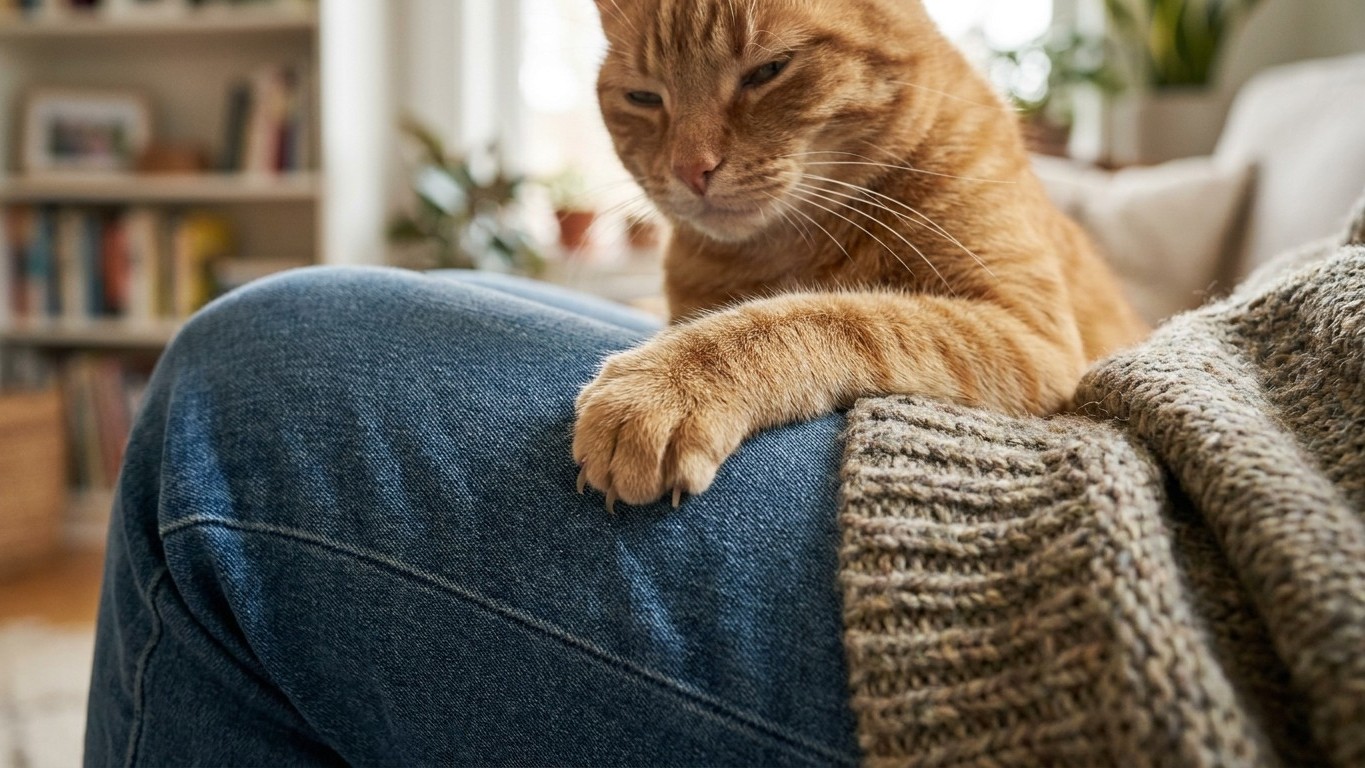
Your cat climbs onto your lap, starts pressing their paws rhythmically into your thighs, and your heart melts. Pure love, you think. And you’re not entirely wrong, but the full picture is considerably more layered, and a closer look at the science reveals that “making biscuits” is far less straightforward than a simple cuddle.
Key takeaways
- Your cat’s kneading habit carries a hidden past rooted in kitten nursing instincts
- The same behavior can signal contentment OR anxiety depending on one telltale detail vets watch for
- Your cat isn’t just showing affection—they’re also claiming you as their territory
The nursing reflex that never quite switched off
Kneading begins in kittens as an instinctual behaviour that is associated with feeding, it is not something cats ever have to learn. “The way the behaviour starts is: they knead the mother’s mammary glands to actually suck the milk.” The kitten’s kneading stimulates milk flow and may also release oxytocin, a social bonding hormone, in the mother. So far, so adorable.
But here’s where it gets interesting. Adult cats sometimes keep the behaviour long after they have fully developed, it is not unusual for domesticated animals to retain juvenile traits into adulthood, a phenomenon called neoteny, which also explains why dogs look and act more like wolf cubs than adult wolves. Your cat, is essentially a permanently juvenile wolf equivalent. A very fluffy one.
Kneading triggers the release of dopamine, a neurotransmitter associated with pleasure and reward. This behaviour, often beginning in kittenhood, is instinctive and tied to the comfort of nursing. As kittens knead their mother’s belly, dopamine is released, enhancing feelings of contentment and security. This physiological response persists into adulthood, meaning that when adult cats knead, they are re-experiencing those early comforting sensations. Think of it as muscle memory, but emotional muscle memory, encoded deep in the brain’s reward circuitry.
What the vet actually saw in the footage
This is where the narrative shifts. Most owners see kneading as affection, full stop. Feline behaviour specialists, though, read the context, the speed, the intensity, the accompanying body language, and they often come to a more nuanced conclusion.
Cats will knead on preferred people in the house or their favourite person, so kneading can be an affiliative, social behaviour that helps build a bond. In most cases, kneading means the cat feels happy, friendly and safe. But “most cases” is doing a lot of work in that sentence.
Kneading can also be a way that cats manage stress and anxiety, functioning as a self-soothing mechanism in situations that feel uncertain or overwhelming. Cats that experience changes in their environment, such as a move, a new pet, a new baby, or disrupted routines, may knead more frequently as a way of calming themselves. The key clue vets look for is the pattern of kneading: is it slow and trance-like, paired with purring and half-closed eyes? Or is it faster, more frantic, paired with restlessness or unusual vocalisation?
Sometimes your cat may look like they’re in a trance when kneading. Other times, they may be doing it faster and more anxiously. Those two scenarios signal very different emotional states, and conflating them is precisely the mistake well-meaning owners make.
Some cats knead when they feel anxious or unsettled, using it as a way to regulate their emotional state, similar to how humans might fidget or engage in a repetitive, calming motion. From this perspective, watching your cat knead is a bit like watching someone compulsively tap their fingers, sometimes it’s contentment, sometimes it’s barely-contained anxiety wearing a warm, fluffy disguise.
Territory, scent, and the ownership of your favourite jumper
There’s a third dimension to kneading that tends to get overlooked entirely: territorial marking. Cats have scent glands in the pads of their paws, which release pheromones when they knead. These chemical signals help cats mark their territory, signalling to other animals that a particular area, object, or even human, is “theirs.” This scent-marking is subtle and usually undetectable to us, but it is a crucial communication tool in the cat world.
So when your cat kneads your lap with great apparent devotion, part of what they’re doing is essentially filing paperwork. You are being registered as their human. When your cat kneads you, they are not just showing affection, they are also marking you as part of their territory and social group. Flattering, if you think about it.
In the wild, cats would create nests or sleeping areas by patting down foliage or grass. These recurring movements helped to soften the ground, making it more comfortable for resting or giving birth. Over time, this behaviour became ingrained in their instincts, even in the absence of such practical needs. Your lap, your blanket, your freshly laundered hoodie, all perfectly serviceable substitutes for a patch of wild grass, in your cat’s estimation.
When to move from charmed to concerned
Veterinary Professionals tend to flag two specific scenarios. The first is a sudden increase in kneading where there was none before. A cat that never kneaded before but suddenly begins doing so frequently may be seeking comfort. Environmental changes such as moving homes, new family members, or schedule shifts often influence behaviour. Kneading can become a grounding habit.
The second is obsessive or compulsive kneading. Excessive, compulsive kneading, particularly if accompanied by sucking or chewing on fabric, can occasionally indicate anxiety, stress, or a condition called wool sucking or pica. This behaviour is more common in cats weaned too early, as nursing provides both nutrition and comfort.
If you notice that your cat’s kneading has increased significantly alongside other signs of stress, such as hiding, changes in appetite, increased vocalisation, or altered litter box habits, it may be worth discussing with your veterinarian. Chronic stress in cats can lead to real health consequences including urinary problems, digestive upset, and skin issues from over-grooming. Always consult your vet if you’re unsure whether a behavioural change is within the normal range.
On the practical side, the advice is consistent across feline behaviour experts: never punish a kneading cat. Punishing your cat for what is a completely normal behaviour may cause fear and anxiety, it won’t correct the kneading and can actually make it worse. Instead, rather than attempting to stop the behaviour, consider gentle redirection. Providing a soft blanket or a dedicated pillow for your cat can offer an appropriate surface where they can engage in this natural activity without Discomfort to humans. Regular nail trims also help considerably.
One final detail that tends to delight cat owners once they know it: some cats start drooling as well when they knead : “those are the really happy guys.” If your cat is simultaneously making biscuits and leaving a small puddle on your trousers, congratulations. That is peak feline contentment, and no vet in the world will read anything alarming into it.
Sources : sunsetanytime.com | scientificamerican.com