
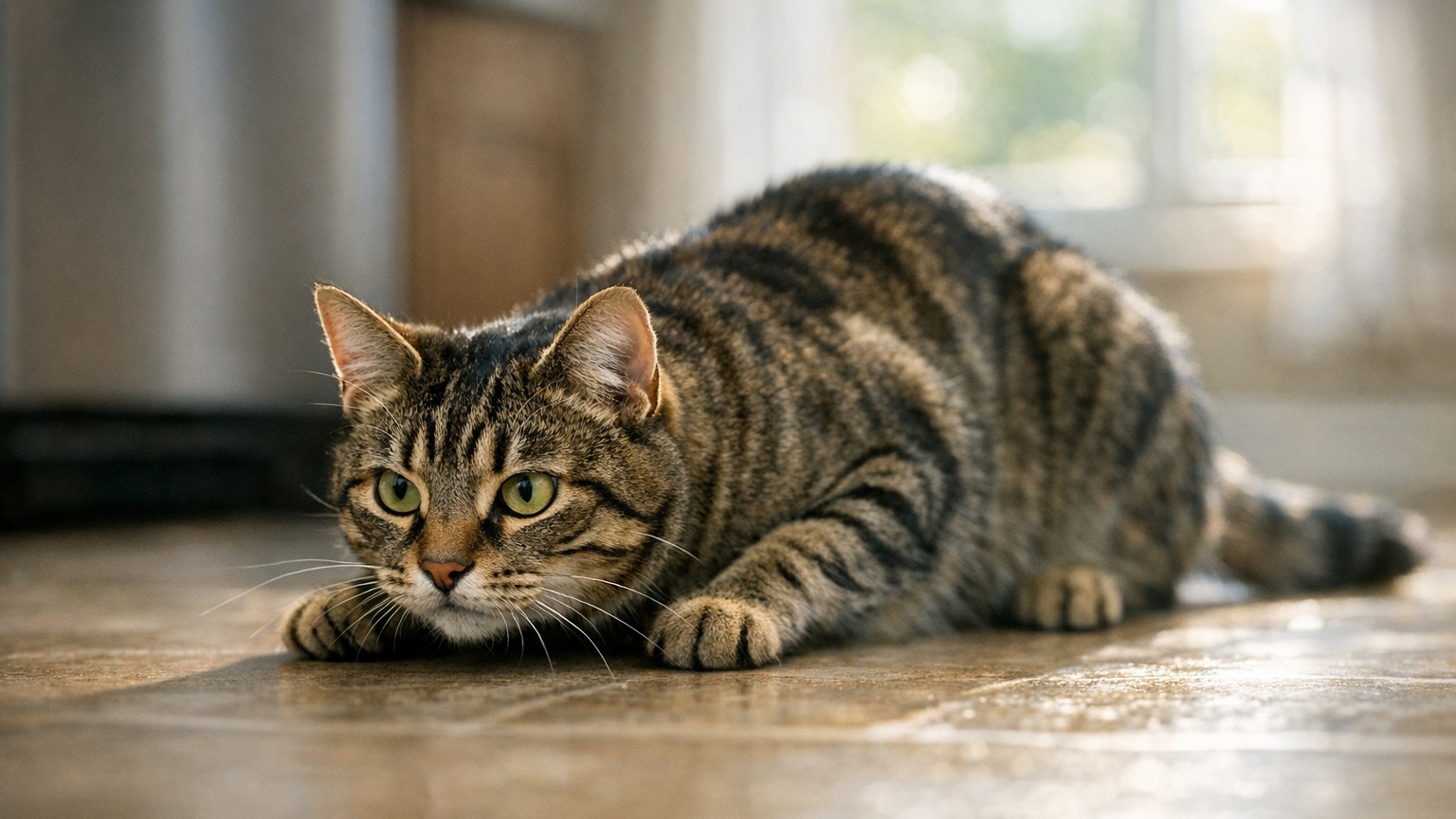
Every morning for three years, my cat Pebble deposited something on the kitchen floor before I’d even had my first cup of tea. A toy mouse on Monday. A dead sparrow on Wednesday. A crumpled crisp packet on Friday. I told friends she was thoughtful. I assumed it was love in its most direct, if slightly gruesome, form. Then I spoke to an ethologist, a scientist who studies animal behaviour in its natural context — and what they told me reshaped the way I understand my cat entirely.
Key takeaways
- Your cat isn’t giving you gifts—she’s trying to teach you to hunt like a proper adult
- Domestic cats are more efficient hunters than lions, yet they hunt out of instinct, not hunger
- There’s a scientifically-proven way to redirect this behavior (and it involves playtime at dusk)
It’s Not a Gift. It’s a Lesson.
The main hypothesis among behavioural scientists is that this behaviour is maternal. In the wild, mother cats go out and hunt and then bring the food back for their kittens, feeding the young cats. Also, providing something for them to play with, practise how to hunt, and recognise prey. So when Pebble dropped a limp sparrow at my feet with the pride of a Michelin-starred chef, she wasn’t honouring me. She was trying to educate me. In the context of human pet owners, our cats may see us as “not so efficient kittens.”
Ethologists studying domestic cats have noted that this behaviour bears strong similarities to behaviours observed in wild cat populations, suggesting deep evolutionary roots that persist despite thousands of years of domestication. That’s the part that genuinely shifted something for me. Pebble wasn’t being generous. She was fulfilling an ancient, instinctive role, and she’d cast me as her hopeless, can’t-hunt-to-save-itself offspring. Oddly flattering, in a humbling sort of way.
Many experts believe that bringing home prey isn’t necessarily a “gift” at all, but a practical matter of security. Home, or the front porch, is a cat’s safe, reliable “core territory.” They bring the catch back to this secure zone to prevent other animals from stealing it. Once the prey is secured, a well-fed domestic cat may simply lose interest in the deceased animal, preferring their usual cat food, and abandon it. Which explains the crisp packet. That, at least, was safe to handle.
The Hunter That Never Clocked Off
Until quite recently, cats were mainly kept to control rodent populations rather than as pets, and during this time, only the best hunters survived and reproduced, meaning our pet cats today descended from the most adept hunters. There’s been very little selective breeding of cats, so their instinctive need to hunt remains strong. Compare that to dogs, where centuries of selective breeding have radically altered behaviour across breeds, and you begin to Understand why no amount of premium kibble has ever made a cat forget how to stalk.
Here’s the statistic that stopped me mid-scroll when I first read it: domestic cats have a hunting success rate of around 32% when stalking birds and small mammals, which might not sound impressive until you consider that lions only succeed about 20% of the time. Your apparently dozy tabby, the one who sleeps 16 hours a day, is statistically a more efficient hunter than a lion. Research has shown that about 96% of their diet came from food provided by their owners, while just 3-4% came from eating wild animals — suggesting that predatory instinct, rather than hunger, is probably the main reason why some domestic cats regularly hunt wild prey. They’re not hunting because they’re starving. They’re hunting because they simply cannot stop themselves.
Regardless of whether a cat is hungry or not, the sight of potential prey awakens their hunting behaviour. It does not matter whether it is an outdoor, indoor, or wild cat, their hunting instinct is inherited and passed on from generation to generation. The average well-fed pet cat only hunts for around 3 hours each day, compared to an unowned, feral cat that’s not being fed, who may hunt for around 12 hours each day. So yes, your cat is restrained by comparison — just not in any way that helps your garden birds.
What You Can Actually Do About It
The hard truth is that you cannot switch off this instinct, and you shouldn’t try to punish your cat for following it. The most important rule is never to punish or yell at your cat. Hunting is a natural, instinctive behaviour. Scolding them will not stop the hunting, it will only cause stress and confusion, potentially leading to other undesirable behaviours. Your cat will not understand what they did wrong; they only understand that their valued family member reacted negatively to a natural act.
Redirection, rather than suppression, is where the real progress happens. Feeding and playing with our pet cats does appear to reduce their hunting behaviour, at least in the sense of the amount of prey they bring home. Toys that mimic prey, feather wands, laser pointers, or battery-operated mice, encourage stalking and pouncing behaviours. Scheduling 20 to 30 minutes of interactive play daily, split into short sessions preferably at dawn and dusk when cats are naturally most active, can make a genuine difference. The goal is to let them complete the full hunting sequence, the stalk, the chase, the pounce, without a robin being involved.
For outdoor cats, breakaway collars with a bell fitted on them have proven effective. Research by the RSPB found that cats with a bell on their collar catch 41% fewer birds and 34% fewer mammals than those without one. Brightly coloured collar covers add another layer of warning for wildlife. Birds and mammals are most active at dawn and dusk, so keeping cats indoors during these times can significantly limit hunting opportunities.
The Relationship Underneath the Dead Mouse
When cats bring gifts, they’re often expressing affection and trust. By sharing their “prey” with you, they’re demonstrating that they consider you part of their family group. Brain imaging studies have shown that cats experience genuine emotional responses when interacting with favoured humans, supporting the interpretation that this behaviour represents authentic attempts at connection and communication rather than random or meaningless behaviour. The ethologist I spoke to put it simply: your cat isn’t indifferent to you. She’s invested in your survival. She’s just decided you’re rubbish at fending for yourself.
Since understanding all of this, I’ve stopped feeling vaguely guilty when Pebble drops a toy at my feet at 6am. I play with her properly now, wand toys at dusk, a puzzle feeder at breakfast, the occasional manic laser session that leaves us both slightly breathless. The morning deliveries haven’t stopped entirely. But they’re more often a toy mouse than a real one. And once, memorably, a single dried pasta bow. Gift-giving in cats encompasses a wide range of objects beyond prey animals, including toys, random household items, and found objects that your cat has deemed worthy of sharing. The pasta, I choose to believe, was a peace offering.
Sources : sci.news | catster.com