
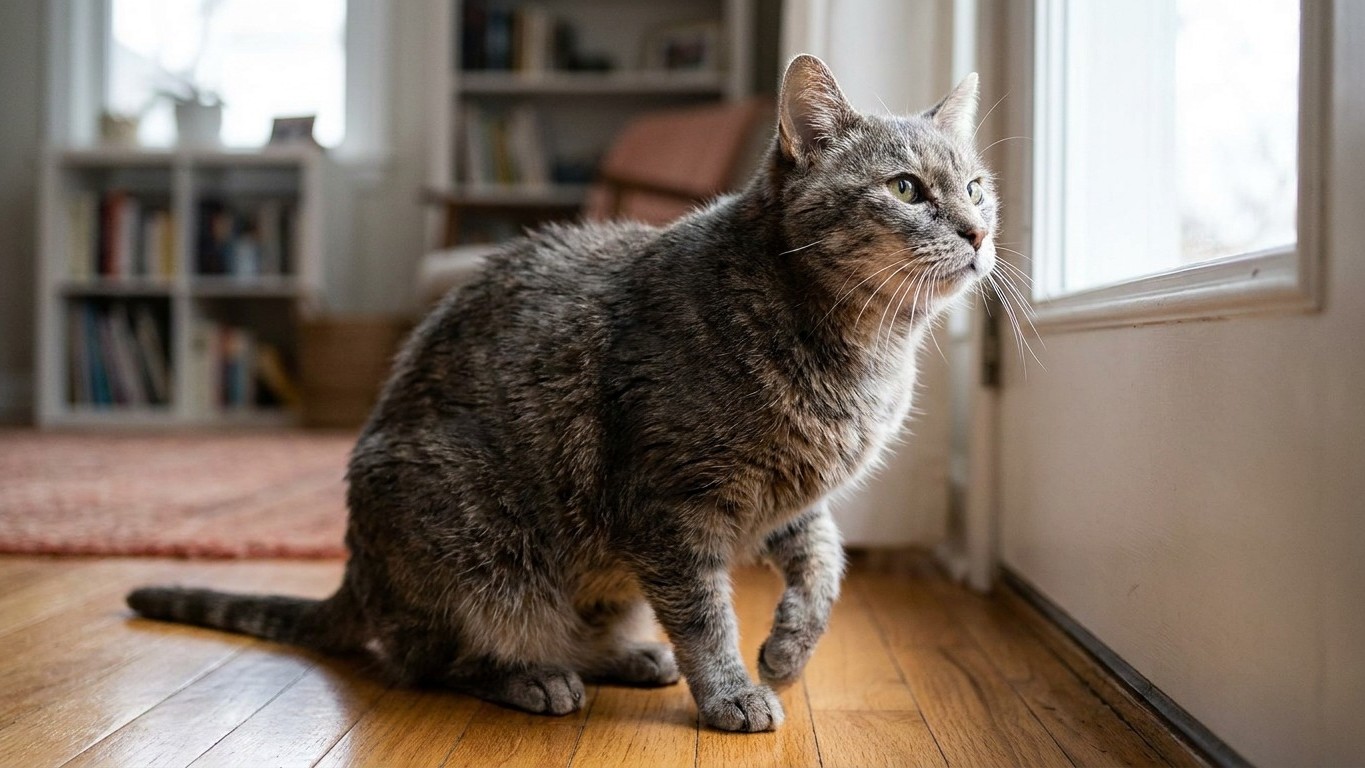
A cat that stops leaping onto the windowsill isn’t being lazy. She’s telling you, in the only language she has, that something in her joints hurts too much to make that jump feel worth it. Vets call this the quiet crisis of feline osteoarthritis, and it’s one of the most under-diagnosed conditions in cats precisely because owners are watching for the wrong symptom.
Most of us grew up with dogs, or at least dog stories, where a sore hip means an obvious hobble. Cats don’t play that game. Lameness isn’t as commonly reported by owners, and in a study of 28 cats with osteoarthritis, less than half limped but almost three-quarters didn’t want to jump, and two-thirds jumped a shorter distance. That statistic alone should reframe how every cat owner watches their pet climb, or fail to climb, onto their favourite perch.
Key takeaways
- Nine out of ten cats with arthritis never show a visible limp—so what are vets actually looking for?
- The moment a cat changes how she jumps, where she sleeps, or which perches she visits, time is running out
- Feline osteoarthritis affects 60% of all cats, yet most cases go undiagnosed because owners are watching for the wrong symptom
Why the limp so rarely shows up
Cats are built to mask pain. It’s an evolutionary hangover from being both predator and prey: a visibly limping cat in the wild is an easy target, so the instinct to hide weakness runs deep, even in a pampered indoor moggy who hasn’t hunted anything more dangerous than a feather toy in years. Cats don’t typically yelp or limp noticeably like dogs with OA do; instead, they subtly alter their behaviours and movements. The joint damage is real and often severe, but the outward sign is a change in habits rather than an obvious injury.
Research backs this up with numbers that genuinely surprised me. Studies found that only 4 to 16.7% of cats with radiographic changes consistent with osteoarthritis demonstrated any degree of lameness. Put another way, if you’re waiting for a limp before you worry, you could be missing the condition in roughly nine out of ten affected cats. Meanwhile, the joint disease itself is startlingly common. Approximately 60% of all cats, and over 90% of cats older than 12, can be identified as having degenerative joint disease. Elbows and hips tend to bear the brunt, though shoulders, hocks, knees and even the spine can be affected too.
The tells that actually matter
Forget the limp. Watch the launch. A cat with early arthritis often still wants to reach her windowsill, her favourite radiator shelf, or the top of the wardrobe, but the way she gets there changes first. She might crouch longer before jumping, take a run-up she never needed before, land with a heavier thud, or break a single leap into two smaller stages using a chair as a stepping stone. Some cats simply relocate their favourite spots to ground level and never explain why.
Beyond the windowsill, a handful of other everyday clues tend to appear around the same time:
- Slower, stiffer movement after a long nap, easing off once she’s warmed up
- Skipping the litter tray or leaving deposits just outside it, because climbing in hurts
- Grooming less thoroughly, especially over the hips and lower back, leaving a scruffier coat
- A shorter fuse when picked up or stroked near the spine or hindquarters
Weight loss, loss of appetite, decreased activity level, and a change in attitude, becoming grumpier or quieter than usual, are also recognised signs. None of these scream “joint pain” on their own, which is exactly why so many cases slip past even attentive owners for months or years.
The scale of the problem
What strikes me most researching this piece is the gap between how common feline arthritis actually is and how rarely it gets diagnosed. One industry report cited by veterinary sources suggests osteoarthritis affects nearly 40% of all cats, yet a huge proportion of those cats never see a vet for it because nobody spotted the signs in time. Part of the problem is generational: for decades, a slower, stiffer senior cat was simply filed under “getting old” rather than “in pain and treatable.” That thinking is finally shifting, but slowly.
The good news is that once arthritis is recognised, there’s genuinely a lot that can be done. Vets now have a growing toolkit that includes anti-inflammatory medication tailored for cats, weight management (extra kilos put brutal extra load on already damaged cartilage), joint supplements, and in recent years a monoclonal antibody treatment that targets the nerve pathway responsible for chronic joint pain rather than just masking it. None of these should be started without a proper veterinary assessment, since cats’ livers process drugs very differently from dogs’ or humans’, and getting dosing wrong can be dangerous.
What to actually do about it
If your cat has quietly given up on her windowsill, book a vet appointment rather than shrugging it off as old age. Mention specifically that it’s the jumping that’s changed, not just “she seems a bit slower,” because that detail helps vets prioritise an orthopaedic check over other possibilities. At home, you can soften the transition immediately: add a low step or a sturdy stool beside high perches, swap a deep-sided litter tray for one with a lower entry lip, and keep her at a healthy weight, since even a small amount of extra body mass measurably increases strain on arthritic joints.
Here’s a detail worth remembering: arthritis isn’t purely a disease of ancient cats. Vets have documented degenerative joint changes in cats as young as two years old, often linked to early neutering, previous injury, or simply genetics rather than age alone. So even if your cat is nowhere near her senior years, a sudden reluctance to make that windowsill leap is worth mentioning at her next check-up, not filing away as a personality quirk.
Sources : academic.oup.com | ncbi.nlm.nih.gov