
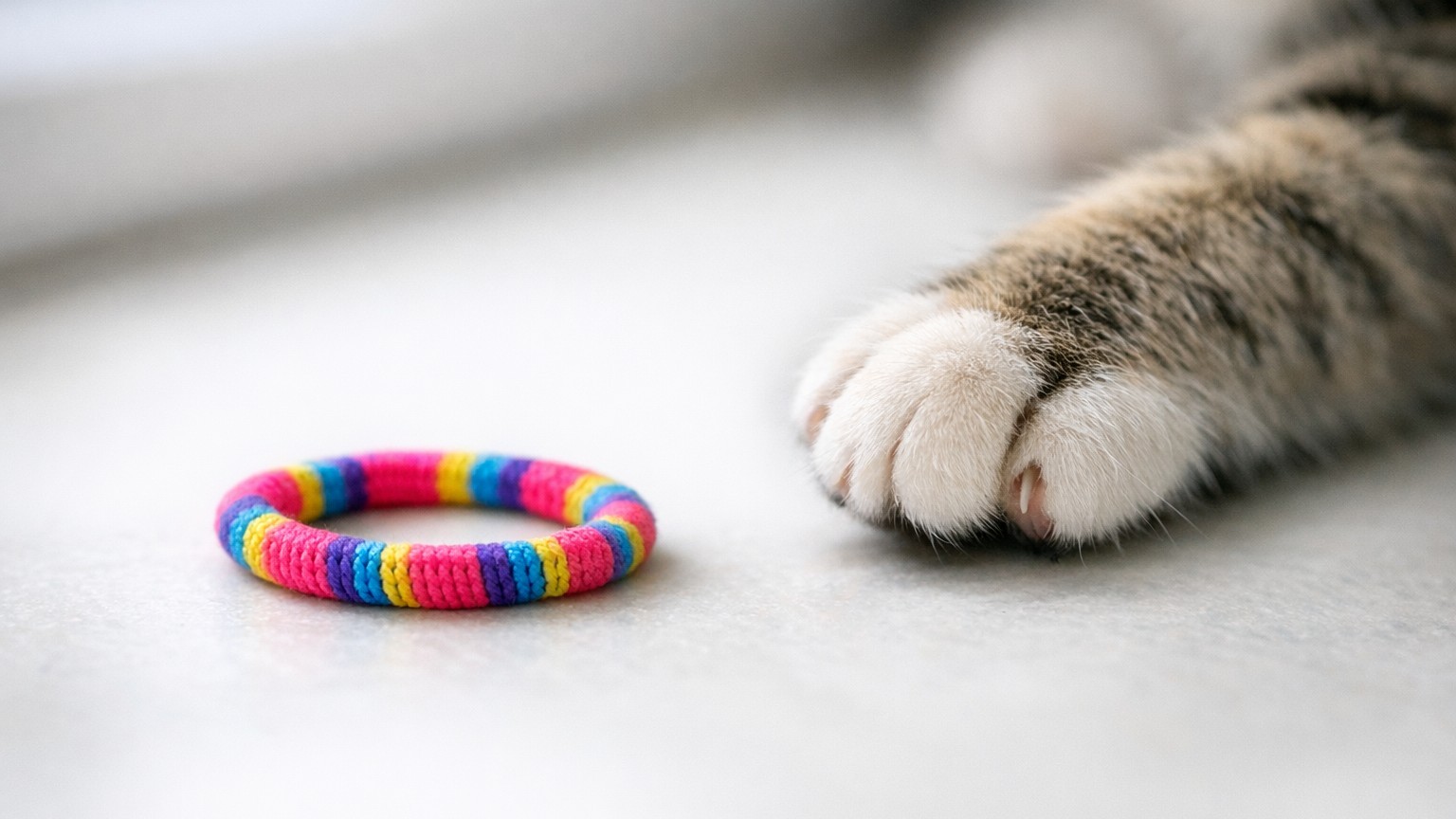
Hair ties are among the most swallowed objects in the feline world, and there is nothing remotely cute about what happens next. The elastic loop that your cat bats across the kitchen floor, flips in the air, and proudly deposits in her water bowl is, from the gut’s perspective, a potential surgical emergency. Most owners never make the connection until the bills arrive, or worse, the diagnosis does.
Key takeaways
- A cat in Florida nearly died after swallowing 26 hair ties — but her owner had no idea she’d eaten even one
- Once inside the gut, a hair tie can anchor itself and pull the intestines into dangerous pleats, cutting off blood flow and causing life-threatening perforation
- The warning signs are easy to miss because cats hide pain — but catching it early enough means a vet might save your pet without surgery
Why cats can’t leave them alone
Many cats love to play with hair ties because they make ideal “prey,” stimulating their natural hunting instincts. The small, looping object bounces unpredictably, skitters across hard floors, and can be flicked into the air with a single paw, which from a cat’s perspective is basically a live mouse on a budget. “The small, quick movements of a hair tie being batted around tap into your cat’s natural hunting instincts,” as one vet puts it : “the hair tie mimics the motions they would expect to see in their prey.”
Cats may also like the comforting scent of their owner on the hair ties. They have an extremely well-developed sense of smell, with far more olfactory receptors than humans, a cat’s nose is almost 40 times more sensitive than ours, so even brand-new hair ties offer intriguing smells. There is also texture at play: the rubbery, stretchy give of an elastic band is unlike most commercial cat toys, and some cats simply cannot stop chewing it.
For a subset of cats, the attraction crosses from play into something more troubling. Pica is a compulsive behaviour where a cat sucks and consumes inedible things, and it can explain why some felines always try to get access to rubber bands and hair ties. Siamese, Burmese, and Tonkinese breeds are the most susceptible to pica. If your cat is methodically making your hair ties disappear rather than just playing with them, that is worth a conversation with your vet, because the reasons can range from stress and early weaning to nutritional deficiencies, and none of them resolve on their own.
What the vet actually sees on the X-ray
Hair ties are among the most commonly swallowed foreign objects in cats, partly because their stretchy texture and small size make them irresistible toys. Once swallowed, the outcome depends almost entirely on whether the elastic stays intact or breaks apart inside the gut.
An especially dangerous type of foreign body, most common in cats, is referred to as a linear foreign body, a term describing long, thin objects such as string, yarn, and tinsel. A hair tie, once stretched or snapped inside the digestive tract, behaves exactly like one. If one end becomes lodged at some point in the gastrointestinal tract — such as at the base of the tongue, in the stomach, or in the intestine, the free end trails down the remainder of the tract. As the intestines attempt to move this trailing foreign body along, it cannot move, resulting in the intestines “crawling” up the foreign body, becoming bunched. The analogy that sticks: these linear objects can anchor at one end while the other end continues to travel through the intestines, causing the intestines to pleat like an accordion, leading to perforation and severe internal damage.
If the hair tie snaps, effectively becoming a string of elastic, it can cause even more serious complications, it can cheese-wire through the wall of the gut if it gets stuck. That is not hyperbole. An elongated hair tie can cut the intestine, leading to septic peritonitis because the faeces leak into the abdomen, and it can also interrupt blood circulation at that level, causing the death of the gastrointestinal tissue (necrosis). Even with treatment, peritonitis can be fatal — and the longer a hair tie is stuck without being removed, the more likely the gut damage will be severe.
The real-world consequences are not hypothetical. In early 2026, a six-year-old cat in Florida narrowly escaped euthanasia after swallowing 26 hair ties that created a life-threatening intestinal blockage, the cat had actually been surrendered to a shelter for euthanasia because of the obstruction. Veterinarians described her condition as dire when she arrived, and during the operation surgeons discovered all 26 hair ties blocking her digestive system. Twenty-six. One owner had no idea.
Spotting the signs and getting help fast
It can be difficult to know if your cat has eaten a hair tie until the clinical signs appear. Cats are specialists in hiding discomfort, which makes timing critical. Symptoms of hair tie ingestion include vomiting, lethargy, loss of appetite, abdominal pain, and difficulty defecating. Some cats may also have pain in the abdomen, be unwilling to lie down or get comfortable, or hide more than usual.
If you actually witness your cat swallowing a hair tie, do not wait to see what happens. Depending on the foreign body and when your cat ate it, a vet can sometimes induce vomiting immediately to recover the foreign object and prevent the intestinal blockage from occurring. That window closes quickly. If a linear foreign body is visible in the oral cavity, it must never be pulled, because it may be embedded in the tissue and pulling may lead to perforation. Leave it entirely to the vet.
Veterinary treatments typically involve diagnostic imaging like X-rays or ultrasounds to locate the hair tie lodged in the digestive tract. Endoscopic removal is often preferred for accessible objects, minimising invasive surgery and promoting faster recovery. Linear foreign bodies tend to cause a lot of damage to the gut, often requiring the removal of large portions of the intestines and a higher likelihood of complications. The earlier the intervention, the better the outcome.
Making your home actually safe
The fix is straightforward, even if the habit of leaving hair ties everywhere is deeply ingrained. The best way to avoid the worry of your cat eating hair ties is to make sure none are lying around, storing them in a container with a lid or a closed cupboard will ensure that even the most adventurous feline can’t get hold of them. Bathroom surfaces, bedside tables, gym bags left open on the floor — these are the usual culprits. A small lidded pot costs almost nothing.
Your cat needs to play to maintain a healthy lifestyle, but you should provide them with appropriate pet toys intended for their safe enjoyment, rather than allowing them to play with everything they find. The goal is not to eliminate the fun of chasing small, bouncy things, it is to replace the elastic loop with something that cannot cheese-wire through an intestine. Paper rings, crinkle balls, and wand toys scratch exactly the same predatory itch without the surgical risk.
One thing worth knowing if your cat is a compulsive swallower rather than just an enthusiastic player: if you notice such behaviours, it is best to reach out to your veterinarian to determine if it is a mental or physical issue. Pica in cats can sometimes signal an underlying health condition, and treating the habit without addressing the root cause tends not to work. A single vet appointment could save you from a far more expensive and heartbreaking one later.
Sources : audacy.com | upi.com