
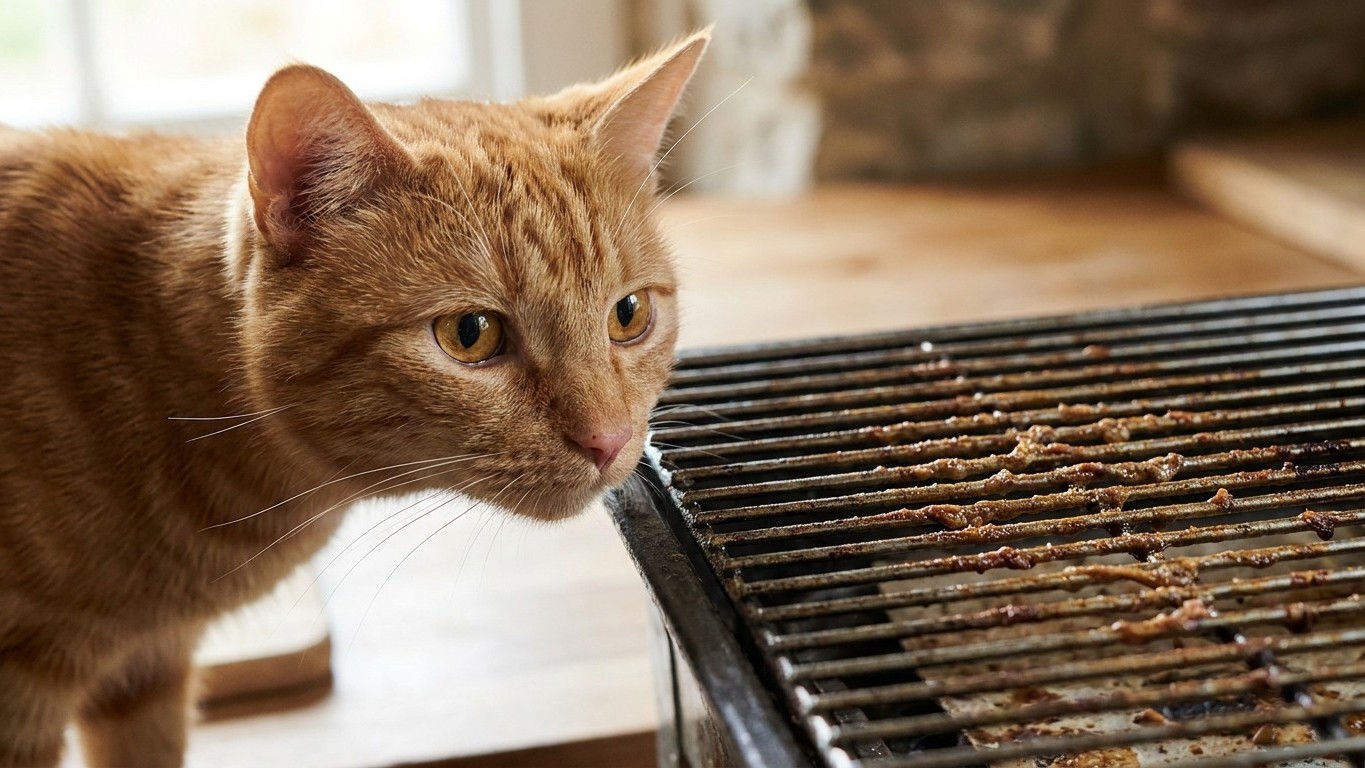
Every summer barbecue ended the same way at ours: plates cleared, guests gone, and my ginger tom Baxter making a beeline for the still-warm grill grates to hoover up every last smear of fat and marinade. I thought it was endearing, a bit like watching him clean his own paws. What I didn’t grasp for years is that those grease-soaked bars were often carrying traces of onion and garlic from marinades, rubs and sauces, and that repeated licking was quietly attacking his red blood cells from the inside.
Cats process onion and garlic completely differently to us. Both onions and garlic belong to the Allium family, which also includes leeks, shallots, and chives, and these vegetables contain compounds called thiosulfates and disulfides that humans can metabolise safely but cats and dogs cannot. On a barbecue plate, those compounds don’t vanish when the meat is cooked. Toxicity can occur from raw, cooked, dried, or powdered forms of these plants, which means a garlicky marinade dripped onto hot metal is just as dangerous once it cools as it was in the bottle.
Key takeaways
- Your cat’s grill-licking habit exposes them to onion and garlic compounds that humans safely metabolize but felines cannot
- Damage accumulates silently over weeks—symptoms only appear 1-7 days after each exposure, making the danger invisible to pet owners
- A single grill-lick might seem harmless, but garlic powder is five times more toxic than fresh garlic, and cats are far more vulnerable than dogs
What’s actually happening to the blood cells
The mechanism is genuinely fascinating in a slightly horrifying way. The primary toxic ingredient in garlic and onions is n-propyl disulfide, an oxidant, and compared to humans, dogs and cats are more sensitive to oxidative damage on their red blood cells. Once absorbed, these compounds are absorbed and begin attacking the hemoglobin in red blood cells, forming structures called Heinz bodies. Think of Heinz bodies as little clumps of damaged, denatured haemoglobin poking out from the cell membrane, like rust spots on the inside of a pipe. The cat’s own immune system spots these deformed cells as foreign material and destroys them, a process vets call haemolysis.
What makes this particularly relevant to grill-lickers is that damage doesn’t require a single big meal. Repeated low-level exposure can be as dangerous as a single large ingestion because damage accumulates. A cat who licks the grates after every barbecue of the season, getting a tiny dose of garlic-laced fat each time, can gradually tip past the point where his bone marrow can keep up with red cell losses. And garlic isn’t a minor player here: garlic is five times more toxic than onions on a per-weight basis, so a barbecue marinade built around crushed garlic cloves is a far bigger worry than one flavoured mainly with onion.
Cats are also simply worse equipped to cope than dogs. Dogs have more areas on their red blood cells that oxidising agents such as n-propyl disulfide can attach to, and this attachment is recognised by the body as a foreign invader, so in the attempt to remove it, the body also destroys the red blood cell, a process called hemolysis. Yet despite dogs having more binding sites, it’s cats who come off worse overall: cats are particularly sensitive to Allium compounds, more so than dogs, making even small exposures potentially dangerous. Size matters too, and it isn’t in a cat’s favour. The cat’s size influences vulnerability, with smaller cats being affected by proportionally smaller amounts, so a slight, 3kg cat is at greater relative risk than a chunky 6kg one from the exact same lick of the grates.
Spotting the warning signs before it becomes an emergency
The frustrating part is that symptoms rarely show up straight away. Vets often see the clinical picture emerge 1-7 days after exposure, which is precisely why owners like me can spend years convinced the habit is harmless. By the time signs appear, the anaemia is already established. Watch for:
- Pale or whitish gums instead of the usual healthy pink
- Lethargy, weakness or reluctance to jump up onto furniture
- Laboured or open-mouthed breathing, which is considered an emergency
- Dark or brownish urine
- Reduced appetite alongside general dullness
One real case reported in veterinary literature involved a domestic shorthair who arrived with weakness, diarrhoea and dark urine after eating onion; blood tests showed moderate microcytic hyperchromic anemia with mild regeneration and a large percentage of ghost cells with large Heinz bodies observed on microscopic examination of stained blood smears. A ginger cat with a persistent grill-plate habit could theoretically build toward the same picture, just more slowly and less dramatically, one barbecue at a time.
Diagnosis in a vet clinic isn’t guesswork either. Diagnosis of Allium spp toxicosis relies on patient’s history of exposure, clinical signs, and clinicopathological confirmation of Heinz body hemolytic anemia. If things have progressed far enough, treatment can get serious: life-threatening clinical signs should be managed first with oxygen supplementation and blood transfusion as needed, and IV fluid therapy is recommended to help protect the kidneys against hemoglobinuric nephrosis.
Breaking the habit without breaking his heart
None of this means the odd curious sniff at a cold, thoroughly cleaned grill is going to send your cat into crisis. It means the plate itself, still carrying marinade residue, needs to be off-limits, every single time. I now scrub the grates with hot water immediately after cooking rather than leaving them to “cool down and get licked clean” as I once did without thinking. I’ve also stopped using garlic-heavy marinades altogether when Baxter is anywhere near the patio, swapping to herb-based rubs that keep the flavour without the risk.
If your cat has form for grill-grazing and you’ve been using onion or garlic in your cooking, it’s worth mentioning the habit to your vet at the next check-up, even without obvious symptoms, since a simple blood smear can flag early Heinz body formation long before a cat looks unwell. One detail that surprised me most in researching this: it isn’t only fresh onion and garlic that carry risk. Because of the concentration, granules are worse than flakes and flakes are worse than the fresh produce, meaning that jar of garlic powder sitting by the barbecue tongs is, gram for gram, more dangerous to a licking cat than a whole clove would be.
Sources : link.springer.com | northcareanimalhospital.com