
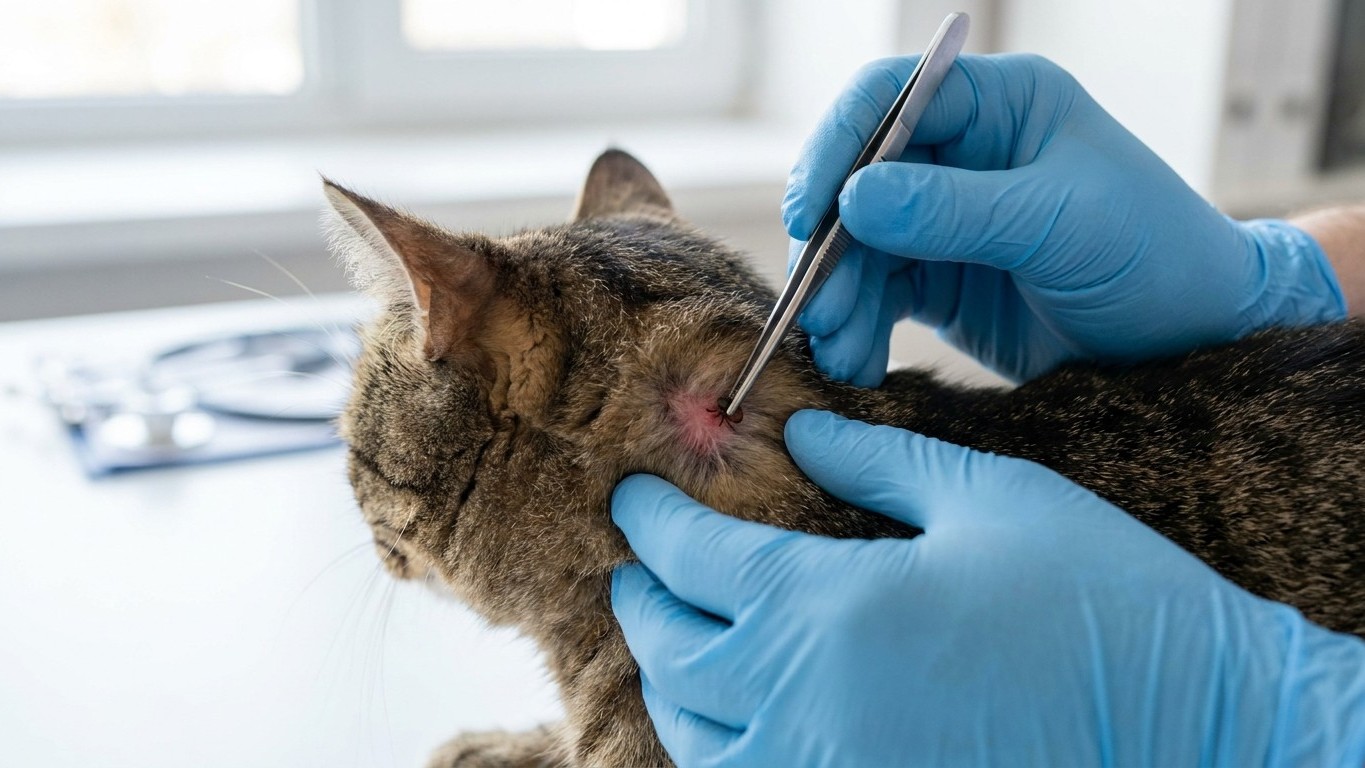
Three days after tugging a tick straight off her cat’s neck with bare fingers, one owner watched her vet ease a pair of fine forceps under the skin and lift out something dark and jagged: the tick’s mouthparts, still lodged in the flesh, surrounded by an angry red halo. The tick’s body had come away easily. Its head hadn’t.
This is a scene that plays out in veterinary practices across Britain every summer, and it happens because the instinct to grab and yank a tick off feels so natural. The trouble is that fingers apply exactly the wrong kind of pressure.
Key takeaways
- A tick’s head can snap off and stay lodged under your cat’s skin if removed incorrectly—three days later it becomes infected
- Squeezing ticks with bare fingers forces dangerous pathogens back into your cat’s bloodstream, increasing disease transmission risk
- The twisting motion with a proper tool works; pulling with tweezers or fingers fails—and the technique difference is critical
What actually stays behind
A tick doesn’t just perch on the skin’s surface. It cements its barbed mouthpart, called the hypostome, into the wound to feed for hours or sometimes days. Ticks vary in size from as small as a millimetre up to a centimetre, and they have a white body until they’ve fed, when they turn darker and grow much larger. Pull on that swollen body without the right grip, and the tissue anchoring the head can shear off and stay put.
You need to be really careful removing ticks from your pet, because the head can be left behind and cause infection if you squeeze the tick’s body, which can push blood back into your cat and cause disease. That’s the double jeopardy of finger-removal: not only can the head snap off, but the squeezing motion of pinched fingers can force the tick’s gut contents (and any pathogens riding along) straight back into your cat’s bloodstream. Ticks burrow down into the skin, where they bite and latch on, and they’ll feed for up to a few days before dropping off once they’ve had enough, plenty of time for trouble if removal goes wrong partway through.
What does a retained mouthpart look like three days later? If a tick is removed by pulling, crushing, or squeezing, it might break apart and leave mouthparts behind, showing up as a small black spot where the tick was attached, with possibly some redness and swelling. It’s easy to mistake this for a new skin tag or a scab, which is exactly why so many owners miss it until a vet points it out.
Why the twisting technique beats pulling
Vets consistently recommend a proper tick-removal tool rather than fingers or standard tweezers. The quickest, safest and easiest method is to use an O’Tom-style tick remover, a special tool slotted onto the tick where it attaches, which with a gentle twisting motion releases the tick’s grip on the skin. The rotation Matters More Than most owners realise. A tick removal tool slides under the tick and gently twists it away from the skin, and twisting rather than pulling reduces the risk of leaving mouthparts behind or squeezing infectious material into the bite.
If you genuinely have no tool to hand and must use tweezers, technique still counts for everything. Hold them parallel to your cat’s skin and grasp the tick as close as possible to the skin, gripping close to the tick’s head to avoid leaving the mouthparts embedded inside your cat, which can cause infection. Pull upwards with steady, even pressure, and never twist with tweezers, as this risks breaking off the mouthparts. Notice the contradiction with a proper tick tool: twist with the tool, never twist with tweezers. The tool is designed to rotate without crushing; tweezers aren’t, so twisting them shears the mouthparts off instead.
Once the tick is out, don’t just chuck it in the bin. Placing it in a container of rubbing alcohol kills it and prevents it from reattaching to your pet, or even to you. Then clean the bite site properly rather than moving straight on with your day.
If the head does stay behind
Resist the urge to dig. If the tick’s head gets stuck in the skin, it should be treated like a splinter that’s difficult to remove, and repeatedly trying to extract it is more likely to delay healing. A vet has proper tools and a steady, controlled setting to do this safely, which is precisely why the owner in this story needed forceps rather than another go with her fingertips at home. Left alone, the body usually deals with small retained fragments by working them out gradually, but that doesn’t mean ignore it entirely. Watch for spreading redness, swelling, heat, or your cat repeatedly licking the spot, and get it checked if any of those appear.
The disease question worries most owners, understandably. Lyme disease isn’t common in cats, but they can potentially get it from UK ticks, and it’s a bacterial infection that can cause serious problems if not caught early. Location matters too: cats that hunt or explore in woodland, moorland and fields shared with wildlife or grazing animals may pick up the sheep or deer tick, with the South West of England, East Anglia, the Scottish Highlands and Islands, and Northern England considered higher-risk areas. Reassuringly, some studies show the tick must stay attached for 36–48 hours to transmit the bacteria, as cats are highly resistant to infection, which is one reason prompt, correct removal matters so much.
Building the habit that actually protects your cat
Peak tick season runs from March to October, though animals can pick up ticks all year round, with increased risk in summer as ticks thrive in warm, humid weather. Regular checks after your cat’s been out in long grass or woodland, especially around the ears, neck and armpits, catch ticks early before they’ve fed long enough to pose a real risk. Pair that habit with a vet-prescribed preventative treatment, since dog tick medicine should never be used on cats, as some formulations contain chemicals that are toxic and can even be fatal to them.
A small, oddly useful trick for spotting a tick in the first place: a majority of the time, if you look hard enough, you can see that ticks have eight little legs, and a magnifying glass or your phone camera zoomed in can help confirm it rather than a wart or scab. It sounds fiddly, but that ten-second check is far less stressful for your cat than a follow-up trip to the vet three days later to have something removed that never needed to stay in the first place.
Sources : danielcameronmd.com | petmd.com