
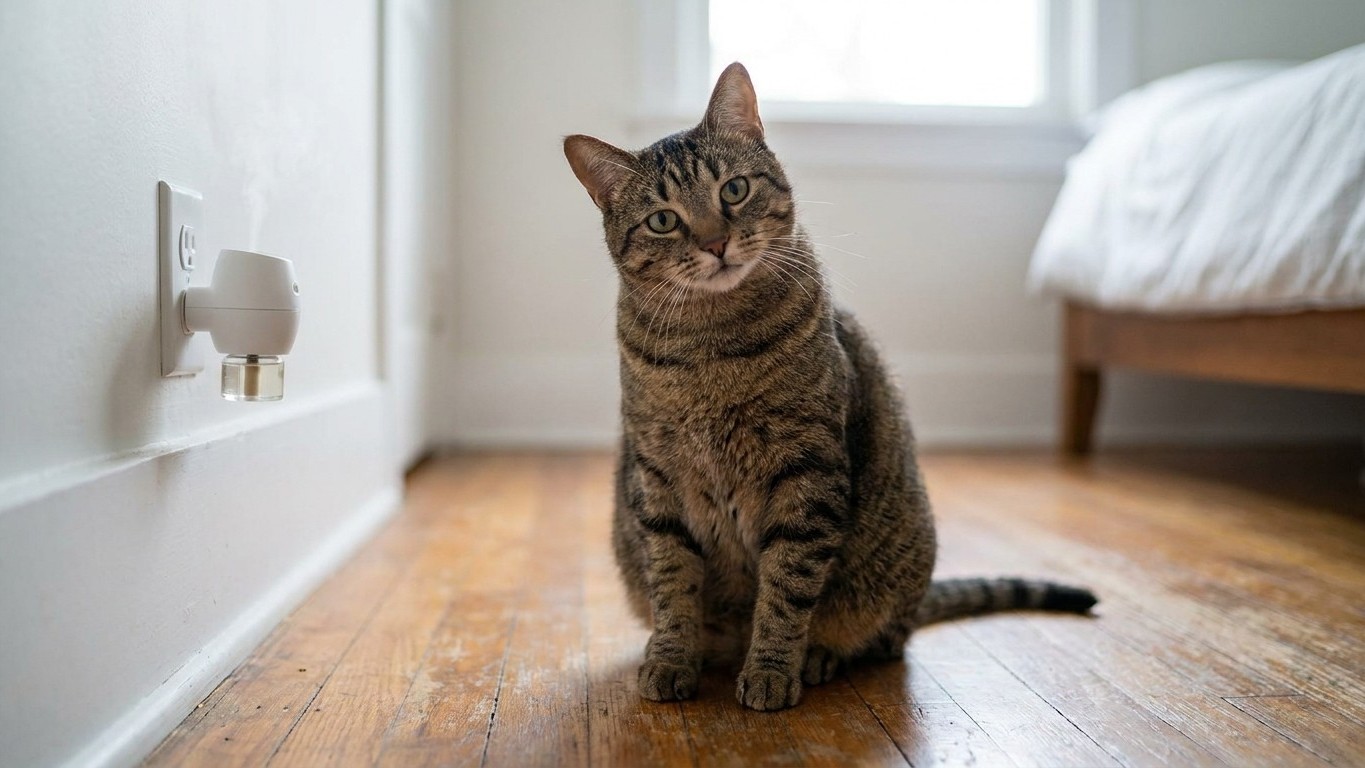
Drooling, wobbling, bumping into furniture as if the room’s suddenly gone sideways. Most owners immediately suspect food poisoning or a dodgy bit of chicken pinched from the counter. But if your cat’s behind a closed door for hours at a time, the real culprit is often hanging quietly on the wall socket: a plug-in diffuser or air freshener.
Key takeaways
- Cats can’t metabolize essential oils the way humans do—toxic buildup happens fast in sealed rooms
- Some common oils like tea tree and peppermint can trigger severe neurological symptoms including seizures
- Even ‘plain’ air fresheners contain hidden chemicals like phthalates that most manufacturers don’t disclose
Why closed doors turn a mild irritant into a real problem
Cats process toxins nothing like we do. A cat has a deficiency of the enzyme, glucuronyl transferase, resulting in a reduced ability to metabolize certain toxins. These toxins then build up in your cat’s system and cause damage. Add a shut door with no airflow, and whatever a diffuser releases simply has nowhere to go. The cat breathes the same concentrated air for hours, and whatever settles on its fur gets ingested later during grooming, because when you use oil in a diffuser, it floats through the air as droplets, and the droplets land on your pet’s skin and they may accidentally ingest them while grooming.
This is precisely why symptoms often appear “at the end of the day”, as the title puts it. A cat shut in a bedroom or utility room since morning has had a full working day of low-grade exposure, followed by an evening grooming session that delivers the final, concentrated dose straight into its mouth.
The wobbly walk isn’t dramatic invention, either. Vets describe it plainly: a large intake of essential oils can cause agitation, weakness, unsteadiness, and tremors, and the cat will not be able to walk correctly or at all. Drooling tends to come first, since drooling or lip-licking is often the first sign, because the cat tastes or smells something irritating. From there, things can escalate quickly. Depending on the type of essential oil your cat is exposed to, you may notice vomiting, drooling, wobbly gait, tremors or seizures, low body temperature, low heart rate, liver failure, and skin irritation, alongside respiratory signs such as watery or irritated eyes.
Not every diffuser behaves the same way
There’s an important distinction most people never think to check: how the device actually disperses its scent. Two popular types of diffusers are “passive” and “active.” The former works by evaporating the oil, producing a pleasant smell, while active diffusers emit microdroplets of the oil into the air in addition to producing the pleasant smell. The passive ones are the gentler of a bad bunch, since passive diffusers can sometimes cause respiratory irritation in cats, leading the feline to develop a watery nose or eyes, a burning sensation in the throat or nose and coughing or wheezing.
The active ultrasonic diffusers, the little ones that puff out visible mist, are the ones I’d genuinely worry about behind a closed door. They coat surfaces, fur and whiskers with actual oil particles rather than just scent molecules. A cat grooming itself after hours of that exposure isn’t just smelling something unpleasant, it’s swallowing it.
Not all oils carry equal risk, but some are genuinely nasty regardless of dose. Tea tree oil is one of the most dangerous essential oils for cats, causing severe neurological symptoms including tremors, wobbling, and seizures, and even small amounts can poison a cat. Peppermint isn’t much better: peppermint oil contains menthol and menthone, both of which are toxic to cats, and it can cause vomiting, diarrhoea, breathing difficulty, and neurological symptoms. Eucalyptus, wintergreen, citrus oils, pine, clove, cinnamon, ylang ylang and pennyroyal all sit on the same worrying list according to poison control specialists.
Plain plug-in air fresheners (the ones with no essential oil branding at all) aren’t automatically safer. Plug-in air fresheners are unhealthy for cats because the chemicals they emit can be poisonous to felines if inhaled or ingested, and to release the scents into the air they need a carrier, and that carrier is a chemical known as phthalates. One estimate suggests it has been estimated that 86% contain phthalates, and airborne, they can trigger allergic reactions and asthma. Manufacturers rarely tell you exactly what’s in the bottle, either: companies that manufacture air fresheners are not required to disclose all the ingredients, and studies have found that fewer than 10% of volatile ingredients are typically even listed on the labels.
What to actually do if you spot the signs
Don’t wait it out. The first move is simple: get the cat out. If a cat owner suspects that their pet is in distress, they should move their cat to fresh air immediately, and if the cat does not quickly recover, the owner should seek emergency veterinary care. Unplug the diffuser, open every window in the room, and check your cat’s paws and chin for any oily residue rather than assuming it’s just a smell.
Ring your vet, describe exactly what device and scent you’d been using, and don’t try to be a hero at home. Never induce vomiting unless instructed by a veterinarian. If your usual practice is closed, the ASPCA Animal Poison Control Center runs a helpline on 888-426-4435 (a consultation fee may apply, but that’s a small price for the right advice in an emergency).
Cats with pre-existing respiratory conditions are especially vulnerable to any of this. Kitties with existing breathing issues are most at risk. If yours already wheezes or has been diagnosed with feline asthma, treat any scented plug-in as off-limits, not just “used carefully”.
A safer way to enjoy a nice-smelling home
You don’t need to live in a scentless house to keep your cat safe. Good ventilation genuinely earns its reputation as the boring-but-brilliant fix here, since when using a diffuser, ensure that you are in an area with sufficient ventilation that your cat cannot access. If you can’t resist the odd lavender diffuser session, keep it brief and supervised: diffuse for 15 minutes maximum in an open room on the lowest setting, and watch your cat for drooling, sneezing, or lethargy.
The single biggest change worth making, though, is a mental one rather than a shopping one: stop treating a shut door as “containment” for your cat and start treating it as a sealed chamber that traps whatever’s in the air with them. A cracked window, a diffuser in a room the cat genuinely can’t enter, or simply going back to old-fashioned cleaning with unscented products will do far more for your cat’s health than any amount of vanilla or eucalyptus ever will. Worth remembering too: naphthalene, found in many major brand air fresheners, has caused lung tissue damage and cancer in lab rats, a detail that rarely makes it onto the packaging but is exactly the sort of thing worth asking your vet about if you’re ever unsure what’s safe to plug in near your cat.
Sources : instacuppastore.com | happytailservet.com