
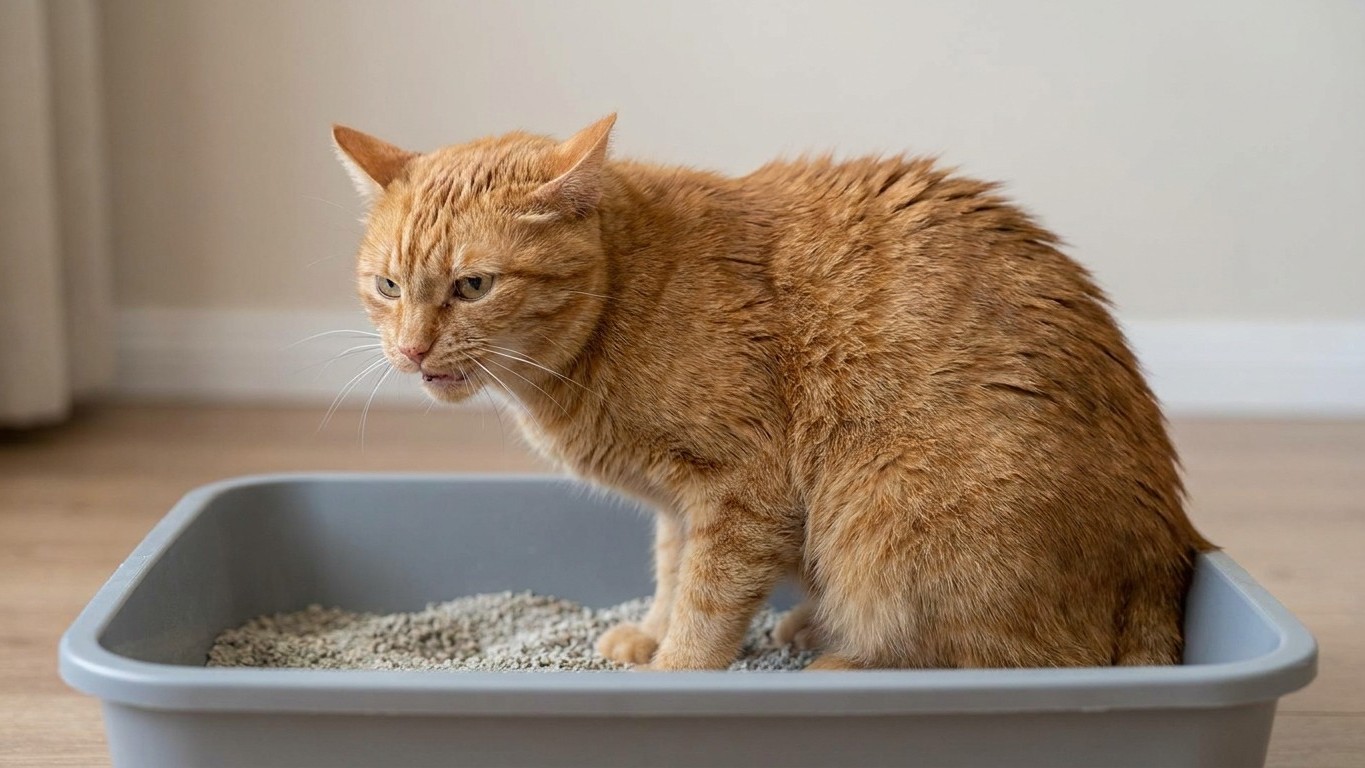
A cat straining in the litter tray and producing nothing isn’t constipated. It’s very likely a blocked bladder, and without treatment within hours, not days, it can be fatal. This is one of the most urgent situations in small animal medicine, and the confusion between “can’t poo” and “can’t wee” costs cats their lives every single year.
The anatomy explains why this is overwhelmingly a male problem. Male cats are more vulnerable to urethral obstruction in part because their urethra, the portion of the urinary tract connecting the bladder to the outside world, is longer and narrower than in females. That narrow tube is easily plugged by a gritty mixture of crystals, mucus and inflammatory debris, or occasionally by a proper stone. Once it’s blocked, urine has nowhere to go. The bladder swells like a balloon nobody can deflate, and the kidneys, unable to filter waste, start poisoning the bloodstream from the inside.
Key takeaways
- A male cat’s narrow urethra can become blocked by crystals and debris in as little as 24 hours—with fatal consequences
- Owners often confuse urethral obstruction with constipation, delaying critical emergency treatment by hours or overnight
- Nearly 30% of blocked cats don’t survive their episode, mostly because treatment was delayed until their condition became irreversible
Why the “he’s just constipated” mistake happens
Cats squatting, straining and vocalising in the tray look remarkably similar whether the problem is at the front end or the back end. Owners see the posture, assume a bowel issue, and reach for pumpkin puree or wait it out overnight. That delay is the dangerous part. Straining to urinate, where a cat attempts to urinate frequently but produces little or no urine, can easily be mistaken for constipation. The giveaway, if you look closely, is what (or rather what doesn’t) end up in the tray: no urine, or perhaps a few drops tinged pink with blood, rather than the small, dry faecal pellets typical of true constipation.
Behaviour changes usually accompany the physical straining. Blocked cats are constantly straining and in their litter box, trying to relieve the pressure, and they regularly lick their genitals. Cats who are struggling to pass urine are restless and distressed, often meowing and yowling, and may breathe more rapidly or pant. As they are in pain, they may be reluctant to allow you near them and can become aggressive. A vet at the University of Illinois Veterinary Teaching Hospital describes the same pattern from the clinical side: cats may vocalize while attempting to urinate, repeatedly strain to urinate without success, produce small amounts of bloody urine, attempt to urinate in abnormal locations outside of the litter box, and vomit. Some owners even feel it themselves. If the owner attempts to feel the bladder in the back part of the abdomen, a large, firm, ball-shaped structure may be felt.
Left unaddressed, things deteriorate fast, and not just locally. The longer the cat is blocked, the more owners may see a systemic effect: cats may appear lethargic, show decreased activity levels, quit eating, and may even become weak and collapse, because electrolyte imbalances, including too much potassium and too little calcium, may disrupt electrical activity and contractility of the heart. In plain terms, a blocked bladder can eventually stop a cat’s heart, not just damage his kidneys.
How fast this actually kills, and why waiting is never sensible
Sources vary slightly on the exact timeframe, which itself tells you something: nobody can predict which cat has hours versus a day or two, so nobody should gamble. Life-threatening consequences can occur in as little as 24 hours of being unable to urinate. International Cat Care puts the outer limit only slightly further out: without treatment, it can cause kidney failure and can be fatal within 2-3 days. Either way, “let’s see how he is in the morning” is not a safe plan for a cat who hasn’t produced urine.
A study of primary-care veterinary records across the UK, using the VetCompass database, gives a sobering sense of scale. Researchers from the Royal Veterinary College reviewed a study cohort of 237,825 male cats, with 1,293 incident cases, giving an estimated incidence risk during 2016 of 0.54%. That sounds small until you remember how many cats live in British households, translating those figures into thousands of real emergencies annually. More troubling still was the outcome data: death during a urethral obstruction episode occurred in 329 of 1,108 cases (29.6%), and 285 of those 329 deaths (88.0%) involved euthanasia. Nearly one in three affected cats didn’t survive the episode, and the overwhelming majority of those deaths were a difficult decision made once the cat’s condition had become too severe or too costly to reverse, not sudden collapse. That’s a statistic that should change behaviour, not just inform it.
Interestingly, this isn’t a disease of elderly cats winding down. Urethral obstruction is reported to predominantly affect young to middle-aged cats under seven years old, which are almost all males because their longer and narrower urethra compared to females is more likely to lead to obstruction. Underlying feline idiopathic cystitis, an inflammatory bladder condition linked to stress, plays a bigger role than most owners realise: feline interstitial cystitis is reported in up to 53% of these cases. So a stressed indoor tom, perhaps one who’s just had a new pet introduced to the household or endured building work next door, may be at genuine risk even without any stones or obvious dietary trigger.
What actually happens at the vet’s, and what you can do beforehand
Treatment is invasive but usually effective if the cat gets there in time. It’s possible to unblock most bladders by putting a thin tube into the penis and allowing the urine to drain out, after which the vet will use a variety of drugs and fluids to treat any infection, crystals, spasm or pain. This isn’t a five-minute fix, though. A cat with a blocked bladder will need intensive care in a veterinary hospital until they’re out of danger and their bladder is working again, which will take a few days, including a fluid drip and investigations to find out what caused the problem. For cats who block repeatedly, there’s a surgical option worth discussing with your vet, a perineal urethrostomy, which widens the urethral opening to reduce future risk.
Prevention leans heavily on hydration and stress reduction: wet food over dry, water fountains that tempt fussy drinkers, multiple clean litter trays, and a calm environment. None of it guarantees immunity, but it tilts the odds. If your male cat is in and out of the tray, straining, licking underneath himself, or crying, don’t wait for morning surgery hours or hope he’ll “pass something eventually.” Ring an emergency vet the moment you notice it. As one clinician bluntly put it, a urethral obstruction requires immediate intervention, full stop, and every hour genuinely does count against him.
Sources : onlinelibrary.wiley.com | academic.oup.com