
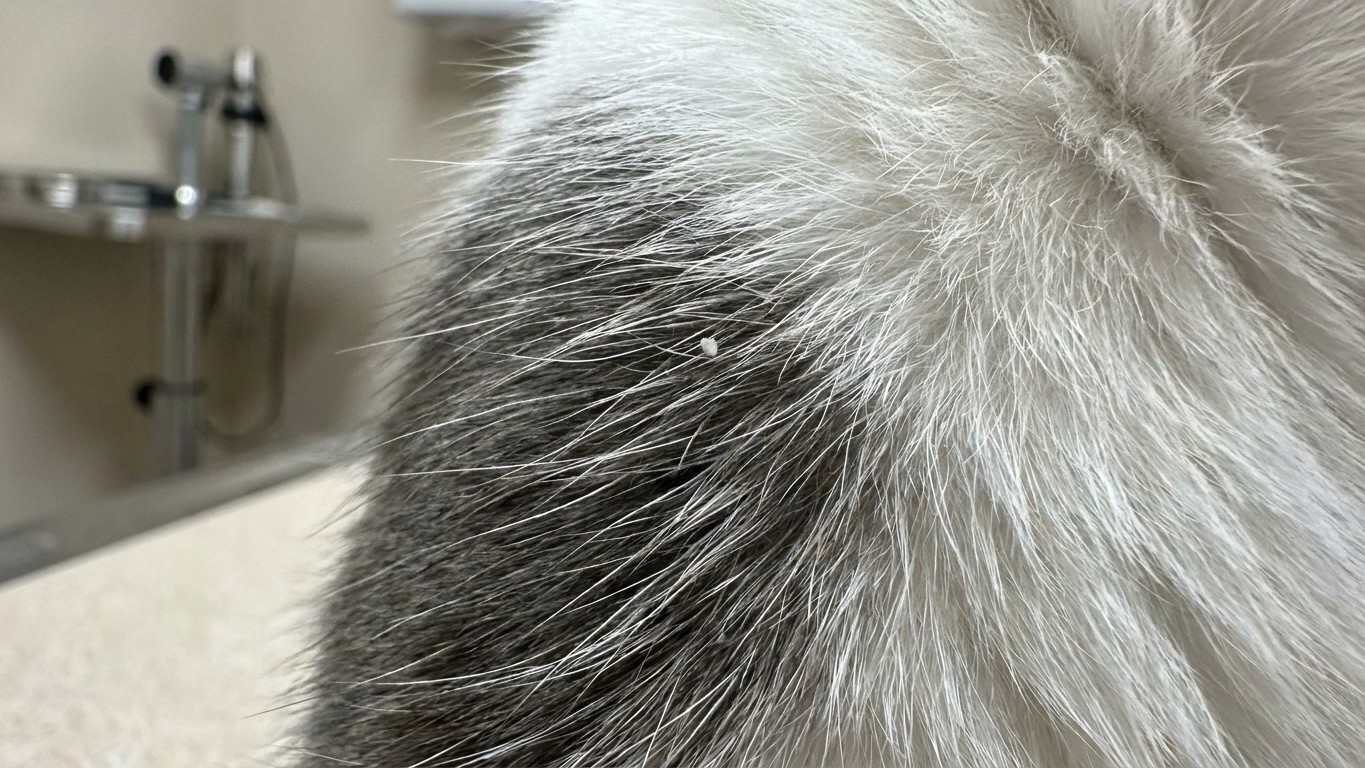
Those moving white flecks under the lamp were almost certainly Cheyletiella mites, the parasites responsible for a condition vets nickname “walking dandruff”. What looks like ordinary dry skin is, in reality, a colony of tiny arachnids shuffling about in the dead skin cells they feed on, and yes, they really are visible to the naked eye if the light catches them right.
Cheyletiellosis is caused by Cheyletiella blakei in cats specifically, a close relative of the mites that trouble dogs and rabbits. Dogs and cats each have their own species of the mite Cheyletiella, which appear to be host-specific, C. yasguri in dogs and C. blakei in cats. Despite that specificity, cross-infection between species does happen. Cheyletiellid mites are highly contagious and not host specific, so cats can also acquire infestation with C yasguri from dogs or C parasitovorax from rabbits. If you’ve got a multi-pet household, one infested animal rarely stays the only one for long.
The reason the flakes appear to crawl isn’t some optical illusion. The mites burrow down under the skin to feed, resulting in loss of the top layer of skin cells, which presents as dandruff, and as the mites move around, the skin cells appear to move as well. Essentially, each fleck of “dandruff” is a mite wearing a little cape of dead skin. Under a bright lamp or magnifying glass, that cape twitches, and once you’ve seen it, you can never quite look at flaky skin the same way again.
Key takeaways
- A cat owner discovered their pet’s ‘dry skin’ was actually moving under a lamp—revealing a shocking truth about what dry skin really is
- The mites are visible to the naked eye, contagious to other pets and humans, and can spread through shared brushes and bedding
- Veterinarians can treat the condition effectively, but the diagnosis is often sneaky because symptoms mimic ordinary skin complaints
Why it’s so easily mistaken for dry skin
Cheyletiellosis is sneaky precisely because its symptoms overlap with mundane skin complaints. Cats with cheyletiellosis present with persistent dandruff with small white flecks in it, and itchiness or overgrooming which gets worse over time, and it’s more common in young cats, cats with an underlying illness, or those who have spent time in crowded cat housing, such as in boarding or at a breeding facility. A cat who’s recently come from a rescue, a cattery, or a breeder is statistically more likely to be carrying these mites than one who’s never left the house.
Some cats show barely any signs at all, which makes brushing sessions the perfect moment to catch it early. The pet’s signs may be symptomatic or non-symptomatic, meaning pets may appear normal, itching very little, but still harbour the mites. Others fastidiously groom the mites away before they build up, which sounds helpful until you learn the twist: in some cases, mites and eggs may be detected with a stool test, particularly in cats that overgroom and ingest the mites. A cat that seems suspiciously clean might simply be eating the evidence.
The whole grim life cycle happens entirely on your cat’s body. Cheyletiella spp mites have a standard life cycle of egg, larva, nymph, and adult that can be completed in roughly 21 days. Other sources put the full cycle closer to five weeks, but either way, once established, populations can build quickly if left untreated.
Can it spread to humans and other pets?
Here’s the bit that tends to make people put the brush down rather quickly. Cheyletiellosis can also cause a transient infestation in humans that come in contact with pets carrying the mites. In practice, this usually shows up as an itchy rash rather than anything serious. The mites are contagious to humans, who may experience small red, very itchy, grouped bumps often found on the forearms, chest, and abdomen. The reassuring news is that we’re a dead end for them. They can even affect humans, causing small, itchy bites, but fortunately, they can’t survive permanently on humans, though they can be a nuisance.
Other household pets are far more vulnerable than you are. Because these mites are so contagious, if you have an outbreak on one animal, you’ll need to treat all dogs, cats, and rabbits in your home or that come into contact with your cat. This isn’t a mite that respects species boundaries or personal space, and shared bedding, sofas, and grooming brushes are all fair game. Mites can be transmitted through brushes, leashes, collars, and grooming tools, through reinfestation from recently contaminated bedding or housing, and Cheyletiella have even been found on fleas, lice, and flies, which may help transport them between pets. If You’ve Been Using the same brush on multiple animals, that’s your prime suspect for how it spread in the first place.
What actually happens at the vet, and what you can do meanwhile
Confirming cheyletiellosis isn’t always straightforward, even for professionals. Mites may be difficult to find, so the diagnosis is sometimes made based on a cat’s response to treatment. Your vet might use a magnifying lens on skin scrapings, sticky tape samples, or, as mentioned, a stool sample if your cat is a compulsive self-groomer. There’s no need to panic if the first test comes back clear; a course of treatment that clears up the symptoms is often considered confirmation enough.
Treatment itself is generally straightforward and effective, though it does require commitment. There is no licensed product specifically for the treatment of these mites, but walking dandruff can usually be treated by most flea and tick control products. Because female mites can survive briefly away from a host, don’t assume treating the cat alone is enough. Household therapy may be needed since the mites may survive for several days off the host, and premise sprays used for environmental flea treatment are usually sufficient to treat the home. Wash bedding on a hot cycle, hoover thoroughly, and treat every furry housemate at the same time, even the ones showing no symptoms whatsoever.
If you spot flaky skin on your own cat, resist the urge to diagnose from a search engine and book a vet appointment instead. Never self-treat with products bought for a different species or a different parasite, since dosing errors with mite treatments can genuinely harm a cat. One oddly comforting detail worth remembering: cheyletiellosis has an excellent prognosis, and most cats are back to their sleek, flake-free selves within a few weeks of proper treatment, mites and all evicted for good.
Sources : pethealthnetwork.com | vetster.com