
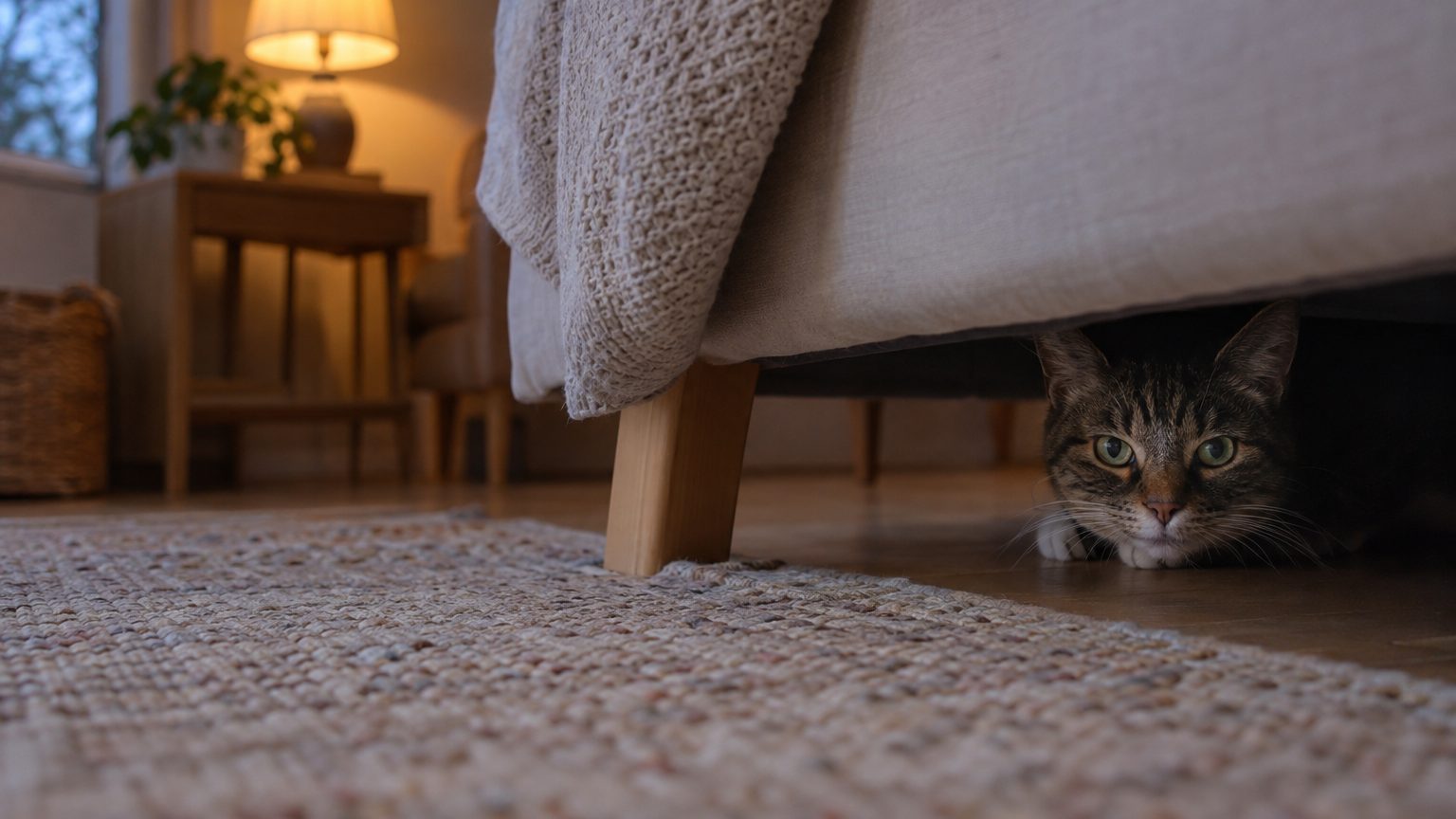
The best way to calm a cat during fireworks is to give her somewhere safe to hide before the first bang, then leave her to it. Most of the work happens in the hour before dusk, not once the sky is already lit up.
Everything else is supporting detail.
- Cats can hear sounds up to about 64 kHz, far beyond human hearing.
- Offering several hiding spots in a quiet room works better than one den.
- Fireworks can continue for five or six hours on Bonfire Night.
- Human painkillers such as paracetamol are highly toxic to cats.
Build the hiding place before the noise starts
A cat’s hearing stretches far beyond ours, reaching roughly 64 kHz where humans give up around 20 kHz. Each ear also has around 30 muscles that swivel it towards a sound, so a rocket doesn’t just register, it gets tracked. Hiding is a cat’s natural answer to a threat she can’t identify or escape, and it works.
Aim for several options rather than one perfect den. A cardboard box on its side with a blanket over it, the space under a bed, the bottom of an open wardrobe, a carrier with a towel draped over three sides: all of these give a cat the enclosed, dark, snug feeling she’s looking for. Spread them across more than one room, and include something raised, since some cats prefer height and others want the floor. Put a worn T-shirt or familiar blanket inside so it smells like home.
Pick the quietest room in the house, ideally one with few windows and an interior wall between it and the street. Close curtains and shut windows before dark to dull both the sound and the flashes.
Synthetic feline pheromone diffusers are popular, and plugging one in a couple of weeks before 5 November costs little. The evidence for how well they work is mixed, though, so treat them as a possible bonus rather than the plan. If your cat has reacted badly in previous years, a vet can discuss what else might help.
A cat in a wardrobe is a cat coping, not a cat in trouble.
Timing: the evening starts earlier than you think
Bonfire Night falls on Thursday 5 November this year, but the bangs rarely respect the calendar. Private displays and early celebrations pop up across the preceding fortnight, and Diwali follows on 8 November. Under UK fireworks rules, the usual curfew runs from 11pm to 7am, with extensions on 5 November (until midnight), New Year’s Eve, Diwali and Chinese New Year. So on the night itself, a nervous cat may be dealing with noise for the best part of five or six hours.
Feed her dinner earlier than usual, and play hard for ten or fifteen minutes beforehand. A tired cat with a full stomach is likelier to settle than a hungry, restless one. Put a litter tray somewhere accessible indoors, even if she normally goes outside, because she won’t want to step out for anything once it starts.
Low, steady background sound helps mask the sudden crack of bangs. A radio or television at moderate volume does the job, though it’s worth trying it on a quiet evening first so the sound itself doesn’t become a surprise.
Shut the cat flap before dusk, not when the first rocket goes up.
What to avoid on the night
Don’t pull her out of her hiding place. A frightened cat that’s hauled into the open may scratch, bite or bolt, and she’ll learn that her refuge isn’t reliable. If you need to check on her, sit nearby, speak softly and let her come to you if she wants to.
Scolding is pointless, since fear isn’t misbehaviour, and holding a panicking cat tightly tends to make her struggle harder. Never open a door or window to “let her get some air”, and don’t take her into the garden to show her it’s harmless. Human painkillers and calming remedies are a firm no: paracetamol, for example, is highly toxic to cats, and even a small dose can be dangerous. Anything to ease her anxiety needs to come from your vet.
Signs that a cat is struggling beyond ordinary jumpiness include panting, drooling, wide pupils, refusing food for a day or more, and toileting accidents indoors. Some cats freeze rather than flee, which is easy to mistake for calm.
If your cat reacts badly every year, speak to your vet well before next autumn. Sound desensitisation, using recordings played at a very low volume and raised gradually over weeks, can reduce fireworks fear in some animals, but it needs a proper plan and sometimes a qualified behaviourist. Starting in October, as we are now, leaves enough time to try a few things before the main event.
One last practical point: since June 2024, microchipping has been a legal requirement for pet cats in England, and a frightened cat that bolts is exactly when it matters. Check that your contact details on the chip database are up to date, because a chip registered to an old address or phone number can’t bring her home.