
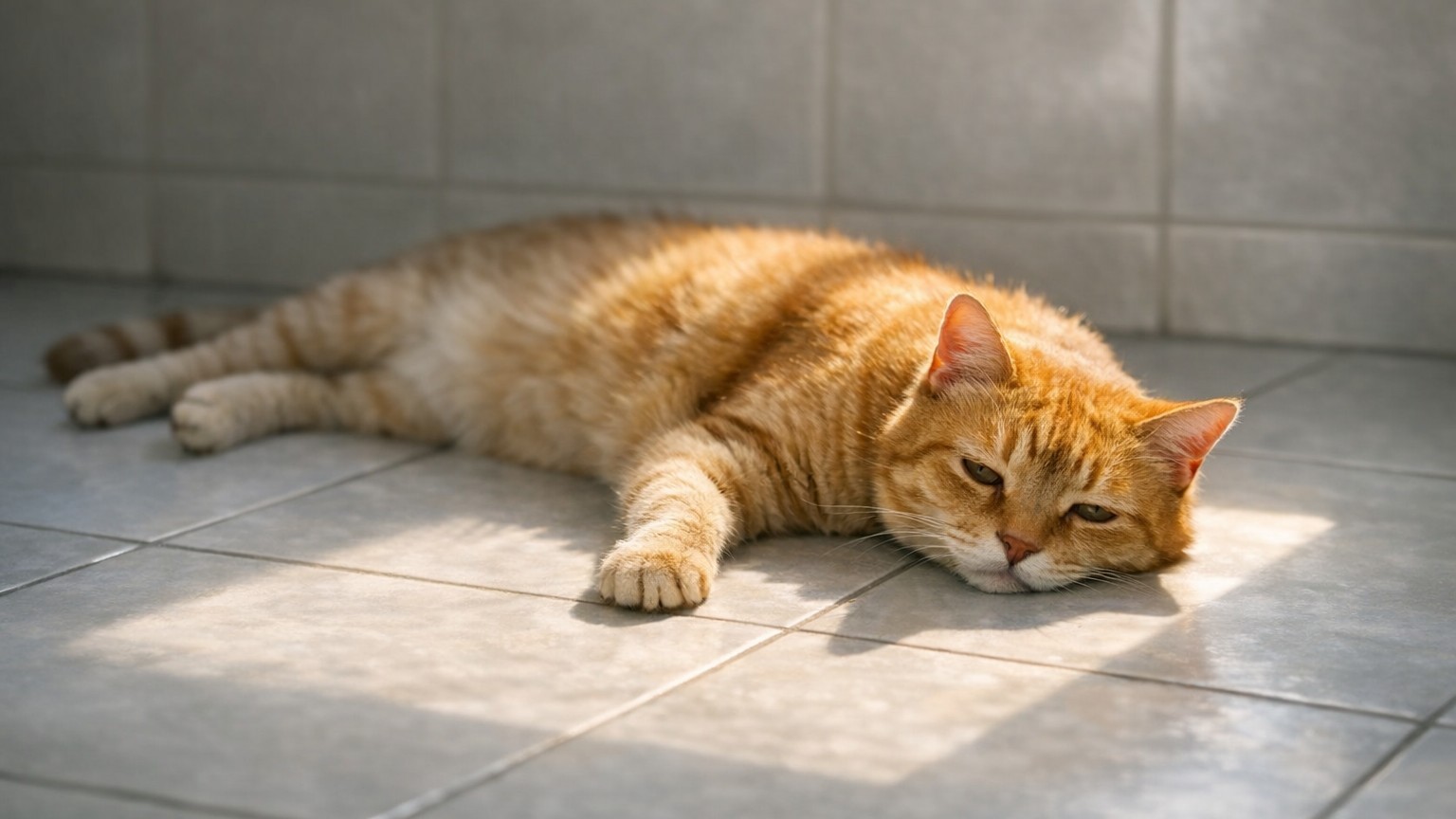
A cat stretched out in a patch of sunlight is one of summer’s most reassuring sights. They look utterly peaceful, completely relaxed, perfectly themselves. But that motionless, heavy-lidded stillness you’re admiring from the kitchen window? It can, in some circumstances, be the very first sign of something going badly wrong. Lethargy in a hot cat is not the same as a cat simply enjoying a snooze — and knowing the difference could save her life.
Key takeaways
- Cats are secretly terrible at handling heat despite their desert origins—they only sweat through paw pads
- A ‘sleepy’ cat might actually be in deadly heat exhaustion that progresses to organ failure in under 30 minutes
- The sneaky part: heatstroke signs in cats (lethargy, slight panting) look exactly like a normal summer snooze
Why cats are deceptively bad at coping with the heat
Originating from the desert, cats are generally very comfortable in the heat and can often be found stretched out sunbathing. This desert heritage lulls owners into a false sense of security. The truth is that cats have a very limited ability to sweat, so instead, they control their temperature by licking themselves and seeking shade on warm days. Unlike humans, cats only sweat through their paw pads. They also pant to expel heat through the mucous membranes in their mouth. Licking their fur helps to cool them down by allowing saliva to evaporate, simulating the cooling effect of sweat. These mechanisms work reasonably well, right up until the point where they simply don’t.
Heatstroke can progress from mild discomfort to a dangerous emergency within 20 to 30 minutes. That’s shockingly fast. Inflammation caused by heatstroke sets off several reactions that affect every major system of the body, causing the breakdown of essential proteins and enzymes. This puts the cat at risk of organ failure and potentially death. And here’s what makes it truly treacherous: in cats, the signs are often more subtle than in dogs. Your cat may not look dramatically ill. She may just look… tired.
Cats also love finding a warm place to sleep, which is why most cases of heatstroke develop after being accidentally shut in a hot place such as a shed, greenhouse, conservatory, garage, or car. The most common cause of heatstroke in cats is being accidentally trapped in a hot, poorly ventilated space such as a shed, greenhouse, conservatory, or garage. A cat who wandered into the garden shed while you were fetching the lawnmower, and whom you didn’t notice was still inside when you padlocked the door. It happens every summer across Britain, and it is preventable.
The warning signs that are easy to miss
Heat exhaustion is the early stage of overheating. Your cat may be tired, lethargic, or breathing rapidly, but their core body temperature hasn’t hit critical levels yet. This is a warning sign and a chance to intervene before things get worse. The deceptive part is that lethargy, on its own, looks exactly like a nap. The difference lies in the details.
Early signs include seeking cool surfaces like tile floors or sinks and increased grooming. Your cat might show mild low energy, slightly faster breathing, and warm ears. Signs of heat exhaustion in cats include restless behaviour as they search for a cool spot or area, panting, drooling, sweaty paws or excessive grooming, which are all an effort to cool themselves down. If your cat is flopped on the bathroom tiles in July when she normally sleeps on the sofa, that’s worth paying attention to.
Panting is the sign that should set alarm bells ringing loudest. Cats rarely pant unless they’re overheated or stressed. Any panting that doesn’t improve within minutes of moving to a cooler area needs veterinary attention. As the situation deteriorates, severe heatstroke shows as heavy panting, drooling, bright red or purple gums, and vomiting. Your cat may seem confused, walk unsteadily, or collapse. Gum colour can be a valuable indicator of heatstroke in cats. Bright red gums may point to elevated body temperature, while pale or bluish gums could signal more advanced distress.
If your cat’s body temperature goes above 40°C/104°F they are at risk of heatstroke, which can cause severe dehydration, seizures, blood clotting problems, organ damage, coma and death. A study from the Journal of Feline Medicine and Surgery found that 1 in 4 cats with severe heatstroke do not survive, underlining the urgency of early intervention.
Who is most at risk, and it’s not just outdoor cats
Obese, long-haired, old, young and brachycephalic/flat-faced cats (such as Persians) are most at risk of developing heatstroke because they find it harder to cool down. For flat-faced breeds, the problem is structural: cats get rid of significant amounts of body heat through their nose as they breathe out. Brachycephalic (flat-faced) cats such as Persians struggle to release heat this way because they have much less space inside their nose. This puts them at a much higher risk of heatstroke, even on seemingly cool days.
Indoor cats are by no means safe either. While outdoor cats are especially vulnerable, indoor cats can also overheat, especially during heatwaves or power outages. A south-facing flat with no through-breeze on a 28°C British summer day can become genuinely dangerous. It doesn’t always have to be ‘hot’ for an animal to develop heatstroke. Exercising excessively in warm weather, or being left in a warm or humid environment that is poorly ventilated can cause animals to quickly overheat.
What to do, and what not to do
Speed is Everything here. Heatstroke is more dangerous the longer their body temperature stays high, so the quicker they are cooled down and treated by a vet, the better their chance of a full recovery. The moment you suspect your cat is overheating, move her immediately to a cool, well-ventilated room. Then begin gentle cooling.
You can use a cloth to wet their coat with lukewarm water and put them somewhere cool and safe before contacting your vet as soon as possible. Cooling your cat down needs to be gradual to avoid shock and not cause your cat stress, as stress can increase their body temperature further. The instinct to grab a bag of ice or plunge your cat into cold water is completely understandable, but it’s the wrong call. Never use ice-cold water or ice baths to cool a cat with heatstroke. Cooling too quickly can cause shock and worsen the situation.
Call your vet while you’re cooling her down. Even if your pet seems to be okay, it’s important to have them checked, as the more serious signs of heatstroke may not be immediately apparent. Prolonged high body temperature can damage a cat’s kidneys, liver, heart, and brain. Kidney problems are common after heatstroke and may not show symptoms until days later. A cat who seems to have “bounced back” after a cooling-down session still needs a vet check, the damage can be quietly unfolding inside.
Prevention, day to day, is straightforward: make sure your cat has access to shade and water at all times, and always check sheds, greenhouses, conservatories and cars before shutting them. Multiple water bowls placed around the house, a fan running in the hottest room, blinds drawn on sun-facing windows, small habits that take seconds. And before you lock up the greenhouse after a bit of summer weeding, always glance behind the pots. It takes three seconds. For your cat, those three seconds might be the whole story.
Sources : rvc.ac.uk | pinolepethospital.com