
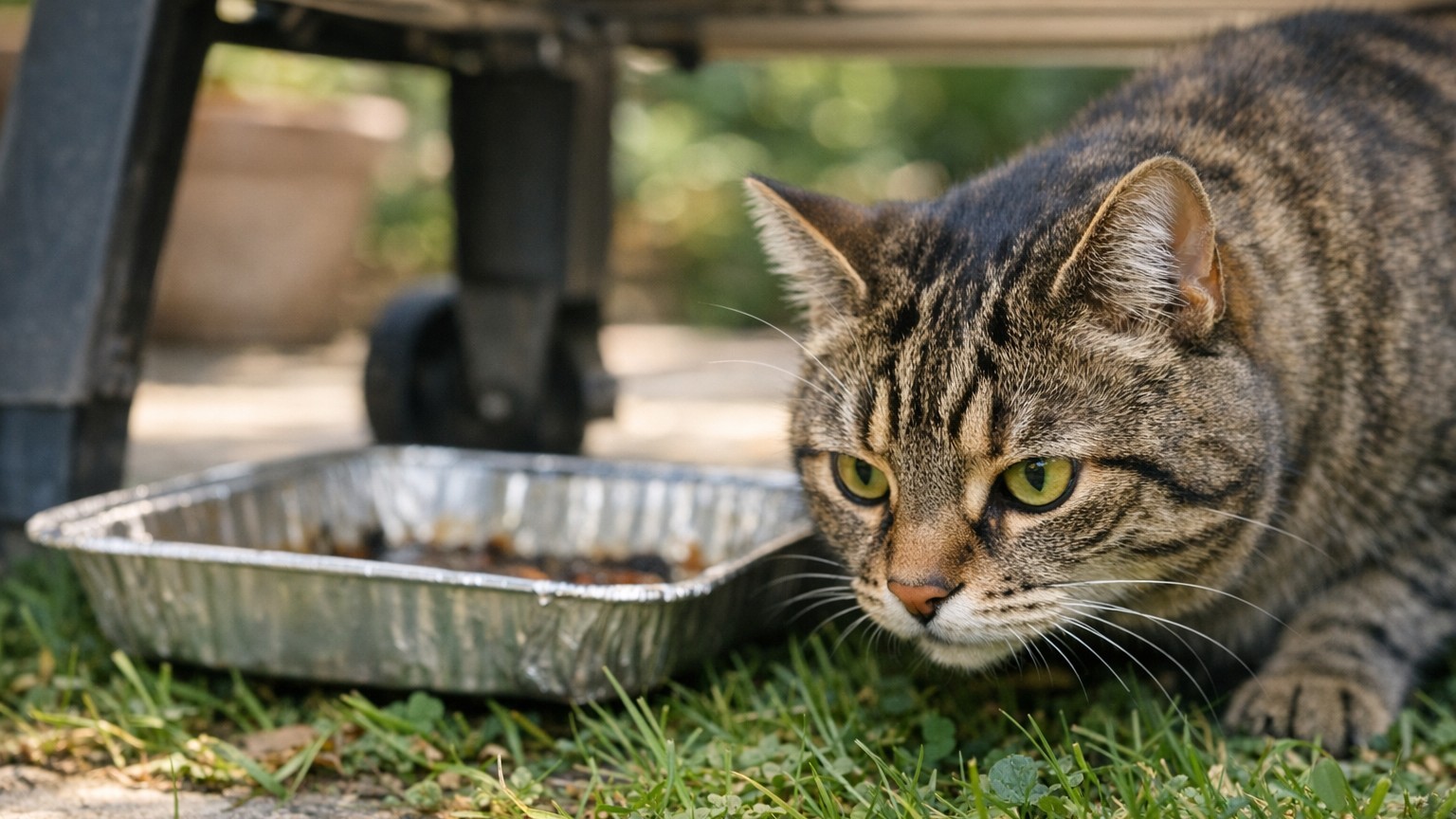
The grease tray sat there innocently under the barbecue all weekend, cooling in the garden air, collecting a weekend’s worth of burger fat, sausage drippings, and charred meat juices. Two days later, a cat ended up on an intravenous drip at an emergency vet, not from some obscure toxin, but from a pool of cooking grease that most pet owners never give a second thought. This is not a rare story. It is a very avoidable one.
Key takeaways
- A cat’s sense of smell is 40 times stronger than ours—grease is irresistible bait they can’t refuse
- Symptoms of grease poisoning can appear suddenly or be delayed by 24+ hours, making early detection critical
- Emergency treatment requires hospitalization, IV fluids, and can cost thousands—all preventable with one simple habit
Why cats are drawn to barbecue grease in the first place
Cooking grease has a strong aroma and rich flavour that actively attracts cats, who are naturally drawn to fatty and savory smells because of their carnivorous nature. The biology behind it is worth understanding. A cat’s sense of smell boasts around 200 million scent receptors compared to our mere 5 million. That grease tray sitting under a warm grill, still carrying the residual heat of an afternoon cookout, is broadcasting a signal that a cat’s nose simply cannot ignore.
There is also a taste component. Cats can’t even taste sugar, so fat is one of the key things that signals “high-calorie, high-value food” to them. Unlike dogs, who will cheerfully eat almost anything left unattended, cats are typically fussy eaters and it is uncommon for cats to consume a poisonous food product unless it’s mixed in with something appealing. A tray of concentrated meat fat is, to a cat, the feline equivalent of a bowl of the most irresistible thing imaginable. The grill’s grease trap or drip tray is often Overlooked as a potential pet danger. That oversight cost one family a two-night emergency vet stay.
What grease actually does to a cat’s body
Cats are obligate carnivores and handle moderate amounts of animal fat in their normal diet, but concentrated grease, the kind that pools after cooking bacon or frying meat, delivers a massive dose of fat all at once. A cat’s pancreas has to produce extra digestive enzymes to break down that sudden fat load, and when the demand is too high, those enzymes can start damaging the pancreas itself. This is pancreatitis, and it is one of the most common serious consequences of grease ingestion in cats.
Consuming too much fat can cause inflammation of the pancreas and pancreatitis. Pancreatitis can affect other major organs in addition to the pancreas and can be fatal if not properly treated. What makes grease particularly treacherous is that the symptoms don’t always announce themselves immediately. Typically, if signs of poisoning are going to show up they tend to occur all of a sudden, the cat was fine and now he is not, however, in some cases the response can be delayed 24 hours or longer. This is exactly why a cat can seem perfectly normal the day after a cookout, then collapse two days later.
The salt content in barbecue drippings adds another layer of danger. Meat cooked with marinades, rubs, and seasonings leaves behind grease laced with garlic powder, onion granules, and sodium. The problem with these seasonings for cats is their salt, nitrates and high fat content. High quantities of salt can be fatal to felines, who can fall victim to sodium ion poisoning. Garlic and onion residues in the drippings are also independently toxic to cats, onions, garlic, chives, shallots, leeks, and scallions are in the Allium species, and ingestion of these foods can cause destruction of red blood cells, resulting in anaemia.
There is another complication that vets worry about after a grease episode: hepatic lipidosis. When a cat stops eating for an extended period, whether from nausea after grease ingestion or any other cause, the body starts mobilising fat stores to the liver for energy. In cats, this process can spiral quickly into liver failure. Signs include dramatic weight loss, jaundice visible in the gums, inner ears, or whites of the eyes, vomiting, and extreme lethargy. A cat that hasn’t eaten in more than 48 hours after a grease episode needs veterinary evaluation.
Recognising the signs and knowing when to act
Watch for repeated vomiting over several hours, refusal to eat for more than a day, lethargy, abdominal pain (your cat may hunch over or resist being picked up around the belly), and watery diarrhoea. The problem is that cats are masters at hiding illness, and in mild cases, you may not notice any symptoms at all. A cat curled up quietly in their usual spot might not look like a cat in the early stages of pancreatitis, they just look like a cat.
Even if you only suspect that your cat has swallowed or touched something poisonous, you must act quickly. Contact your vet immediately. Don’t wait for signs of illness as by then your cat may be too sick to survive. This is not hyperbole. Recovery from poisoning will greatly depend on how much of the poisonous substance your cat has been exposed to and how quickly you have gotten them to the vet for treatment. Outcomes for cats who receive early treatment are much better than for cats who experience a long delay.
One thing you should not do: try to make your cat vomit at home. Forcing or encouraging your cat to vomit may not be helpful and you should not try to treat your cat’s symptoms yourself. If you can, take a photo of the drip tray or note what was cooked, this gives the vet information about potential seasoning ingredients in the grease.
What treatment looks like, and what it costs
A cat on a drip at an emergency vet is not an overreaction. It is the standard protocol. Acute feline pancreatitis poses the most serious risk and nearly always requires hospitalisation. An animal hospital will treat your cat with intravenous fluids to address dehydration. IV fluids are also necessary to detoxify the pancreas from damaging inflammatory chemicals. Alongside fluids, the vet will also give your cat pain relievers and anti-nausea medication, and slowly add food back.
Pancreatitis is emerging as a common problem in cats and can present with mild symptoms such as intermittent vomiting or more severe signs such as lethargy, weight loss, abdominal pain and inappetence. Although the exact cause of pancreatitis is often not known (called idiopathic), cats have a unique anatomy that is thought to predispose them to the disease as they share a common duct between their pancreas, gut and liver. Some cats who recover from one episode go on to develop chronic pancreatitis, requiring long-term dietary management. Cats recovering from a more serious episode may need to stay on a low-fat diet for weeks or even longer. Some cats with recurrent pancreatitis end up on a permanently modified diet.
The practical lesson from all of this is straightforward. Empty the drip tray after each use in an area your pet cannot access, if you accidentally “flavour” the grass, gravel, or ground nearby, your cat could eat it and end up seriously ill. Ideally, clean the tray immediately after cooking, before it cools and solidifies into a slab of concentrated fat. Store cooled grease in sealed containers rather than leaving it in open pans, and dispose of grease-soaked paper towels in a lidded bin. What smells like last night’s sausages to you smells like a five-star meal to your cat — and barbecue season runs for months.
Sources : facebook.com | dialavet.com