
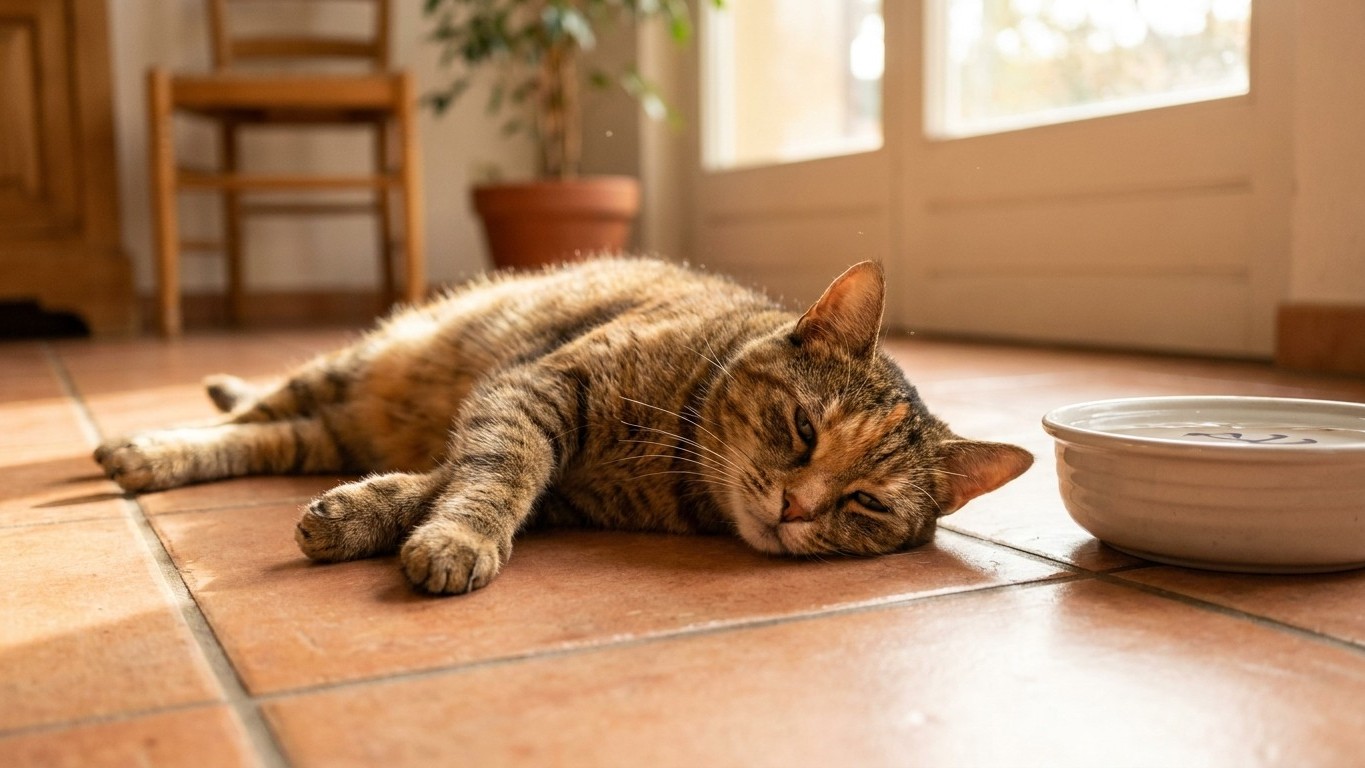
That extra afternoon nap on the hottest day of the year isn’t always what it looks like. Vets across the UK see the same pattern every summer: an owner assumes their cat is simply “conserving energy” in the heat, when in fact quiet, prolonged sleepiness is often the very first sign of dehydration setting in. It can be hard to diagnose because cats like to nap during hot days and conserve energy, but lethargy often goes beyond laziness, and if your cat struggles to move or eat, they might not be drinking enough water. The trouble is that cats are masters of disguise when it comes to feeling unwell, and a sleepy cat looks reassuringly normal right up until the point it isn’t.
Cats didn’t evolve to drink much. Their ancestors were desert hunters that got most of their moisture from prey, which is exactly why modern moggies still have a famously weak thirst drive. Cats evolved as desert animals and historically obtained much of their hydration from prey, meaning they often have a low thirst drive compared to dogs and may not drink enough water on their own, particularly when eating dry food exclusively. That biological quirk means a cat can be running on empty for days before anyone notices anything’s wrong. As one veterinary internal medicine specialist puts it, “Dehydration is a deficit of water in the body. Water accounts for 60-70 percent of body weight in cats and is the main component of most body tissues.” Lose even a modest percentage of that and every system, from digestion to kidney function, starts to struggle.
Key takeaways
- Cats have a biological quirk that makes them terrible at self-hydrating—and it’s silently dangerous in summer heat
- One telltale sign that looks completely normal could actually be your cat’s body shutting down
- Two quick physical checks (that take under 30 seconds) reveal what your cat won’t tell you
The tell-tale signs beyond the nap
Lethargy rarely arrives alone, which is useful, because it gives you other clues to check. Vets commonly list dry or sticky gums, reduced appetite, lethargy, sunken eyes, reduced skin elasticity, constipation, increased sleeping, and panting as the hallmark signs to watch for. The litter tray is an underrated diagnostic tool here: dehydration and constipation often go hand in hand, and you might see hard, dry faeces and a lack of urine in the litter box. Fewer wet clumps than usual over a couple of days is worth taking seriously, especially paired with a cat that’s suddenly less interested in play or food.
Panting deserves a special mention, because it means something entirely different in cats than in dogs. A panting dog after a game of fetch is unremarkable. A panting cat is not. Although dogs pant after exercise, cats usually only pant when dehydrated, struggling to breathe, or overheating. If you ever see your cat with its mouth open and breathing audibly, don’t wait to see if it settles down. That’s an emergency sign, not a heat quirk. Eyes can betray dehydration too, though usually only once things have progressed further: as cats become dehydrated they lose luster in their eyes and the skin around them sags, while bright, alert eyes are a sign of a healthy cat and dull, sunken eyes can indicate dehydration or illness.
The two checks you can do at home tonight
Forget guesswork; there are two simple physical checks vets use themselves. The first is the gum test. Gently lift your cat’s lip and touch their gums, which should be wet and slimy like human gums; if they are dry to the touch and seem a little tacky, your cat is most likely dehydrated.
The second is the famous skin tent test, and it really is as quick as it sounds. Gently pinch a small amount of your cat’s skin at the scruff of the neck, then release it: in a well-hydrated cat the skin will snap back almost immediately, while in a dehydrated cat the skin will return slowly or remain tented for several seconds. Veterinary continuing-education resources note the physiology behind this: when a patient is under 5% dehydrated the skin turgor appears normal, returning immediately after being tented, but when more than 5% dehydrated the skin will not return to its normal position as rapidly.
A word of caution though, because this test isn’t foolproof and I’d hate for anyone to panic unnecessarily. The test tends to be less reliable in obese cats, since excess fat under the skin can cause it to return more slowly and give a false positive, while in very thin or emaciated cats the skin may snap back quickly even if they are dehydrated, and senior cats naturally lose skin elasticity so their skin may return slowly even when perfectly hydrated. Treat it as one piece of the puzzle, not a standalone diagnosis, and always combine it with the gum check and a general sense of how your cat is behaving.
Making the water bowl worth visiting
Prevention is far kinder than treatment, and thankfully it’s not complicated. Wet food is doing a lot of heavy lifting here that dry kibble simply can’t match: wet food is one of the most effective ways to hydrate cats in summer because it contains significantly higher moisture content than dry food, with many wet cat foods containing approximately 70 to 80 percent water. Location matters too. Cats are fussier than we give them credit for, and reasons cats avoid drinking include dirty bowls, warm water, poor bowl placement, stress, strong smells near water stations, a preference for moving water, and some cats disliking bowls that repeatedly touch their whiskers. A ceramic or steel bowl in a quiet spot, topped up with cool fresh water twice a day, solves more hydration problems than most owners realise.
One thing worth flagging clearly: never reach for milk as a hydration fix, however tempting it seems. Some pet parents mistakenly offer milk to hydrate cats, but many adult cats are lactose intolerant and may develop diarrhoea. If you’ve done the gum check, the skin tent test, and you’re still uneasy, or if your cat shows open-mouth breathing, repeated vomiting, or simply won’t rouse from that nap, please don’t try to manage it yourself with broth and hope. Dehydration is often a sign of a serious underlying medical condition in cats, so if you suspect your cat is dehydrated, contact your veterinarian for help right away. A same-day check-up, even if it turns out to be nothing, is always the safer bet than another day of “let’s see how they get on.”
Sources : paumanokvethospital.com | animalmedicalclinicgg.com