
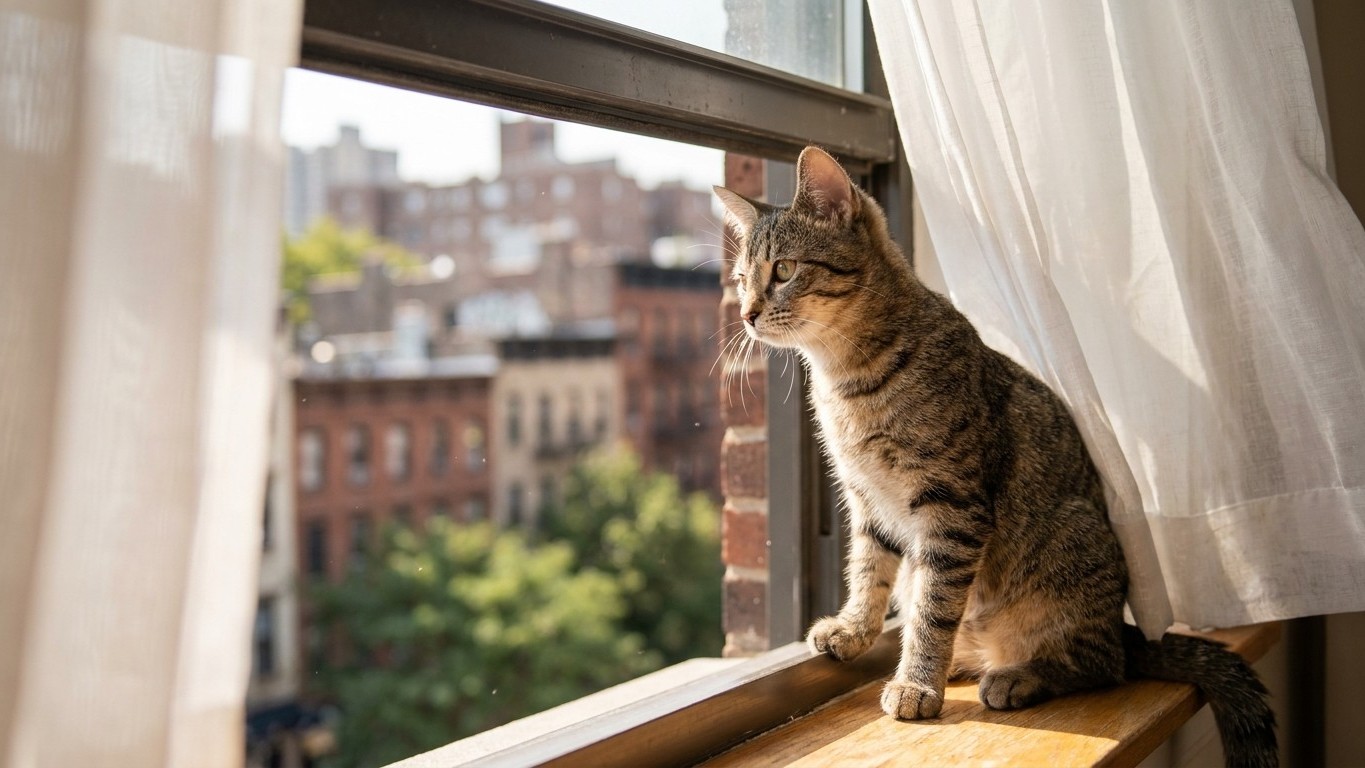
A cat perched on a windowsill during a heatwave is not showing off its balance. It is putting itself one gust of wind, one darting pigeon, or one careless step away from a trip to the emergency vet. Veterinary data is unambiguous on this: falls from height are one of the most common warm-weather injuries seen in feline patients, and the danger starts from the second floor, not the tenth.
The condition even has a clinical name. High-rise syndrome is a veterinary term for injuries sustained by a cat falling from a building, typically higher than two stories (7–9 m). The phrase was first used decades ago after veterinarians in New York City in the 1980s noticed that cats seemed to survive very high falls, noting the same triad of injuries in many of these cats, with a great survival rate, even with some cats falling as much as 32 stories. That statistic tends to make owners relax. It shouldn’t.
Key takeaways
- A cat’s ‘perfect balance’ myth masks a counterintuitive danger: short falls are often deadlier than high ones
- During heatwaves, open windows spike cat fall injuries—and tilted windows are deceptively more dangerous than you think
- 90% survival sounds reassuring until you learn one-third need emergency vet care to survive at all
Why “perfect balance” is a dangerous myth
Cats do have a genuine trick up their sleeve: the righting reflex. They can rotate and twist their bodies midair to right themselves quickly, then arch their back, like a parachutist, to increase their drag and slow their fall. It’s a brilliant bit of evolutionary engineering, and it genuinely helps cats survive falls that would flatten most mammals.
Here’s the counterintuitive bit that catches so many owners out. A fall from the first or second floor can be worse than one from the eighth. Another common misconception is that falling from a lower height isn’t dangerous to your pet, but a fall from a one- or two-story window can actually put your cat in more danger than a higher fall, because it takes a little time for a cat to twist itself around to land on its feet, and short falls may not give them enough time to do this. A Croatian study looking specifically at cats presented to a veterinary faculty found that the cats fell from at least the second storey, and even at that modest height, injuries were far from trivial: 46.2% of cats had fractured limbs, with the tibia fractured most often, followed by the femur. So the confidence a cat displays on a windowsill four metres up is no guarantee at all, it simply hasn’t had the physics work in its favour yet.
Surfaces matter too. Claws are a cat’s grip on the world, quite literally. While cats can generally hold onto tree branches and wooden surfaces with their sharp claws, other surfaces such as concrete or plastic are more challenging, and declawed cats are at even greater risk for the same reason. A smooth painted windowsill or a plastic UPVC frame offers nothing for claws to catch on if a paw slips.
Why 35°C makes the risk spike
Summer doesn’t just make cats sleepier, it makes owners open every window in the flat and forget about them. The pattern shows up consistently across the research. High-rise syndrome was more frequent during the warmer period of the year in the Croatian caseload, and the largest study to date, drawing on over a thousand cases from a Berlin clinic, reached the same conclusion: this study confirms that certain times of the year, especially summer, pose a higher risk for falls. British summers rarely hit Mediterranean extremes, but a heatwave pushing towards 30-35°C is exactly when flat windows get flung wide open and left that way overnight, with nobody watching what the cat is doing near the gap.
Young cats are disproportionately represented in these accident statistics, which makes sense given their impulsiveness. In the Zagreb cohort, 59.6% of cats were younger than one year, and the average height of the fall was four stories. Curiosity, a distracted lunge at a passing bird, or simply misjudging a jump onto a windowsill are enough. A bird or bug flying around just beyond their reach can distract them enough that a loud noise or strong breeze startles them and causes them to fall.
Tilt-and-turn windows deserve a special mention, because they’re deceptively risky. Left in the tilted position for ventilation, they create a narrow gap that a determined or panicking cat can squeeze into and then become wedged or fall through entirely as the sash swings. Vets across Europe increasingly flag these windows as a specific hazard during warm weather, precisely because owners assume a small gap is safer than a fully open window. It often isn’t.
What actually protects your cat
The survival figures sound reassuring at first glance, but they hide a sting. While 90% of cats will survive falling from a high-rise building, about a third of those cats won’t survive without veterinary help. That distinction matters enormously: survival in these studies almost always assumes prompt, proper veterinary treatment, not a cat left to recover alone on a balcony. If your cat has fallen, however alert or normal it seems, treat it as an emergency. Internal injuries and shock don’t always announce themselves immediately.
Prevention is genuinely simple and doesn’t require turning your home into a cage. Fit secure mesh screens or purpose-made safety nets to any window a cat can reach, checking regularly that fixings haven’t loosened in the heat. Consider a window box enclosure or an outdoor “catio” run if your cat likes to feel the breeze; it satisfies the urge to be near the outside world without the fall risk. And during a heatwave specifically, get into the habit of checking which windows are open and how, rather than assuming a tilted pane or a fly screen will hold under sudden weight or panic.
One detail worth remembering next time someone repeats the old “cats always land on their feet” line: younger age and aggressive or excitable behaviour were both linked to a greater likelihood of falling in comparison studies of cats that had and hadn’t fallen. It isn’t bad luck that catches most cats out. It’s a hot day, an open window, and a bird flying past at exactly the wrong moment.
Sources : pmc.ncbi.nlm.nih.gov | pmc.ncbi.nlm.nih.gov